
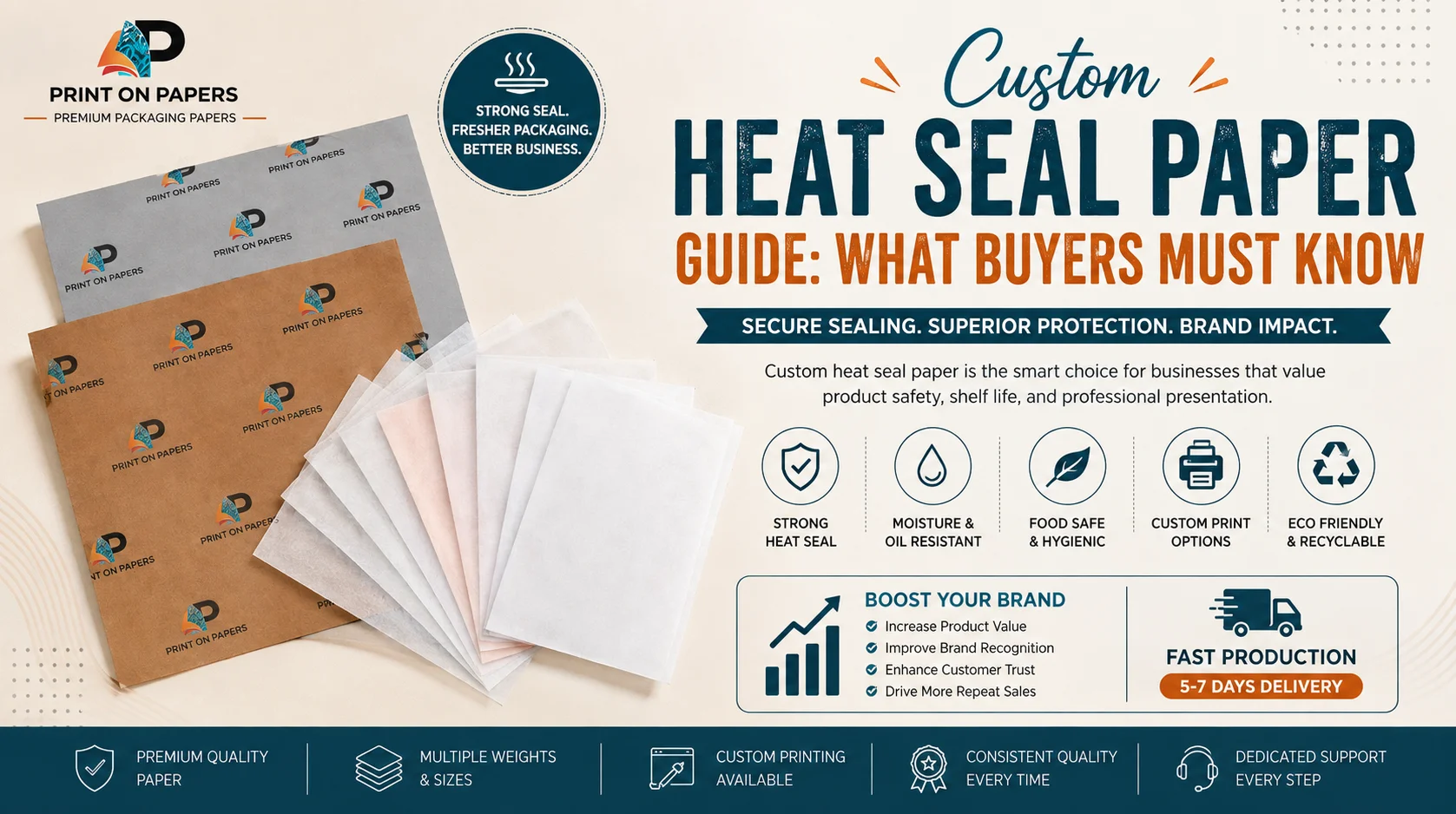
TL;DR: Standard deli paper and heat seal paper look almost the same off the roll, but only one of them can actually seal. If your packaging keeps popping open on the line, you likely ordered the wrong grade. This guide explains what custom heat seal paper is, how the coating works, what specs to check before you order, and how it compares to deli paper, wax paper, and glassine paper.
A production run just failed. The wrap will not close, the edges peel apart under light pressure, and the product keeps falling out of the package. This happens more often than most suppliers admit, and it almost always traces back to one root cause. Someone ordered standard paper, expecting it to behave like sealing food paper, and plain paper simply cannot do that job. Deli paper, kraft paper, and basic wax paper have no heat reactive layer at all. No amount of heat or pressure will bond them together. If your line is fighting the paper instead of sealing it, the fix usually is not your machine settings. It is the paper itself. Checking the coating before you blame the equipment can save an entire production day, and it is the first thing any experienced packaging supplier will ask about.
Custom heat seal paper is a base paper coated with a heat reactive layer, usually PE or PET, that melts under heat and pressure and bonds to itself as it cools. The coating is what makes the seal, not the paper underneath it. Once printed with a logo and cut to size, it becomes food safe paper with a logo that still performs the same sealing function on a production line.
The heat seal coating sits on one or both sides of the sheet, depending on whether you need the paper to seal to itself or to a second material like film or foil. When a heat press or sealing bar applies pressure, that coating softens, fuses, and hardens again as it cools, creating a bond strong enough to hold through shipping and handling. This is what separates true heat seal paper food packaging from a wrap that only looks similar on the shelf but has no bonding layer at all.
These three get confused constantly, and the difference is not subtle once you know what to look for.
| Paper Type | Coating | Seals to Itself | Best Use | GSM Range |
| Heat Seal Paper | PE or PET, heat reactive | Yes | Sealed pouches, wraps, bags | 35 to 50 GSM |
| Deli Paper | Light wax or PE, not heat reactive | No | Sandwich and cold cut wrap | 30 to 45 GSM |
| Wax Paper | Paraffin or soy wax | No | Bakery and candy wrap | 30 to 45 GSM |
Custom deli paper works fine for wrapping a sandwich you fold by hand. It was never built to bond under heat. The same goes for custom wax paper, which resists moisture but will not seal under a heat press either. If your packaging line requires a closed, sealed pouch or wrap, heat seal deli paper style coatings are the only option that will actually hold.
There is a related product worth knowing about too. If what you actually need is a smooth, semi transparent wrap for candy or bakery display rather than a sealed closure, custom glassine paper solves a different problem. It is built for presentation and light grease resistance, not for bonding under heat. If you want to see how that coating and finish come together, how custom glassine paper is made walks through the process in more depth. Choosing between heat seal paper and glassine paper really comes down to one question. Do you need the package to seal shut on its own, or do you just need a clean wrap around the product? If the answer is sealing, heat seal paper is the only paper on this list built for that.
Before you place another order, confirm four things with your supplier. Skipping any one of these is usually what leads to a failed batch.
Coating type matters first. PE coating activates at a lower temperature and works well for most food wraps. PET coating handles higher heat and holds up better for hot fill or reheated products.
Activation temperature matters next. Most heat seal coatings bond somewhere between 250 and 350 degrees Fahrenheit, but your exact sealing equipment needs to match that range or the seal will not form properly.
GSM, or paper weight, affects how the sheet handles on your line. Lighter sheets in the 35 to 40 GSM range work for lightweight wraps, while heavier stock in the 45 to 50 GSM range holds up better for bulkier products.
Seal type is the last piece. Fin seal folds the coated sides together for a flat closure, while lap seal overlaps the edges for a stronger bond on heavier items. Tell your supplier which one your equipment is set up for before the order ships, not after.
Yes, when it meets the right standards. FDA 21 CFR 176 governs what substances are allowed in paper and paperboard that touches food directly, and any heat seal paper used for food packaging needs to meet that standard.
PFAS free coatings matter more now than they did even two years ago. According to the FDA, the agency determined in January 2025 that 35 food contact notifications tied to PFAS based grease proofing substances for paper and paperboard packaging were no longer effective, since manufacturers had already stopped producing them. Existing stock made before that ruling had a compliance deadline of June 30, 2025. In plain terms, PFAS based coatings are no longer part of the legal supply chain for new food contact paper in the United States, and any supplier still offering them is behind current regulation, not ahead of it.
Soy based, food grade inks are the other piece of the compliance picture. Petroleum based inks can migrate under heat, and heat seal paper by definition gets exposed to heat during sealing, so ink choice matters more here than it does on paper that never touches a heat press. Confirming both the coating and the ink before an order ships is the fastest way to keep sealing food paper compliant from batch to batch, instead of finding out after a shipment is already out the door.
Chocolatiers and confectioners use heat seal paper to wrap individual pieces that need to stay sealed through shipping. Bakeries reach for it on items that need a closed wrap rather than a folded one, especially anything sold online or through a subscription box. Meal prep brands and co-packers depend on it for pouches that have to survive refrigeration and reheating without opening early.
Demand for this category is not slowing down either. Future Market Insights values the global paper based fresh food wraps market at 814.4 million dollars in 2026, projected to reach 1,543.2 million dollars by 2036, with greaseproof and heat sealable wraps making up a large share of that growth.
Cafes and quick service spots sometimes pair heat seal paper with custom fry paper for combo orders, using sealed wraps for the main item and standard fry paper for sides that do not need a closure. Gift focused food brands sometimes layer heat seal paper with custom printed tissue paper for presentation, sealing the product first and wrapping it for display second. Snack brands selling through third party retailers lean on it too, since a sealed pouch survives handling on a store shelf far better than a folded wrap ever could.
| Question | Answer |
| What is custom heat seal paper used for | It is used to create a sealed, closed wrap or pouch for food items using heat and pressure instead of tape or staples. |
| Why is my heat seal paper not sealing | The most common cause is ordering standard deli or kraft paper by mistake. Only paper with a heat reactive PE or PET coating can bond under heat. |
| Is heat seal paper the same as wax paper | No. Wax paper resists moisture but has no heat reactive coating, so it cannot form a sealed bond under a heat press. |
| What temperature does heat seal paper need | Most heat seal coatings activate between 250 and 350 degrees Fahrenheit, depending on whether the coating is PE or PET. |
| Is custom heat seal paper food contact safe | Yes, when it meets FDA 21 CFR 176 and uses PFAS free coatings with soy based, food grade inks. |
Confirm three things before you place your next order. Ask your supplier directly whether the paper has a heat reactive coating, and get the coating type in writing. Ask for the activation temperature range so it matches your sealing equipment. Ask whether the paper meets FDA 21 CFR 176 and uses a PFAS free coating, since that is now the baseline requirement, not an upgrade.
Print On Papers manufactures custom heat seal paper with PE and PET coating options, FDA compliant, PFAS free, and printed with soy based inks. Custom heat seal paper wholesale USA pricing starts from $0.20 per sheet, with orders opening at 500 sheets. Production runs 7 to 10 working days, with a 5 to 7 day rush option, and shipping is free worldwide through DHL, FedEx, and UPS out of Valley Stream, New York. You can browse the full lineup of food contact papers, including custom papers built for every stage of food service, directly on the site.
Stop guessing at coatings and temperatures. Get a free quote → and confirm the exact spec your line needs before your next order ships.
A failed seal is rarely a machine problem. It is almost always a paper problem, and now you know exactly what to check before it happens again. Custom heat seal paper works because of its coating, not because of the base paper underneath it, and confirming coating type, activation temperature, and food contact compliance before you order is the single best way to avoid a repeat of a failed batch. Whether you are wrapping chocolate, sealing a meal prep pouch, or packaging a subscription box, getting this one spec right the first time saves a lot more than a reorder. It saves the delivery date your customer is already counting on, and it keeps your production line running instead of stopping to troubleshoot a paper that was never going to seal in the first place.
Print On Papers is a custom printed paper and wrapping paper company serving restaurants, bakeries, delis, food trucks, butchers, florists, apparel brands and food brands across the US and worldwide. We deliver food-safe, eco-friendly, fully branded custom paper, from your first 500 sheets to your next 500,000