
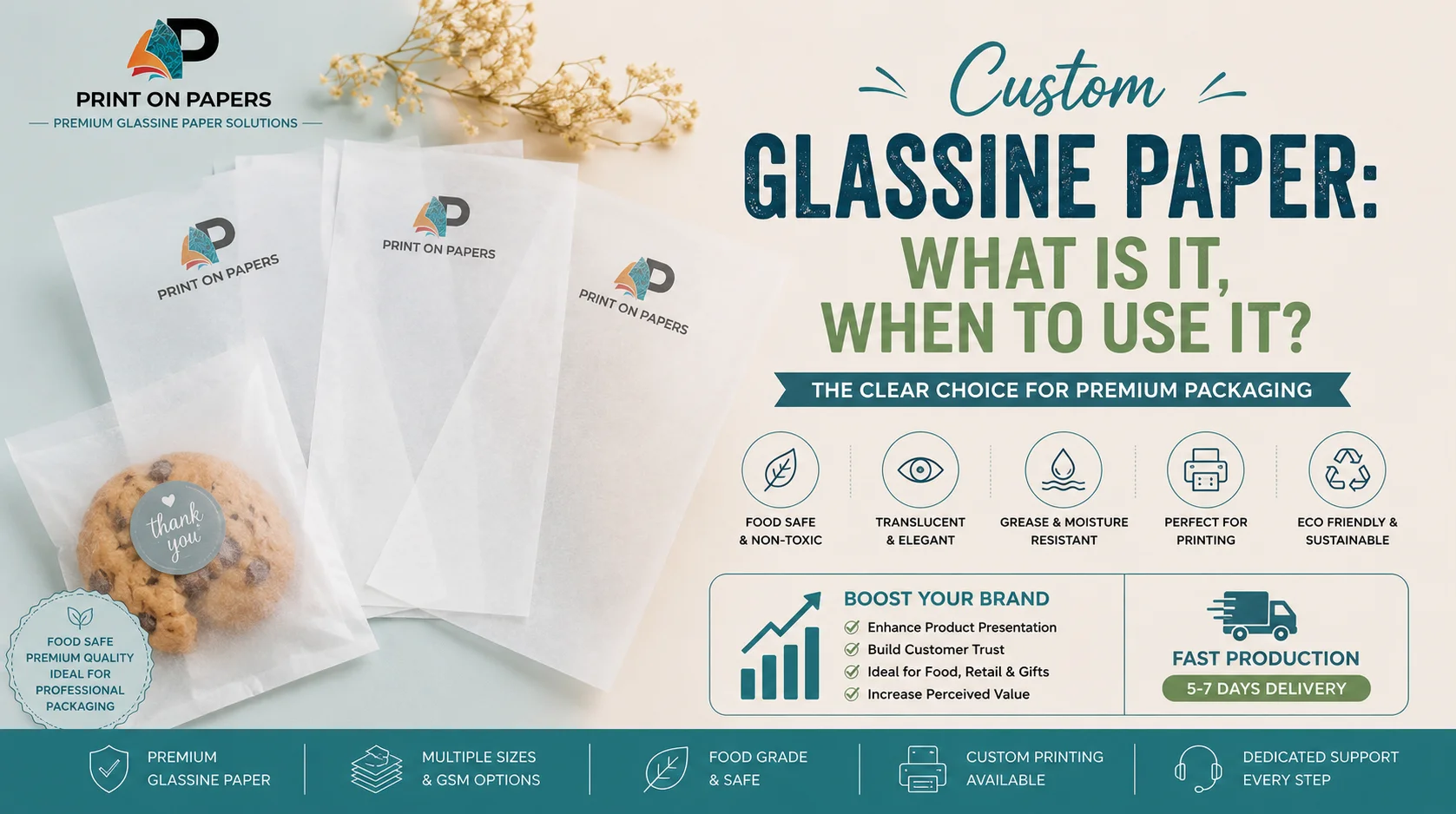
TL;DR: Custom glassine paper is a smooth, translucent, food safe wrap made by pressing wood pulp until it resists grease and light moisture naturally. Bakeries use it for gift wrapping and candy since it shows the product without leaking oil onto the box. It is not oven safe, so parchment still wins for baking.
Nobody wakes up looking for glassine paper by name. Bakers search for translucent food paper, or something grease resistant, or a wrap that will not turn a gift box soggy by the time it lands on someone’s counter. Custom glassine paper is usually what they end up buying, though not always, and if this whole category is new to you, it helps to first know what custom printed paper actually is before zeroing in on glassine specifically. Here is the short version: what it is, where it earns its keep in a food business, and where a different paper wins instead.
Glassine is a smooth, semi see through sheet pressed from wood pulp until it’s dense enough to resist grease. Bakeries wrap cookies, pastries, and candy in it because the product shows through without oil bleeding onto the box. One thing it will not do is survive an oven. If heat is part of the job, parchment takes that spot, and that single fact drives almost every decision below.
Start with the process, because the process explains the product. Mills refine wood pulp fibers, then run the sheet through a supercalender, a machine that squeezes paper between heated rollers under serious pressure. Two things happen at once. The surface smooths out and turns slightly see through, and the fibers compress so tightly that grease and light moisture struggle to get through at all.
That’s a different mechanism than the other papers sitting in most kitchens. Wax paper leans on a brushed layer of paraffin. Parchment gets its non-stick, oven ready surface from silicone. Glassine skips the coating entirely and gets its barrier from the paper itself. It also comes out PH neutral and acid free, which is part of why photo framers and archivists reach for it too, not just bakers. Nothing about that is a marketing detail either, it’s the same reason museums use glassine interleaving sheets between old photographs, since an acidic paper would slowly damage whatever it touches over years of storage. Once you understand that one manufacturing difference, most of the rest of this decision writes itself. For anyone who wants the fuller picture, what glassine paper means for food businesses goes deeper into exactly this.
There’s a real test for it. TAPPI T454, the Turpentine Test for Grease Resistance, times how long oil takes to work through the sheet, rather than scoring it against a harsh oil blend the way coated papers get tested. A supplier who mentions that standard by name is telling you something you can verify. One who just says “grease resistant” is asking you to take their word for it.
Custom glassine paper begins as plain wood pulp, nothing exotic. Mills bleach it, spread it into a loose sheet, then run it through supercalendering rollers two or three times. Each pass presses the fibers tighter and squeezes out the tiny air pockets that would otherwise leave the paper cloudy instead of clear.
Most finished sheets land somewhere between 30 and 90 GSM. Lighter weights suit interleaving and small wraps. Heavier stock holds its shape in standing pouches and printed retail bags. Here’s a number worth knowing: a January 2026 Future Market Insights report puts bleached glassine at 52.3 percent of global product type demand this year, mostly because food and healthcare buyers want a cleaner finish than unbleached grades give them. The same report values the whole market at 2.9 billion dollars in 2026, rising toward 4.5 billion by 2036 as bakery, confectionery, and label converting demand keeps climbing.
Glassine paper uses food service more than any other setting, and it’s mostly about presentation, not just protection. Picture a bakery boxing macarons for a birthday order. The owner wants those pastel colors visible the second the lid lifts, not hidden behind a wall of plain kraft. That’s glassine bakery gift wrapping doing its actual job: translucent enough to show off color and shape, tight enough to keep grease off the box lid.
A handful of uses keep coming up. Candy and chocolate wrapping, so pieces don’t fuse together in transit. Cookie and pastry interleaving, keeping layers apart without soaking up butter. Bagel and donut liners, where grease resistance matters more than heat ever will. Cheese wrap that lets a little air through while still blocking surface moisture. Even candle and soap retailers use it, since the translucency does branding work a plain label can’t. Some coffee shops line pastry cases with it too, mostly because it photographs better under store lighting than plain paper ever does.
Outside food, glassine turns up in photography sleeves, stamp collecting sheets, and as the release liner behind adhesive labels, though none of that matters much if you run a kitchen. What matters is the moment described above, a box that needs to look good and stay clean at the same time. If the actual task is sealing a bag shut instead of wrapping something for display, custom heat seal paper fits that job better since glassine was never built for closure, only presentation.
This question comes up constantly, and honestly, the two papers were never competing for the same job. Parchment exists for the oven. Its silicone coating lets baked goods release cleanly and lets the sheet handle heat up to roughly 425 degrees Fahrenheit. Glassine has no coating at all, so anywhere near a hot pan it will scorch, curl, and stick.
| Paper Type | Heat Resistance | Grease Resistance | Recyclable | Best For | Typical GSM |
| Glassine | Not oven safe | High, from fiber density | Yes, uncoated | Gift wrap, candy, cold presentation | 30 to 90 GSM |
| Parchment | Up to 425°F | High, from silicone coating | No | Baking, roasting, oven liners | 40 to 50 GSM |
| Wax Paper | Not oven safe | Moderate, from paraffin coating | No | Cold storage, moisture barrier wrap | 30 to 45 GSM |
Glassine’s real strength shows up once the food has already cooled. A box lined an hour after something came out of the oven doesn’t need heat resistance anymore, it needs a paper that looks clean, shows the product, and keeps glaze or butter off the lid. That’s exactly where glassine wins, and it’s why plenty of bakeries just keep both papers on hand rather than forcing themselves to pick one for good.
If the paper has to survive baking, go with custom parchment paper instead, full stop. If the job is wrapping or presenting something that’s already cooled, glassine usually wins. It’s worth reading what actually makes parchment the right call for in oven work if your kitchen handles both baking and gift packaging on the same day, since the two decisions rarely overlap the way people expect.
Wax paper is really its own category. It handles moisture fine but isn’t recyclable and doesn’t take a crisp printed logo the way glassine does. For a branded, food safe wrap that still covers cold storage duty, custom wax paper still earns its place, but glassine wins the moment visibility and print quality matter more than raw moisture resistance.
Yes, and this isn’t a vague claim. Food contact papers, glassine and greaseproof grades included, fall under FDA regulation 21 CFR Part 176, the actual federal rule covering substances used in paper and paperboard that touch food. Suppliers producing food grade custom glassine paper build every sheet against that standard, using food safe, PFAS free materials with nothing extra sitting between the paper and whatever it’s wrapping.
Because the barrier comes from fiber density instead of a surface coating, there’s no wax, no silicone, no fluorinated chemical involved anywhere in the process. That’s a big part of why it holds up so well for direct contact with baked goods, candy, and cheese. Still worth asking your supplier directly about FSC certified sourcing and PFAS free status, since neither one comes bundled automatically with basic FDA compliance, no matter what the product page implies. A supplier who hesitates when asked for those specifics, or answers with something vague, is usually a sign to keep looking.
If you’re searching custom glassine paper wholesale USA food safe 500 sheets, you’ve probably already decided glassine is the right call and just need the logistics nailed down. Print On Papers sets that minimum at 500 sheets, no penalty for staying right at the floor, with wholesale pricing usually starting around 24 cents a sheet depending on GSM and how detailed the print job gets.
Standard turnaround runs 7 to 10 working days from proof approval, or 5 to 7 days if you need it faster. Shipping is free across the USA through standard carriers, and design support comes included, so a small operation doesn’t need to hire a designer just to land a clean, print ready proof. Worth browsing the custom glassine paper lineup directly to compare GSM and finish side by side, or checking the wider range of custom papers if another format ends up being the better call after all.
If you’ve read this far, you probably already know whether glassine belongs in your gift boxes or on your candy counter. What’s left is getting real numbers instead of more reading. Request a free quote and a sample sheet so you can feel the translucency and grease resistance yourself before committing to a full run.
| Question | Short Answer |
| Is glassine paper the same as parchment paper? | Not even close. Parchment carries a silicone coating meant for oven heat. Glassine has none, and it is not oven safe. |
| Can you print a logo on glassine paper? | You can, using flexographic or gravure printing. The surface is smooth and non absorbent though, so the ink formula matters more than it would on regular paper. |
| Is glassine paper recyclable? | Uncoated glassine runs through normal paper recycling. Wax coated paper cannot say the same. |
| What GSM works best for bakery gift wrapping? | Somewhere around 30 to 40 GSM usually. Light enough to stay see through, dense enough to still resist grease. |
| Is there a minimum order for glassine paper? | Most suppliers set it at 500 sheets, with wholesale pricing that typically starts near 24 cents a sheet. |
| Does glassine need a chemical coating to resist grease? | No, and that surprises people. The resistance comes from how tightly the fibers are pressed during supercalendering, not from anything applied afterward. |
Custom glassine paper earns its spot in a bakery or specialty food business when the job is presentation after baking, not survival during it. It shows the product, blocks grease, and takes a clean print, which covers most of what a gift box or candy wrap actually needs. Once the job moves inside an oven, parchment takes over. Once moisture resistance outranks visibility, wax paper still has its place. Knowing which paper fits which moment is really the whole difference between packaging that just holds food and packaging that makes someone stop, notice, and remember the name behind it.
Print On Papers is a custom printed paper and wrapping paper company serving restaurants, bakeries, delis, food trucks, butchers, florists, apparel brands and food brands across the US and worldwide. We deliver food-safe, eco-friendly, fully branded custom paper, from your first 500 sheets to your next 500,000