
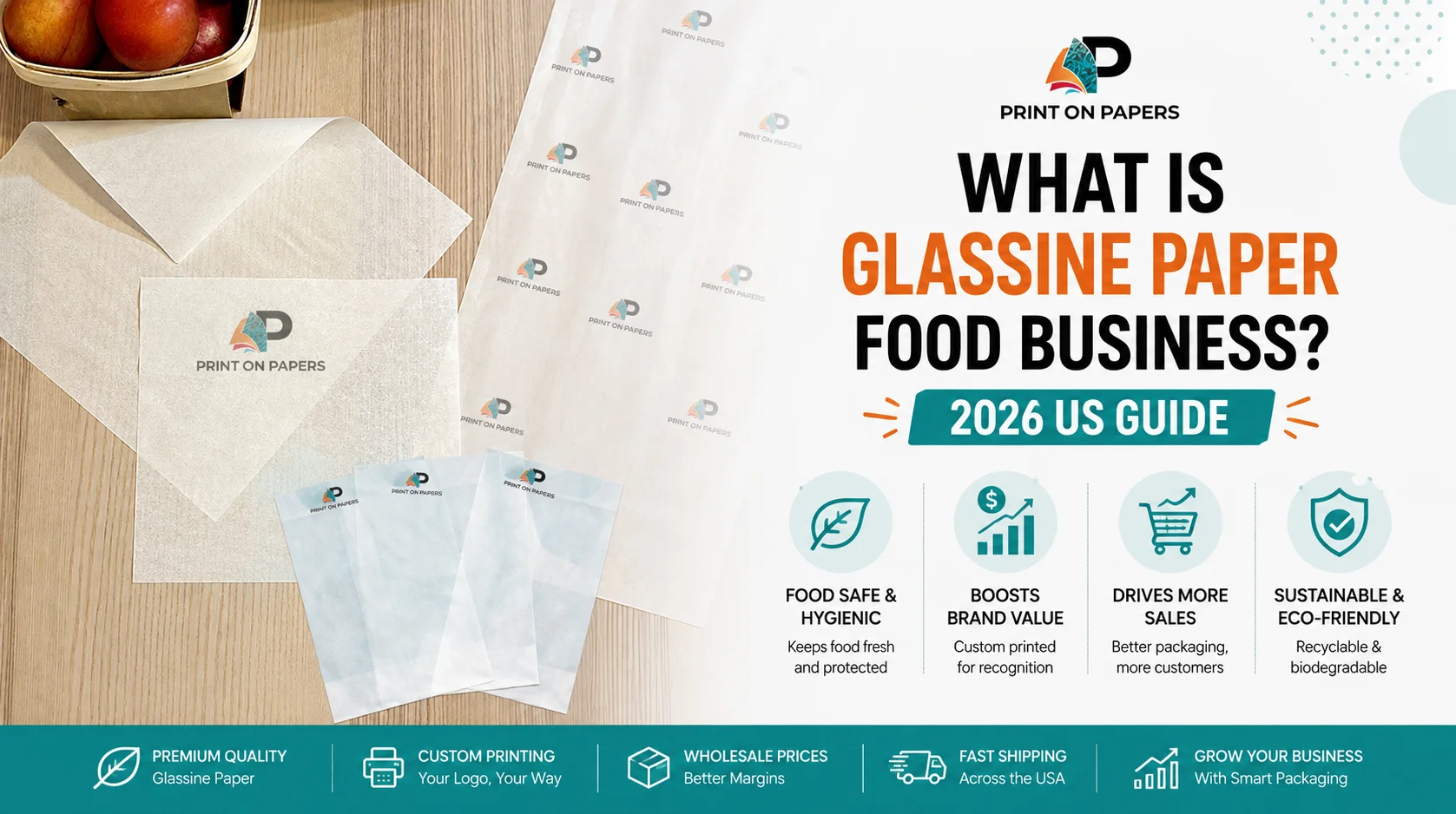
What Is Glassine Paper? Uses, Food Safety, and When to Use It for Your Food Business
TL;DR
Glassine paper is a smooth, see-through paper made from wood pulp. It resists grease on its own, with no added coating, so it never needed PFAS chemicals in the first place. Bakeries, candy makers, florists selling food gifts, and gift food brands reach for it because customers can see the product before they buy. Federal food packaging law names it directly, and custom glassine paper wholesale orders start at 500 sheets.
Table of Contents
- What Is Glassine Paper in 2026
- What Is Glassine Paper Used for in a Food Business
- Is Glassine Paper Food Safe for Direct Food Contact
- Glassine Paper vs Parchment Paper for Bakery Use
- How to Order Custom Glassine Paper Wholesale
- FAQ
- Get a Free Quote
If you have ever bought a croissant that came wrapped in a thin, see through bag, you have already used glassine paper. You just did not know its name. More food business owners are asking about it every month, and once you know what to look for, you will start noticing it everywhere. We field this question weekly at Print On Papers, so here is the straight answer.
What Is Glassine Paper in 2026?
Glassine paper is a smooth, translucent food paper made from wood pulp. A mechanical refining process gives it grease resistance, not a chemical coating. Most food grade glassine runs between 30 and 50 GSM, light enough to wrap a pastry without adding bulk, while heavier grades up to 90 GSM show up outside the kitchen entirely, most often as the release liner behind sticker labels and shipping tape. Food business owners keep asking about the food grade version in 2026 because packaging rules around chemical coatings keep tightening state by state, and glassine sidesteps the whole issue by never needing one.
What Is Glassine Paper Used for in a Food Business?
Glassine paper uses in a food business fall into a few clear categories. Bakeries wrap cookies, croissants, and pastries in it because customers can see the product before they buy. Candy and chocolate makers like it because it resists grease without adding a plastic layer. Florists who sell food gifts, along with specialty retailers, mix glassine paper bakery florist combinations into bouquets that include chocolates or baked treats, since the paper protects the food without covering up the flowers.
A lot of the appeal comes down to what glassine paper skips. Plastic film fogs up. Wax paper can leave a faint waxy smell on baked goods. Bakery owners tell us they switched after customers kept asking what was inside the bag before they even opened it, which says something about how much the see through look actually sells.
Printed glassine paper adds another layer to this. Put a logo on the wrap, and a bag walking out the door becomes free advertising. It is the exact phrase we see in our own search traffic every week, which is custom glassine paper used for food business USA owners running on tight marketing budgets. The short answer is branding, since a printed bag does the job of an ad without costing anything extra to hand out.
Is Glassine Paper Food Safe for Direct Food Contact?
Yes. Glassine and greaseproof papers are named directly in federal food packaging law. Title 21, Part 176 of the Code of Federal Regulations covers paper and paperboard used with food, and it lists glassine as an approved material for dry food contact (eCFR, 21 CFR Part 176, 2026). Anyone can look up that regulation and read it themselves.
Glassine paper food safe USA status traces back to how the paper is made. Fiber refining and a hot roller process called supercalendering press the fibers tight together, and no wax, plastic film, or PFAS coating ever gets added. A growing number of states have started restricting PFAS chemicals in food packaging, so this construction detail matters more now than it did five years ago.
The paper is also acid free and pH neutral, which keeps it from reacting with whatever food sits inside it. New buyers ask us almost every week whether glassine paper food safe for direct food contact really holds up under scrutiny, and the short version is that the paper’s own chemistry answers the question before any regulation even has to.
Glassine Paper vs Parchment Paper for Bakery Use
Bakery owners need this comparison more than any other, and a surprising number of online guides get it wrong by treating glassine and parchment as interchangeable. They are built for opposite jobs.
| Paper Type | Coating | Oven Safe | Best For |
| Glassine Paper | None, naturally grease resistant | No | Wrapping, bakery bags, gift food |
| Parchment Paper | Silicone coated | Yes, up to 450F | Baking sheets, lining pans |
Parchment gets a silicone coating so food releases cleanly from a hot pan, and that coating is also what lets it survive an oven. Glassine skips the coating entirely, so it cannot go anywhere near heat, but skipping the coating is also why it stays clear instead of fogging up. Whether you reach for glassine vs parchment really just depends on whether the paper is touching a hot pan or a customer’s hand.
Bake with parchment. Wrap with glassine. Most glassine paper vs parchment paper for bakery USA comparisons come down to that one line, especially when you want the product visible through the packaging rather than hidden behind it.
How to Order Custom Glassine Paper Wholesale
Ordering custom glassine paper wholesale is easier than most first time buyers expect. Minimum orders start at 500 sheets, the same floor mentioned earlier, and pricing typically runs from about 20 cents per sheet upward depending on size, GSM weight, and whether you are adding a printed logo. Turnaround usually runs 7 to 10 working days once you approve a proof.
Flat sheets or rolls both work, depending on how your kitchen or packing line handles material. Printed glassine paper carries your logo in CMYK color or a Pantone match, so the branding on sheet 500 still matches the branding on sheet 1. An artisan bakery or a small gift food packaging business can order at this scale without touching a warehouse sized minimum.
Print On Papers builds custom glassine paper around these exact specs, using FDA compliant materials and a straightforward ordering process built for food businesses of any size. If glassine is not the only paper your kitchen needs, the full Custom Papers lineup covers everything from deli wrap to kraft bags.
Demand for this material keeps climbing. Food packaging made up 38.2 percent of the global glassine paper market in 2026, the largest single application tracked, out of an estimated USD 2.9 billion market overall (Future Market Insights, 2026). Every industry buying glassine is expanding, and food packaging is growing fastest among them.
Frequently Asked Questions About Glassine Paper
| Question | Answer |
| Is glassine paper food safe for direct food contact? | Yes. FDA regulation 21 CFR Part 176 names it as an approved material for dry food contact, and the paper carries no PFAS coating. |
| What is glassine paper used for in a food business? | Bakeries, candy makers, florists, and gift food sellers wrap products in it to keep them visible through the packaging. |
| What is the difference between glassine and parchment paper? | Parchment has a silicone coating and handles oven heat. Glassine skips the coating, so it cannot go in the oven, but it stays clear and translucent instead. |
| Can glassine paper be printed with a logo? | Yes. Printed glassine paper carries a CMYK or Pantone matched logo for consistent branding on every order. |
| Is glassine paper recyclable? | Yes, for the uncoated food grade sheets this guide covers. They go into standard paper recycling in most areas, the same acid free construction that keeps it from reacting with food. Glassine used as a release liner behind adhesive labels is a different product and often needs separate recycling handling. |
| What is the minimum order for custom glassine paper wholesale? | Most orders start at 500 sheets, available as flat sheets or rolls. |
Ready to Order Custom Glassine Paper for Your Food Business?
Running a bakery, candy shop, florist, or gift food business means your packaging is doing half the selling before a customer even opens the bag. If you want packaging that shows off the product instead of hiding it, custom glassine paper is worth trying. Get a free quote and see real pricing for your order size before you commit to anything.
Get Your Free Glassine Paper Quote Now
Conclusion
Glassine paper comes with real regulatory backing, a specific manufacturing process, and a growing footprint in bakery and gift food packaging, so there is nothing mysterious left about it once you know how it is made. So, what is glassine paper food business owners should actually walk away remembering? One advantage covers most of it: your product sells itself through the wrap instead of hiding behind it. The material meets FDA food contact rules through its own construction, it costs less to test the water on than most owners expect at a 500 sheet minimum, and it hands a small bakery the same branding tools a much larger company uses. If your product deserves to be seen before someone opens the bag, this is the paper built for that job.