
What Is Custom Printed Paper? A Complete Guide for US Food Businesses (2026)
TLDR: Custom printed paper is food-safe wrapping paper branded with your logo, colors, and design. Sheets start at $0.20 each, minimum orders begin at 500 sheets, and most shipments arrive within a week. No designer, big budget, or packaging experience needed.
What does a first-time customer see when they pick up their order from your counter? If the answer is a plain white wrapper or a generic brown bag, you are handing someone your product inside packaging that could belong to any business on the block.
That is the gap custom printed paper fills. This guide covers what it is, how to make sure it is food-safe, what it costs, and how to order without the headaches.
What Is Custom Printed Paper?
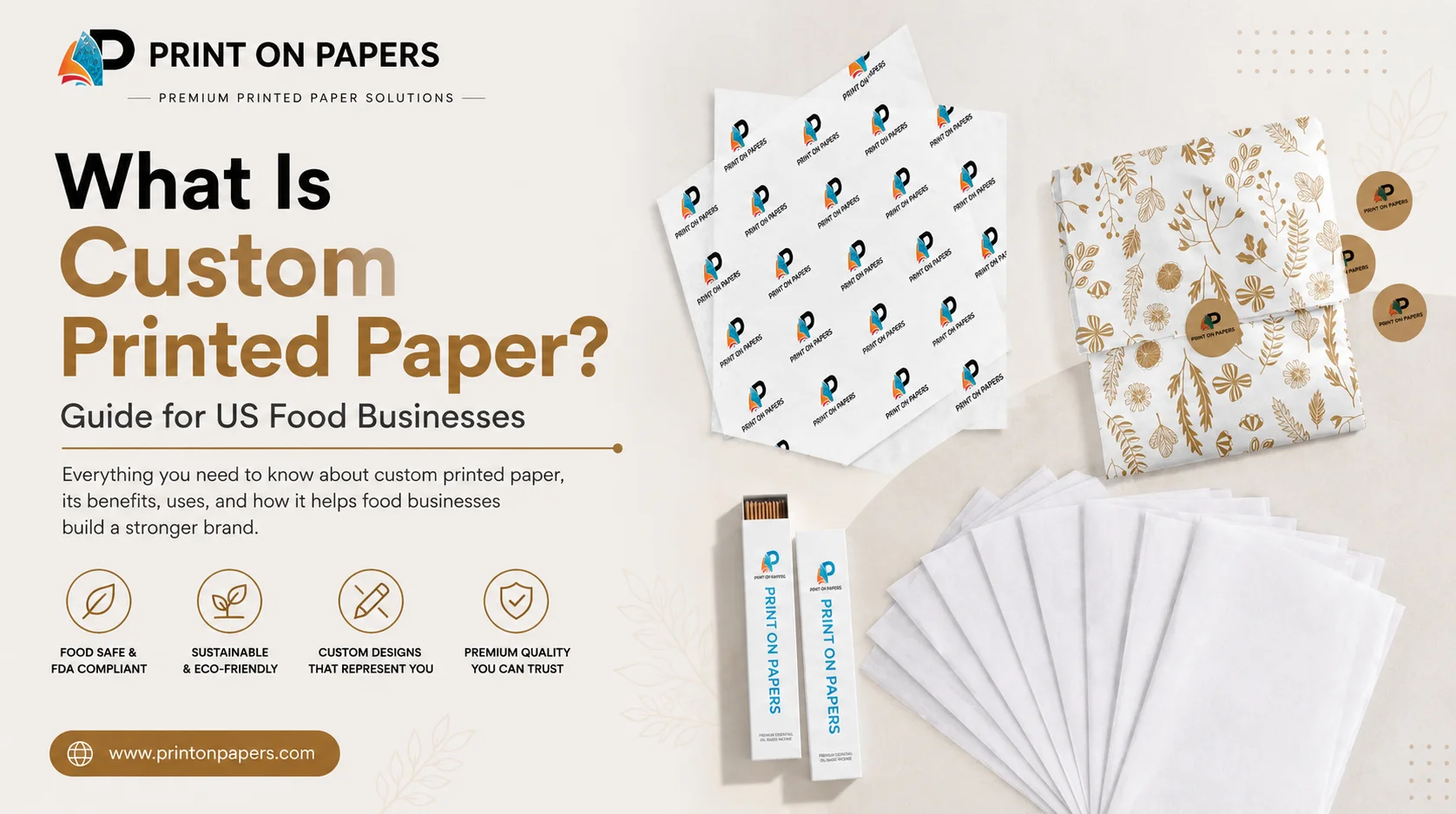
Custom printed paper is a type of branded food packaging specifically, food-safe wrapping paper printed with your business logo, brand colors, and design, made for direct food contact. It does the same protective job plain deli paper or butcher wrap does blocking grease, moisture, and contamination but it doubles as a branding surface every time a customer picks up, unwraps, or photographs their order.
The global custom packaging market hit $48.17 billion in 2025, with food and beverage businesses driving nearly a third of that demand at 32.67%, according to Fortune Business Insights. That growth is not coming from massive chains. It is being pushed by independent operators who figured out that the paper touching the food is part of the experience they are selling.
How Is It Different from Regular Wrapping Paper and Is It Actually Food-Safe?
Regular wrapping paper was never engineered for food contact. The base material, coatings, and inks were not tested against hot oil soaking through or a warm wrap sitting in a bag for twenty minutes.
Custom printed food paper is built differently at every layer. The base paper is selected for the food type greaseproof for fried items, breathable wrap for cheese, moisture-resistant wax paper for sushi. The inks are food-grade, typically soy-based or water-based formulations meeting FDA standards. And the coatings are chosen for safety and function, not appearance.
In the US, any paper contacting food must comply with FDA 21 CFR Part 176, the federal regulation governing paper and paperboard in food contact applications. It covers three components independently: the base material, coatings, and inks. All three have to clear the standard. A supplier using FDA-compliant paper but printing with non-compliant inks is not selling you a food-safe product.
Also look for FSC certification on the raw paper stock and confirm any grease-resistant treatments are PFAS-free. If a supplier cannot provide these in writing before you order, keep looking.
Types of Custom Printed Paper for US Food Businesses
Choosing the right paper is about matching the material to the food it will touch. Each type is best for a specific use case, and picking the wrong one means wasted money or poor performance.
| Paper Type | Best Use Case | GSM Range | Food Safety | Eco Credentials |
| Custom deli paper | Sandwiches, wraps, cold cuts | 30–45 GSM | FDA compliant | FSC certified |
| Greaseproof paper | Burgers, fries, fried items | 25–50 GSM | PFAS-free | Biodegradable |
| Wax paper | Moisture-heavy items, sushi | 30–60 GSM | Soy-wax options | Compostable |
| Kraft paper | Butcher use, heavy wrapping | 40–160 GSM | FDA compliant | Unbleached available |
| Freezer paper | Meat, seafood, cold storage | 57–65 GSM | BPA-free PE coat | Recyclable |
| Cheese paper | Specialty cheese, artisan deli | 40–70 GSM | Breathable coating | FSC certified |
| Parchment paper | Baking liners, bakery service | 40–60 GSM | Silicone coated | Compostable |
If you run a sandwich shop or deli counter, custom deli paper is the best option to start with, it handles cold cuts and wraps without moisture bleed, and it is the most commonly ordered custom food packaging option for US restaurants. Our complete guide to custom sandwich paper for food businesses covers GSM weights, printing options, and order quantities in detail.
If your menu is heavy on fried food, custom greaseproof paper is the best choice for burgers, fries, and anything cooked in oil. Our complete greaseproof paper guide covers everything from fiber density to real-world performance.
For bakeries, parchment paper doubles as both a baking liner and a branded presentation layer. Butcher shops should look at kraft paper for heavier cuts and freezer paper for cold storage. And cheese paper is a smart pick for specialty delis, it lets cheese breathe while retaining moisture, something generic wrap works against.
Who Is Actually Using Branded Food Paper Right Now?
Branded food paper is not a chain restaurant play. The operators leaning in hardest are independents, food truck owners, cafe owners whose customers photograph everything, deli counters competing against grocery store branding, butcher shops building neighborhood loyalty, and bakeries where the unboxing moment is part of what people pay for.
Hospitality and cafe businesses are the fastest-growing segment in US food service packaging, expanding at a 6.18% CAGR according to Mordor Intelligence outpacing even quick-service chains.
Will customers consciously notice your branded wrap? Not always. But they register the difference between plain paper and something with a name on it. Where it really pays off is social media, when a customer photographs their food and your branding is visible, that is free advertising you never had to create or boost.
How Much Does It Actually Cost in 2026?
Custom tissue paper starts at roughly $0.20 per sheet. Greaseproof runs around $0.25. Deli paper, wax paper, and kraft paper fall in the $0.30 to $0.40 range. Specialty items like cheese paper start closer to $0.50.
Minimum orders start at 500 sheets, a realistic first run for a small sandwich shop, not a warehouse-sized commitment.
To put that in context: if you serve 50 customers a day at $0.35 a sheet, that is $17.50 a day — $122.50 a week. For that, your name is on every item leaving your counter. Compare that to what even a modest Instagram ad costs for a week of visibility that vanishes when you stop paying.
Custom Printed Paper vs. Other Branding Options
Custom stickers on plain wrap are cheaper upfront but add labor to every order and fall off on greasy surfaces. Rubber stamps look handmade but the ink may not be food-safe. Branded bags without inner wrap still leave the paper, the last thing a customer touches unbranded.
Custom printed paper handles branding and food protection in one layer with no extra labor. If you only serve a handful of customers, a rubber stamp might work to start but once volume picks up, printed paper wins. Our breakdown of food wrapping paper benefits for restaurants and takeaways covers the full case.
How to Order Custom Printed Paper
Step 1: Share your requirements. Paper type, sheet size, quantity, and your logo. Most suppliers take a JPEG or PNG and handle the artwork for free.
Step 2: Review your digital proof. You see exactly how your design will appear before anything goes to press. Nothing moves forward until you approve.
Step 3: Production and shipping. Most orders go through production in 5 to 7 working days. Shipping is tracked and the finished product matches your proof.
Working against a deadline? Ask about rush timelines when you request your quote.
What to Look for in a Supplier
Not all suppliers are equal. Look for FDA compliance and ink types confirmed in writing before you pay, not just claimed on a website. The quote should have no hidden setup or design fees. Minimums should start at 500 to 1,000 sheets so you can test without overcommitting. There should be a digital proof approval step before anything prints. Print quality should stay consistent across reorders. And on the sustainability side, confirm FSC-certified stock and PFAS-free grease treatments, as reported by the EPA, PFAS restrictions in US food packaging are tightening fast.
At Print On Papers, every order includes free artwork preparation, a digital proof, FDA-compliant inks, FSC-certified paper options, and tracked worldwide shipping. Pricing starts at $0.20 per sheet. Get your free quote here , the team responds within 24 hours.
FAQs
What is custom printed paper for restaurants?
Think of it as your regular food wrapping paper, except it has your restaurant’s name and logo printed right on it. You wrap your sandwiches, burgers, deli orders the same as you do now but every item that leaves your counter has your brand on it. No extra steps for your staff, no stickers to peel. The branding just happens automatically.
What materials are used in food-safe custom printed paper?
It depends on the paper type, but most food-safe options start with an FSC-certified base, usually kraft, greaseproof, or parchment. The inks have to be soy-based or water-based to meet FDA 21 CFR Part 176, which is the federal standard for anything that directly touches food. Then there is a coating layer on top that changes depending on what you need. Parchment gets silicone. Wax paper gets soy-wax. Cheese paper gets a breathable coating so the cheese does not suffocate in the wrap.
How much does custom printed paper cost?
Less than most people expect, honestly. Tissue paper starts around $0.20 a sheet. Greaseproof is about $0.25. Deli paper, wax paper, and kraft paper run somewhere between $0.30 and $0.40. Cheese paper is the priciest at about $0.50 a sheet. You can start with as few as 500 sheets, and the price per sheet drops when you order in larger quantities.
Can small businesses order, or is it only for large chains?
This is probably the most common misconception out there. You do not need to be a chain. Most suppliers let you start at 500 sheets, which is a perfectly normal first order for a small deli or a weekend farmers market stand. Plenty of two-person bakeries and single food trucks order in those small batches and scale up from there.
How long does delivery take?
From the moment you approve your proof, most orders take about 5 to 7 working days to produce. After that, it ships tracked through DHL, FedEx, or UPS. Depending on where you are in the US, expect a few more business days for delivery.
What is the difference between greaseproof paper and wax paper?
They solve different problems. Greaseproof paper resists oil because of how the fibers are processed, they are packed tight enough that grease cannot seep through. That makes it the go-to for burgers, fried chicken, fries, anything dripping with oil. Wax paper takes a different approach. It has a wax coating that blocks moisture, so it works better for cold items like sushi or fresh deli wraps where wetness is the issue, not grease.
Will the printed logo transfer ink to food?
No, not if the supplier is using proper food-grade inks. Soy-based and water-based inks soak into the paper fibers when they are printed, so they are not sitting on the surface waiting to rub off. That said, always ask your supplier to confirm their inks are FDA-compliant before you commit to an order.
Your Food Already Tells a Story. Make Sure Your Wrap Tells It Too.
Every order that leaves your counter in plain paper is a missed opportunity. Custom printed paper costs less than most operators assume, arrives faster than they expect, and puts your brand directly into the hands of someone who just paid you money. The only question is whether you are using that moment.
Request your free quote from Print On Papers and have branded, food-safe paper on its way in under a week.