
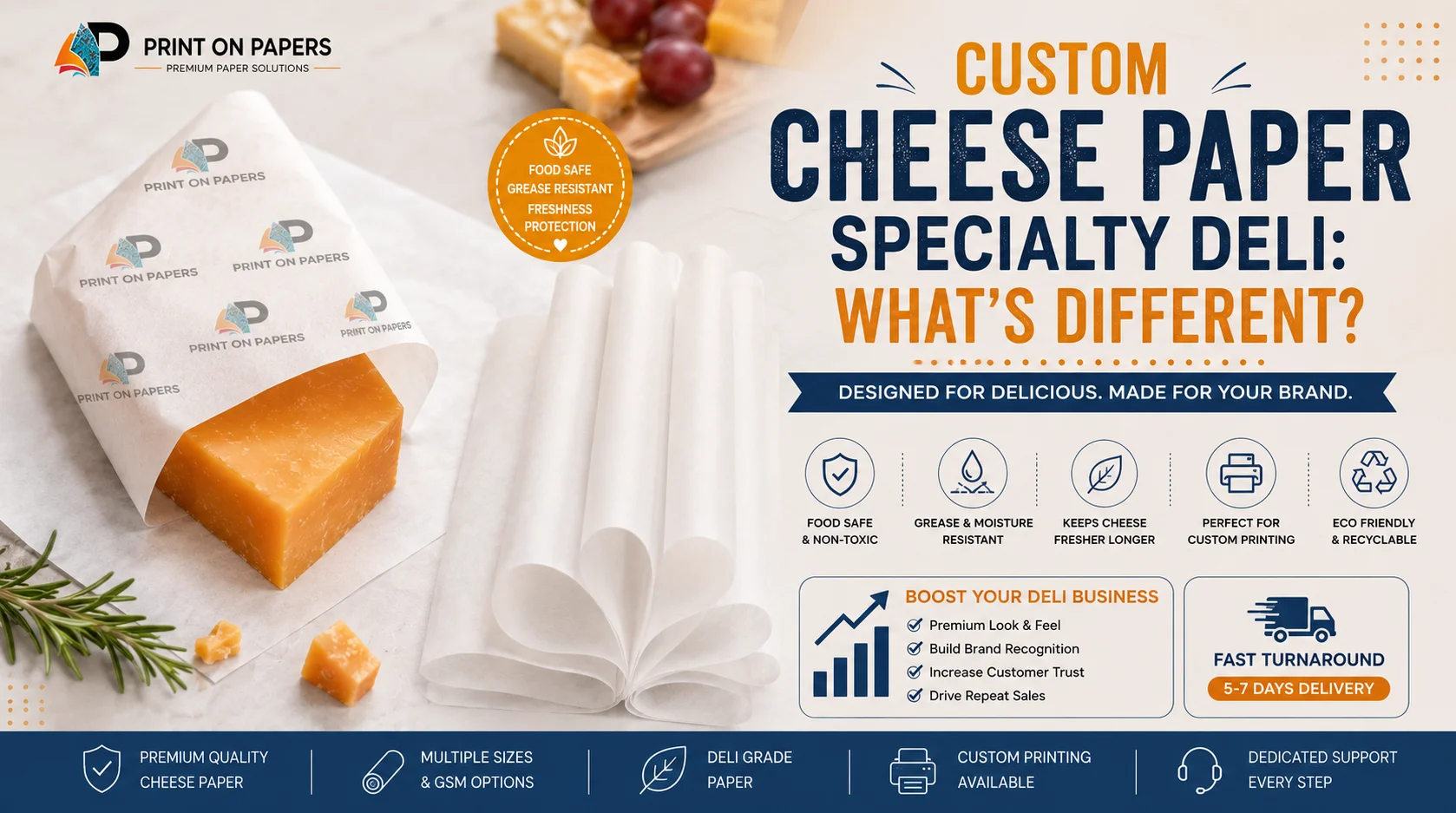
TLDR: Deli paper is built for sandwiches, not cheese. It traps moisture, which causes sweating, sliminess, and early mold. Custom cheese paper specialty deli shops instead have a dual layer construction, an outer coated layer for strength and an inner porous layer that lets water vapor and gas escape. That difference controls humidity, slows spoilage, and keeps cheese presentable longer. Below, you’ll find the science, the comparison, and how to order it.
Custom cheese paper is a two layer wrapping sheet built to hold humidity near cheese while still letting gas and moisture pass through. It is printed with a deli or cheese shop’s logo. Unlike deli paper, which is made for quick service wrapping, cheese paper is engineered around one job, keeping cheese at the right moisture level while it sits in a case or ages. It’s one of several food specific wraps under our custom food papers line, each built for a particular job rather than general use.
A wedge of cheese wrapped in ordinary deli paper often looks fine when it leaves the counter. By the next morning, there’s condensation under the wrap and the rind has gone soft. That’s not bad luck. It’s the paper.
Cheese keeps respiring after it’s cut. It releases water vapor, carbon dioxide, and small amounts of fat and moisture through the rind. Deli paper wasn’t designed to manage any of that. It’s built to hold a sandwich together for twenty minutes, not to regulate humidity around a block of cheese for two weeks.
When moisture has nowhere to go, it collects on the surface. That’s the sweating specialty delis complain about. Trapped moisture also creates the exact damp, low airflow conditions that let the wrong kind of mold take hold faster than it should. The paper isn’t just cosmetic. It’s part of the food safety picture.
Deli paper is lightweight, usually 30 to 45 GSM, with a light wax or PE coating. It’s built for cold and moderate temperature food like sandwiches and cold cuts, and it does that job well. It was never built to manage humidity over days or weeks.
Custom cheese paper solves a different problem entirely. It’s built with two layers instead of one. The outer layer is coated, often with wax or polyethylene, and gives the sheet strength and a barrier against handling. The inner layer is porous, letting air and water vapor move through in a controlled way instead of building up against the rind.
| Feature | Deli Paper | Custom Cheese Paper |
| Layers | Single layer | Dual layer, coated outer plus porous inner |
| GSM Range | 30 to 45 GSM | 30 to 45 GSM |
| Moisture Handling | Blocks moisture, low WVTR | Controls moisture, engineered WVTR |
| Best For | Sandwiches, cold cuts | Cheese storage, aging, display |
| Typical Use Window | Minutes to hours | Days to weeks |
That’s the real answer to what makes custom cheese paper specialty deli buyers reach for it over standard wrap. It’s not a branding upgrade. It’s a different piece of engineering, solving a different problem than deli paper was ever meant to solve.
Breathable cheese paper works on a principle called water vapor transmission rate, or WVTR for short. In plain terms, it’s how much moisture a material lets pass through over time. A fully sealed plastic wrap has a WVTR close to zero, which is exactly the problem. Nothing escapes, so moisture pools right where the cheese meets the wrap.
A 2026 packaging review published in an international food science journal looked at how material choice affects cheese stability, and found that permeability, not just the presence of small holes, is what actually determines whether a wrapped cheese ages properly or turns slimy under a coated barrier. Get the permeability wrong, and even a paper that looks similar to cheese paper can behave more like plastic wrap.
This isn’t unique to cheese, either. Food science studies on other aged products, like moisture permeable packaging trials on aging beef, have found the same underlying pattern: packaging that allows controlled moisture loss reduces microbial buildup compared to fully sealed alternatives, while dry aging without any barrier loses too much product to trimming. Cheese paper sits in that same middle ground on purpose.
Dual layer cheese wrap is the construction behind almost every commercial cheese paper on the market, including the kind used for active cheese aging paper in affinage rooms. One layer holds structure and blocks grease. The other manages air and moisture. Together, they keep humidity in a narrow band instead of letting it swing between soggy and dry.
This matters most for aging cheese, where the rind is still developing. Wrap it too tight in something non breathable, and the surface stays wet, inviting the wrong microbial growth. Leave it too exposed, and the rind dries out and cracks before it’s ready. Cheese aging paper threads that needle by design, not by accident.
Not every cheese behaves the same way, so the paper shouldn’t either. Soft, bloomy rind cheeses like brie need a porous outer layer, since a fully wax coated sheet traps exactly the moisture you’re trying to release. Semi hard cheeses like cheddar tolerate a slightly heavier coating and hold up well in standard cheese paper. Hard, long aged cheeses like parmesan need the least moisture protection and the most airflow, since they’re already low in water content and mainly need protection from drying out too fast. Storage temperature matters here too. USDA’s Food Safety and Inspection Service confirms that soft cheeses need refrigeration for safety while some hard and processed cheeses tolerate more flexibility, which is one more reason a single paper type was never going to work for every cheese in the case.
Cheese isn’t usually the only thing behind a specialty deli counter. Most shops running a serious cheese program also move butter, and the same logic that applies to cheese paper applies there too, the wrong wrap changes texture and shelf life. We covered that in detail in our guide to custom butter paper for delis and bakeries; the short version is that butter and cheese both need a paper chosen for what they are, not whatever’s already behind the counter.
Delis with a bagel or sandwich counter often stock custom bagel paper alongside cheese paper, and shops running a charcuterie board reach for custom butcher paper for cured meats. Printing all of it with the same logo keeps the counter looking like one brand instead of a mismatched pile of wrapping. That consistency is part of what makes specialty cheese packaging worth the switch, on top of the shelf life gain.
| Question People Ask | Direct Answer |
| What is the difference between deli paper and greaseproof paper? | Deli paper is lightweight, 30 to 45 GSM, built for cold and moderate temperature food. Greaseproof paper is denser, resists grease without a wax coating, and holds up to about 200°F. Use deli paper for light contact, greaseproof for anything hot or oily. |
| Is custom cheese paper safe for direct food contact? | Yes. Food contact cheese paper meets FDA 21 CFR 176 and uses food grade coatings and inks, with FSC certified base paper. |
| Why does my cheese sweat even in wax paper? | Wax paper is fully coated on both sides, so it blocks moisture the same way plastic does. It wasn’t built for multi day cheese storage, only short term wrapping. |
| Can I get custom cheese paper for a small specialty deli? | Yes. Orders start at 500 sheets, with no penalty for staying at that minimum. |
| How long does custom printed cheese paper take to produce? | Standard production runs 7 to 10 working days from proof approval, with a 5 to 7 day rush option available. |
| Does cheese paper work for aging cheese, not just retail wrap? | Yes. The same breathable, dual layer construction used at the counter is what affineurs use during active aging, since it manages humidity the same way. |
Custom cheese paper wholesale specialty deli USA pricing starts from $0.20 per sheet, with a 500 sheet minimum and no penalty for staying small. Delis can choose flat sheets or rolls depending on how the counter is set up. Standard production takes 7 to 10 working days from proof approval, and shipping is free worldwide through DHL, FedEx, or UPS, tracked from dispatch. Design support is included, so a shop can send a logo and get back a print ready proof before anything goes to production. Print On Papers ships every order from its own production line, so the timeline above holds even during peak deli season.
As of July 2026, more specialty delis are moving away from generic wax paper for cheese specifically because the cost difference is small compared to what’s lost when a wheel sweats, softens, or gets pulled from the case early. A few cents per sheet is a smaller number than a wasted wedge of cheese.
If cheese is sweating, softening early, or coming out of the wrap looking worse than it went in, the paper is usually the reason. Switching to a dual layer, breathable wrap built for the job fixes that without changing anything else about how the counter runs.
The gap between deli paper and custom cheese paper specialty deli owners rely on comes down to one thing, what each paper was built to manage. Deli paper handles a sandwich for twenty minutes. Cheese paper manages humidity, gas exchange, and rind condition over days or weeks, through a dual layer construction that lets moisture escape instead of pooling under the wrap. For a specialty deli, that difference shows up directly in how long cheese stays sellable and how it looks when a customer picks it up. Getting the paper right is a small change with a real payoff in the case.
Print On Papers is a custom printed paper and wrapping paper company serving restaurants, bakeries, delis, food trucks, butchers, florists, apparel brands and food brands across the US and worldwide. We deliver food-safe, eco-friendly, fully branded custom paper, from your first 500 sheets to your next 500,000