
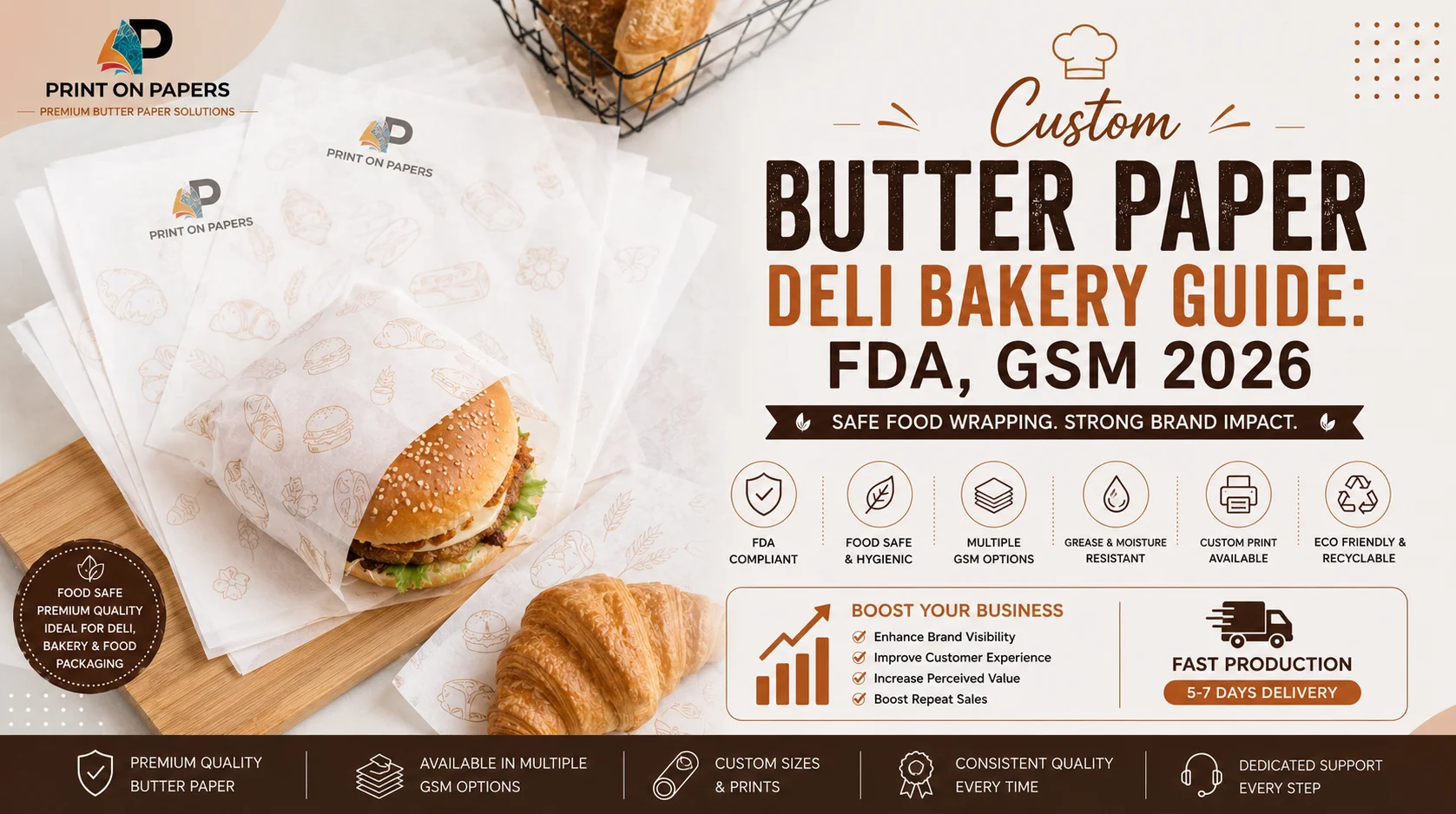
TLDR: Custom butter paper deli bakery buyers need paper that meets FDA 21 CFR 176, uses the right GSM for dairy contact, and ships fast at real wholesale prices. This guide breaks down why butter paper tears, what GSM actually means, and how to order 500 sheets without guesswork.
Table of Contents
Custom butter paper is a food grade sheet printed with your logo and built for direct contact with butter, dairy, and baked goods. It resists grease and moisture, holds up in cold storage, and meets FDA rules for food contact paper. Delis and bakeries use it to wrap, line, and brand products at the counter.
If you run a deli counter or a bakery line, you already know the frustration. You reach for a sheet of butter paper on a busy Saturday morning, and it tears the second it touches a cold, wet block of butter. That single torn sheet is the exact frustration that pushes many custom butter paper deli bakery buyers to start comparing suppliers mid week, costing you time, product, and a little bit of trust with the customer standing at the counter.
This is the exact problem that brought most buyers to search for custom butter paper deli bakery options in the first place. The good news is that the fix is not complicated once you understand what actually causes the tearing.
Most tearing comes down to one thing. The paper’s GSM and coating do not match the job. GSM stands for grams per square meter. It tells you how heavy and how strong a sheet is.
A thin, low GSM sheet works fine for a warm pastry. It does not hold up against a cold, wet block of butter straight from the walk in cooler. Cold moisture makes fibers swell and weaken, and a light sheet gives out fast.
Coating matters just as much as weight. A wax coated sheet resists moisture well, but it can crack in the cold. A PE coated sheet, made from a thin polyethylene layer, tends to hold its strength better in cold, wet conditions and is a common choice for dairy contact paper.
Ink transfer is another real worry for bakery owners who print their logo on the wrap. Soy based, food grade inks do not migrate into the food the way older petroleum based inks could. That distinction matters if your local health inspector ever asks about it.
Butter paper GSM ratings for direct dairy contact usually fall between 30 and 45 GSM, depending on how the sheet will be used. Lighter sheets in the 30 to 35 GSM range work well for wrapping pastries and lining trays. Heavier sheets closer to 40 to 45 GSM hold up better for butter blocks and wet, cold dairy products.
| Use Case | GSM Range | Best Coating |
| Pastry lining | 30 to 35 GSM | Wax or PE |
| Sandwich wrap | 30 to 40 GSM | Wax |
| Cold butter blocks | 40 to 45 GSM | PE coated |
| Cheese counter wrap | 35 to 45 GSM | PE coated |
A simple rule helps here. If the food is cold, wet, and heavy, go heavier on GSM and choose a PE coating. If the food is dry or warm, a lighter sheet with a wax coating usually does the job and costs less per sheet.
Yes, when the paper is made to the right standard. In the United States, food contact paper falls under FDA 21 CFR Part 176, which sets rules for substances allowed to touch food during production, wrapping, and storage. You can read the exact language on the government’s own site if you want to see what your supplier should be citing, not just a vague “FDA approved” claim on a product page.
There is a second layer worth knowing about. In February 2024, the FDA confirmed that manufacturers had stopped selling PFAS based grease proofing agents for food contact paper in the US market, following a voluntary phase out. By January 2025, the FDA published a notice in the Federal Register confirming that 35 food contact notifications tied to PFAS coatings were no longer effective. On top of that, close to 20 states now restrict or ban PFAS in paper food packaging, based on legal tracking published through late 2025, with more state rules set to take effect through 2027.
That matters for a deli or bakery buyer because it means the “PFAS free” claim on a spec sheet is not just marketing anymore in many states. It is close to becoming a legal requirement. For a custom butter paper deli bakery order, that documentation should already be sitting in your supplier’s spec sheet, not something you have to request twice.
Butter paper food safe status also depends on the base stock. FSC certified paper traces back to responsibly managed forests, which is a separate claim from food safety but often shows up on the same spec sheet. Ask for both certifications in writing.
These three get confused often, and the difference actually matters for your order.
Butter wrap paper direct contact use is usually lighter and more flexible than parchment, built for everyday wrapping rather than oven use. Wax paper resists moisture through a wax layer but is not oven safe and can melt near heat. Parchment paper goes through a silicone treatment that lets it handle oven heat up to around 425 degrees Fahrenheit, which butter paper is not built for.
If your team keeps grabbing parchment for counter wrapping because that is what is on hand, you are likely overpaying per sheet for a feature you do not need at the counter. Matching the paper to the job saves money over a full year of orders.
Dairy paper custom print options let a deli or bakery put its logo directly on the wrap. A custom butter paper deli bakery order with logo printing does double duty, protecting food and marketing your name at the same time. Every customer who takes home a wrapped stick of butter or a wrapped pastry sees your name again at home, which plain paper never does.
Custom print does not have to slow down your order. Most USA suppliers run CMYK printing, so any logo color matches consistently across every batch. Ask about proof approval time before you commit to a large run, since a rushed first print run is where most branding mistakes happen.
For a closer look at the full lineup of options, including custom food wrapping paper built for other counter uses, it helps to see how butter paper fits alongside the rest of a kitchen’s paper needs.
Custom butter paper wholesale deli bakery USA 500 sheets is the standard starting point for most independent shops. A 500 sheet minimum lets a single location test a new supplier without committing to a warehouse sized order.
Here is what to check before you place an order.
First, confirm the GSM and coating match your actual use case, not just what a sales page recommends by default. Second, ask for the FDA citation and PFAS free confirmation in writing, not just a badge on the website. Third, confirm turnaround time. Standard production runs 7 to 10 working days from proof approval, with rush options in 5 to 7 days for a tighter timeline. Fourth, check shipping. Reliable USA suppliers ship free nationwide through carriers like DHL, FedEx, or UPS, with tracking included.
Print On Papers builds custom butter paper to these exact standards, starting at 500 sheets with FDA compliant, PFAS free coatings and free design support included on every order. The full custom food papers lineup covers everything from butter paper to butcher paper under the same compliance standards.
Butter paper is not the only food contact paper where GSM and coating choice decide whether a wrap holds up under real kitchen conditions. BBQ restaurants run into the same evaluation problem with a heavier duty product, custom butcher paper, built for raw meat instead of dairy. If your business handles both counters, it is worth seeing how custom butcher paper holds up for BBQ restaurants to compare how the same FDA and PFAS free standards apply across a different use case.
| Question | Answer |
| What GSM is best for butter paper? | Most direct dairy contact uses 30 to 45 GSM, with heavier sheets around 40 to 45 GSM for cold butter blocks and lighter sheets for pastries. |
| Is butter paper food safe? | Yes, when it meets FDA 21 CFR 176 and uses PFAS free coatings with soy based, food grade inks. Ask your supplier for written confirmation of both. |
| How do I stop butter paper from tearing? | Switch to a heavier GSM with a PE coating for cold, wet dairy contact. Wax coated sheets are better suited to dry or warm items. |
| What is the minimum order for custom butter paper? | Most USA suppliers, including Print On Papers, set a 500 sheet minimum with no penalty for staying at that level. |
| How is butter paper different from parchment paper? | Parchment goes through a silicone treatment for oven heat up to 425 degrees Fahrenheit. Butter paper is built for wrapping and counter use, not oven contact. |
If your current butter paper keeps tearing, or you are not sure it meets current FDA and PFAS free standards, this is the moment to switch suppliers instead of restocking the same problem.
Choosing the right custom butter paper deli bakery supplier comes down to three checkable facts: the GSM matches your use case, the paper meets FDA 21 CFR 176 with PFAS free coatings, and the order terms fit a single location instead of a warehouse chain. Skip the vague “food safe” claims and ask for the actual documentation. Your health inspector will ask for it eventually, and your customers deserve a wrap that holds up the first time, not just most of the time.
Print On Papers ships from Valley Stream, New York, with the standards and documentation covered above built into every order. Visit printonpapers.com to see current specs before your next order runs out.
Print On Papers is a custom printed paper and wrapping paper company serving restaurants, bakeries, delis, food trucks, butchers, florists, apparel brands and food brands across the US and worldwide. We deliver food-safe, eco-friendly, fully branded custom paper, from your first 500 sheets to your next 500,000