
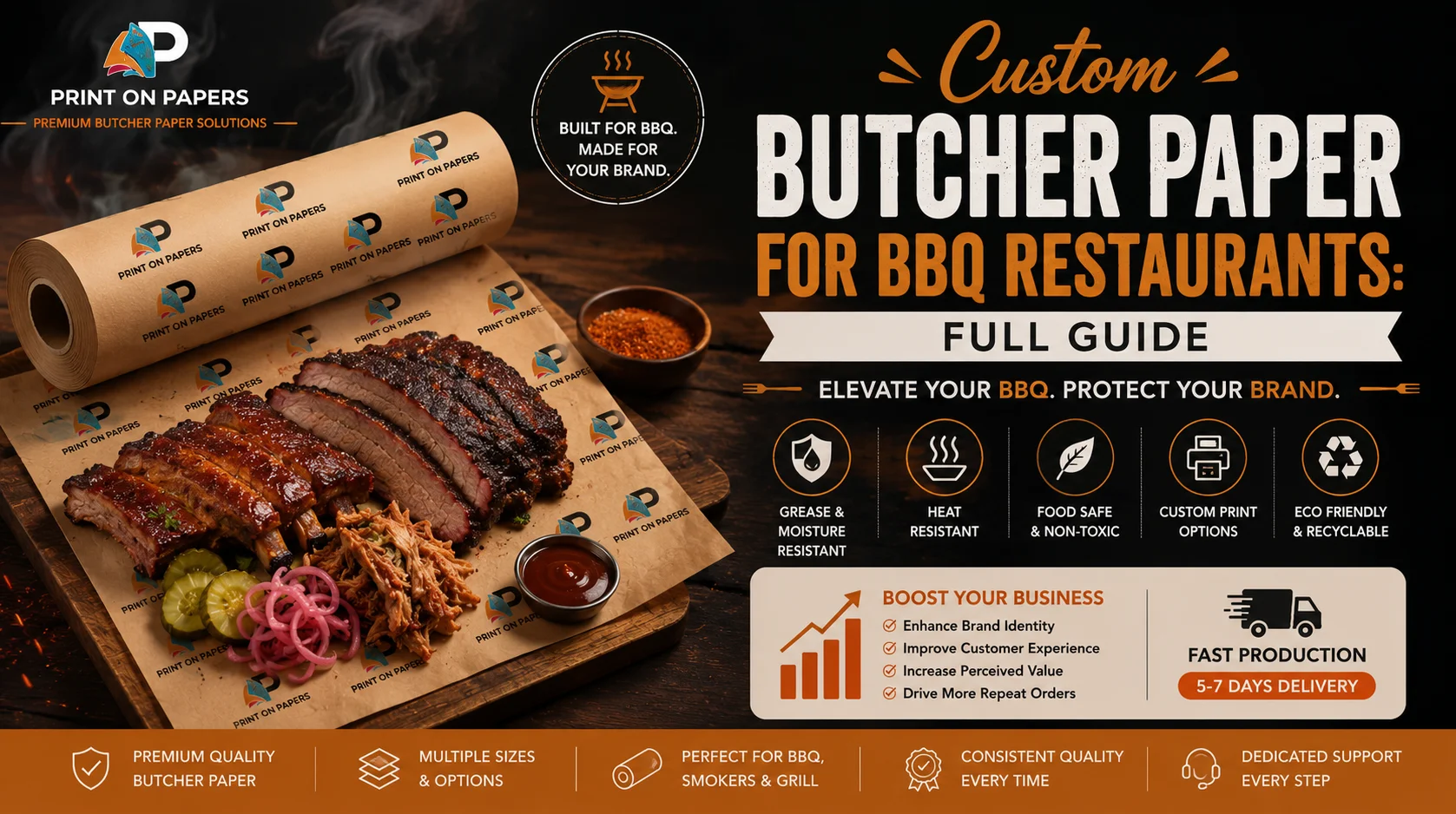
Pink butcher paper wins for smoking brisket and ribs because it stays porous and breathable. White butcher paper often has a light coating, so save it for counter wrapping, not the smoker. Kraft paper is the workhorse for prep and general food service. If you run a BBQ restaurant, order custom butcher paper BBQ restaurants at wholesale volume, and confirm FDA compliance before you standardize on one type.
Custom butcher paper for BBQ restaurants comes in three main types. Pink paper is unbleached and porous, so it lets smoke pass through during a long cook. White paper often carries a coating that blocks that same smoke. Kraft paper handles general wrapping but should stay off the smoker itself.
Butcher paper is an uncoated sheet made mostly from softwood pulp. Restaurants use it to wrap meat, line prep tables, and hold cooked cuts before service. The color you pick tells you how the paper was treated, not just how it looks.
Pink paper skips the bleaching step, so the natural pulp color shows through. White paper gets bleached for a cleaner look. Kraft paper is unbleached and brown, built for strength more than smoke control. For a BBQ restaurant, that treatment difference decides whether the paper helps or hurts the cook. Butcher paper is one product inside a wider custom food papers lineup, and it’s worth knowing where it fits before you standardize on one type.
This matters more now than it did a few years ago. Health departments ask more questions about food contact materials, and customers ask more questions about what touches their food. A restaurant that can explain its paper choice in one sentence looks more credible than one that can’t.
Pink butcher paper, sometimes called peach paper, is the default choice for pitmasters wrapping brisket and ribs. The color comes from unbleached pulp, not dye. That is worth saying plainly, because some customers assume pink means artificial color, and it does not.
The reason pink paper works for smoking comes down to a treatment called sizing. Sizing controls how porous the finished sheet is. Pink butcher paper food safe stock usually skips heavy sizing, which keeps it breathable. Steam escapes, smoke keeps reaching the meat, and the bark on a brisket keeps forming instead of turning soft.
This tradition traces back to Central Texas barbecue. Franklin Barbecue in Austin, run by Aaron Franklin, popularized pink paper wrapping for brisket, a method that traces further back through his mentor John Mueller to the Mueller family’s original barbecue operation. That lineage is well documented in barbecue writing and is part of why pink paper became the default smoking paper for BBQ restaurants rather than just a regional habit.
Pink paper is not indestructible. Most rolls hold up to smoker temperatures under 300 degrees Fahrenheit. Push past that consistently and the paper can scorch at the edges, especially where it touches a grate directly.
White butcher paper looks clean and prints well, which is why it shows up at meat counters and in general food service. The pulp is bleached, and many rolls carry a light wax or poly coating meant for counter wrapping, not the smoker.
That coating is the actual problem, not the color itself. Put a coated white sheet back on a smoker and it can seal in steam instead of releasing it, or scorch where it contacts direct heat. A restaurant that grabs whatever white paper is on hand, without checking whether it is coated, is the most common version of this mistake.
Uncoated white butcher paper does exist and performs closer to pink paper on a smoker. The catch is that most white paper sold at general food service suppliers is not labeled clearly enough to tell the difference at a glance. That is exactly why BBQ restaurants doing high volume benefit from ordering a paper built and labeled for smoking, not a generic white roll.
Kraft butcher paper is unbleached, brown, and strong. It handles general meat wrapping, prep station coverage, and takeout bags well. Natural vs bleached butcher paper comes down to that same bleaching step described earlier. Kraft skips it, keeping the pulp closer to its raw state.
Kraft paper works fine for wrapping a sandwich or lining a tray. It is not the first choice for smoking, mainly because most kraft stock runs heavier and less porous than paper built specifically for smoke penetration. Use it where strength matters more than breathability.
| Paper Type | Best For | Smoker Safe | Coating | Color Source |
| Pink (Peach) | Smoking brisket, ribs | Yes, under 300°F | Usually uncoated | Unbleached pulp |
| White | Counter wrap, display | Only if uncoated | Often light wax or poly | Bleached pulp |
| Kraft | Prep, takeout, general wrap | Not recommended | Uncoated | Unbleached pulp |
The most repeated warning about butcher paper is simple. Use the wrong stock and it can burn or transfer coating residue onto the meat. That risk is real, but it is not the only cost of getting this wrong.
Kitchens running multiple shifts often end up with inconsistent bark because one shift grabs pink paper and another grabs whatever coated white stock is left in the storeroom. The brisket coming off the smoker on a Tuesday looks and tastes different from the one on a Saturday, and regular customers notice.
There is also a brand cost. A wrapped brisket handed across the counter is one of the most photographed moments in BBQ culture. Plain paper is a missed brand impression at the exact moment a customer is most engaged with the food. Multi location operations face a related problem: sourcing paper locally per site leads to different colors and weights showing up under the same menu item depending on which location a customer visits.
Yes, when the paper meets the right federal standard. Butcher paper direct meat contact in the United States falls under FDA rules in 21 CFR Part 176, the section covering paper and paperboard components used with food. That regulation lists which substances are allowed in the food contact surface of the paper, along with limits on how much can transfer to food.
PFAS free status matters here too. The FDA confirmed in February 2024 that grease proofing agents containing PFAS are no longer sold for food packaging use in the United States, following a voluntary phase out that manufacturers began in 2021. That announcement, detailed on FDA.gov, is a useful reference point when a health inspector or a customer asks whether your wrap is PFAS free. Ask your supplier for confirmation in writing rather than taking a generic food safe label at face value.
Butcher paper is one product inside that wider category, built around what food service kitchens actually need. Print On Papers manufactures nine food-specific paper types, including custom butcher paper for smoking and raw meat handling, custom sandwich paper for the pulled pork and brisket sandwiches most BBQ menus sell alongside plates, custom bagel paper for operations that also run a breakfast or bakery counter, and custom burger paper for BBQ joints that also serve burgers. A BBQ restaurant rarely needs just one paper type, and standardizing across a full menu keeps branding consistent from the smoker to the register.
BBQ butcher paper bought at restaurant volume should come from a supplier that states its minimum, price, and production timeline clearly, not one that hides those numbers behind a quote form. Print On Papers sets a 500 sheet minimum with pricing starting from $0.20 per sheet, standard production of 7 to 10 working days, and free design support on every order.
Confirm five things before you standardize on a supplier. Check that the paper is uncoated if it is going on a smoker. Confirm FDA 21 CFR 176 compliance in writing. Ask whether the grease resistant treatment, if any, is PFAS free. Get the per sheet price at your expected order volume. Finally, ask about custom printing, since a wrapped brisket is free advertising you are currently giving away blank.
For a deeper walkthrough of pricing tiers and order sizes, the complete guide to custom butcher paper wholesale in the USA covers volume pricing in more detail than fits here.
| Question | Answer |
| What is the difference between pink and white butcher paper? | Pink paper is unbleached and stays porous, so smoke and steam pass through it. White paper is bleached and often coated, which can trap steam and block smoke during a long cook. |
| Can butcher paper catch fire in a smoker? | Plain butcher paper resists open flame better than wax paper or foil, but it can scorch above 300 degrees Fahrenheit, especially where it touches a hot grate directly. |
| Is pink butcher paper dyed? | No. The pink or peach color comes from unbleached wood pulp, not an added dye. Bleached paper turns white, unbleached paper stays in that natural pink to brown range. |
| Is butcher paper safe for direct meat contact? | Yes, when it meets FDA rules under 21 CFR 176 for food contact paper. Confirm the coating and any grease resistant treatment are PFAS free before you order at volume. |
| What is the minimum order for custom butcher paper? | Print On Papers sets a low 500 sheet floor with no added penalty for staying at that level, which keeps custom butcher paper wholesale BBQ restaurant USA orders accessible for single location shops. |
Browse custom butcher paper options in pink, white, and kraft, or skip straight to pricing.
Pink butcher paper is the right call for smoking brisket and ribs, white paper works for counter presentation as long as it is uncoated, and kraft paper covers general prep and wrapping. Confirm FDA compliance and PFAS free status before you place a bulk order, and choose a supplier that states its minimum and pricing plainly. Getting this right on custom butcher paper for BBQ restaurants is a small decision that shows up in every wrapped order a customer takes home.
Print On Papers is a custom printed paper and wrapping paper company serving restaurants, bakeries, delis, food trucks, butchers, florists, apparel brands and food brands across the US and worldwide. We deliver food-safe, eco-friendly, fully branded custom paper, from your first 500 sheets to your next 500,000