
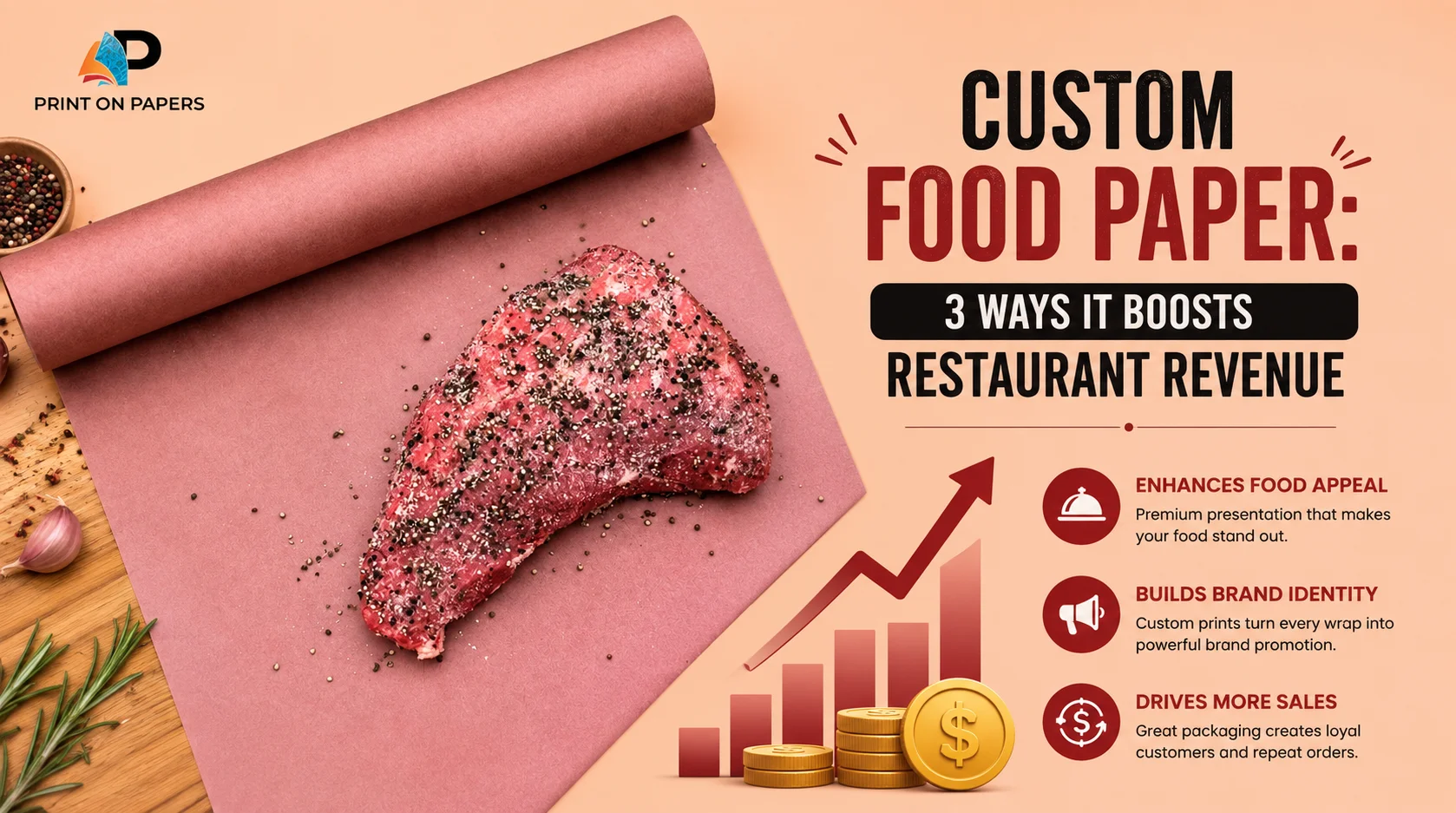
How Custom Printed Food Paper Increases Restaurant Revenue: 3 Real Mechanisms
TL;DR: Custom printed food paper increases restaurant revenue in three ways you can measure. It brings customers back more often. It gets your food shared online for free. And it makes your food look worth more before anyone tastes it. This post shows you the math behind each one.
Table of Contents
- What Is Custom Printed Food Paper
- Does Branded Paper Really Increase Revenue
- Mechanism 1: It Brings Customers Back
- Mechanism 2: It Gets Shared Online
- Mechanism 3: It Raises Perceived Value
- Which Paper Fits Your Restaurant
- How to Test This Before You Commit
- FAQ
- Start Your Business Case
You run a sandwich shop, a bakery, or a food truck. You have seen a quote for branded paper. You wondered if it is worth the extra cost over plain paper.
That is a fair question. A logo on a sheet of paper should not be a leap of faith. It should be a decision you can defend with numbers. This post breaks the case into three parts. Each part is something you can test yourself.
Print On Papers prints custom deli paper, kraft paper, and other food contact paper for small restaurants across the US. This is not a theory piece. It is the business case behind why owners keep reordering the same branded wrap.
What Is Custom Printed Food Paper
Custom printed food paper is food safe wrap printed with your logo. It replaces plain deli paper or wax paper. Every order leaves your kitchen carrying your brand.
In 2026, food costs are tight. Ad spend is expensive. Packaging is one of the few marketing tools that pays for itself on every order, because the customer already has to touch it.
That is the short answer. Here is the longer one.
Does Branded Paper Really Increase Revenue
Yes. And it is not vague brand awareness. There are three specific effects you can track.
Branded paper brings customers back more often. It gets your food shared online for free. And it changes how customers judge your food before they even taste it.
The paper itself is cheap. A custom sheet often costs about twenty cents. But that cheap sheet triggers something bigger after the sale. More visits. More shares. More perceived value. That is where the real return shows up.
- Mechanism 1: It Brings Customers Back
Does branded packaging actually bring restaurant customers back? Research says yes, and this mechanism has the clearest paper trail of the three.
A Dotcom Distribution survey of over 500 online shoppers found something clear. Shoppers who received branded, gift-like packaging were far more likely to buy again from that brand. Plain packaging did not create the same effect. Most shoppers in the same survey said packaging changes how they feel about a brand, not just the product inside it. You can see the survey results reported by Retail Dive here, including the exact repeat-purchase percentage.
Restaurants work the same way. A sandwich in plain paper looks like any other sandwich. A sandwich in your paper looks like it came from somewhere specific. That small signal is what repeat business runs on.
Foodservice research backs this up too. Packaging researchers who study purchase behavior have found that packaging can outrank TV ads and online reviews as a driver of repeat purchases. That is a bigger claim than it sounds. Your wrapping paper may matter more to a returning customer than your last ad campaign did.
Here is the simple math. Say your shop sells 300 sandwiches a week. Branded paper costs about twenty cents more per sheet than plain paper. That is sixty dollars a week. Over a year, that is close to three thousand dollars.
Now flip it around. If branded paper lifts your repeat visit rate by even a small amount, those extra visits cost you nothing to earn. You already have the customer. You are just seeing them again sooner. Run this math with your own weekly order count and you will see how fast it clears.
- Mechanism 2: It Gets Shared Online
Custom paper can turn a sandwich into free advertising. Here is how.
The same Dotcom Distribution research found something similar. Close to four in ten shoppers had shared a photo of a product online after unwrapping it. Most said they would share it again if the packaging felt unique instead of plain. You can read the full survey breakdown here, including which platforms people use most for this kind of sharing.
Restaurants already get a version of this for free. Customers photograph their food constantly. Branded paper just gives that photo something worth noticing.
This is not a separate marketing campaign. It rides on a habit your customers already have.
This is also where ordering in bulk pays off. Print On Papers sets a minimum of 500 sheets, with pricing that drops as your order grows. At that scale, the cost per photo shared gets small fast. One photo can reach people who have never walked into your restaurant, for the price of paper you were buying anyway.
- Mechanism 3: It Raises Perceived Value
This mechanism gets the least credit, but it may matter the most. Branded paper is not just decoration. It changes how good your food looks before anyone takes a bite.
Peer reviewed research on packaging design keeps finding the same thing. Presentation shapes how customers judge quality and taste, not just brand recognition. Color, texture, and print quality all shift how good a product feels, separate from what is actually inside it. A sandwich that looks intentional reads as more carefully made than one wrapped in whatever paper was lying around.
Food safety trust plays into this too. Every food contact paper Print On Papers makes follows FDA rules under 21 CFR Part 176. That is the federal regulation covering what can safely touch food in paper form. Customers do not read regulations. But they do notice when packaging feels considered instead of careless. That feeling is part of what perceived value is built from.
This mechanism shows up most in pricing power. A restaurant that looks more established can often hold its prices, or even raise them. A plainer competitor faces more pushback for the same move. That is a slower return than the first two mechanisms, but it compounds over time.
Which Paper Fits Your Restaurant
Not every paper type does the same job. Picking the wrong one wastes the effect above.
| Paper Type | Best For | Heat Handling | Starting Price |
| Custom deli paper | Sandwiches, cold cuts | Cold to moderate | $0.20 per sheet |
| Custom kraft paper | Bread bags, wraps | Moderate | $0.25 per sheet |
| Custom cheese paper | Deli counters, cut cheese | Cold storage | $0.22 per sheet |
| Custom hot paper | Fried food, hot holding | High heat | $0.25 per sheet |
Most restaurants order two types, not one. A sandwich shop usually needs custom deli paper at the counter. It also needs a heavier paper for anything fried on the side. This guide to custom deli paper for sandwich shops walks through a real ordering setup. And this comparison of kraft paper vs deli paper for restaurants breaks down that specific choice in plain terms.
For the full lineup built for food businesses, see the custom food papers page. If you want to compare paper formats more broadly, browse custom printed papers as a category.
How to Test This Before You Commit
You do not have to order a year of paper to find out if this works. Start small.
Order the 500 sheet minimum in one paper type, usually deli paper if you run a sandwich or counter service business. Use it for four to six weeks. Track two things during that window. Count how many customers you recognize as repeat visits. Watch your social tags or mentions for photos of your food.
You will not get a perfect number from six weeks of data. But you will get a real signal. If repeat visits or shares tick up even slightly, the math from Mechanism 1 already tells you the paper pays for itself. If nothing changes, you have only spent the cost of one small order to find out, not a year of budget.
This is also a good time to compare paper types side by side. Some shops order two designs for the same paper type and rotate them, just to see which design gets photographed more. That is a cheap way to learn what your specific customers respond to before you scale up the order.
FAQS
Does branded packaging really bring customers back?
Yes. Studies on packaging as a purchase driver have found it can outrank ads and reviews in influencing repeat visits. Restaurants see the same brand recognition effect through wrap.
What kind of return can I expect from custom deli paper?
It depends on your order volume. Most shops cover the added cost through repeat visits and free social shares alone. That is before counting any pricing power gained from looking more established.
Is custom paper a lot more expensive than plain paper?
Not usually. Expect two to five cents more per sheet, with the price per sheet dropping as your order size grows.
What is the smallest order I can place for wholesale custom paper?
Most orders start at five hundred sheets. That lets a small shop test branded paper without committing to a huge print run.
How long does custom food paper take to print and ship?
Standard production takes seven to ten working days from proof approval. Rush options are available if you need it sooner.
Is custom printed paper safe for direct contact with food?
Yes. Food contact paper is regulated under FDA rules, and a reputable supplier will confirm compliance before printing your order.
Start Your Business Case
You do not need a marketing background to justify this line item. You need three numbers. Your weekly order volume. The price difference between plain and branded paper. A rough guess at how many repeat visits or shared photos would cover that gap.
Most restaurants clear that math within a few weeks of their first order.
Get a Free Quote From Print On Papers →
Conclusion
Custom printed food paper increases restaurant revenue through three mechanisms, and none of them require guessing. It brings customers back. It gets shared for free. It makes your food look worth more before anyone tastes it. Run the numbers on your own order volume, order enough paper to test it, and let the results decide if it belongs in your budget for good.