
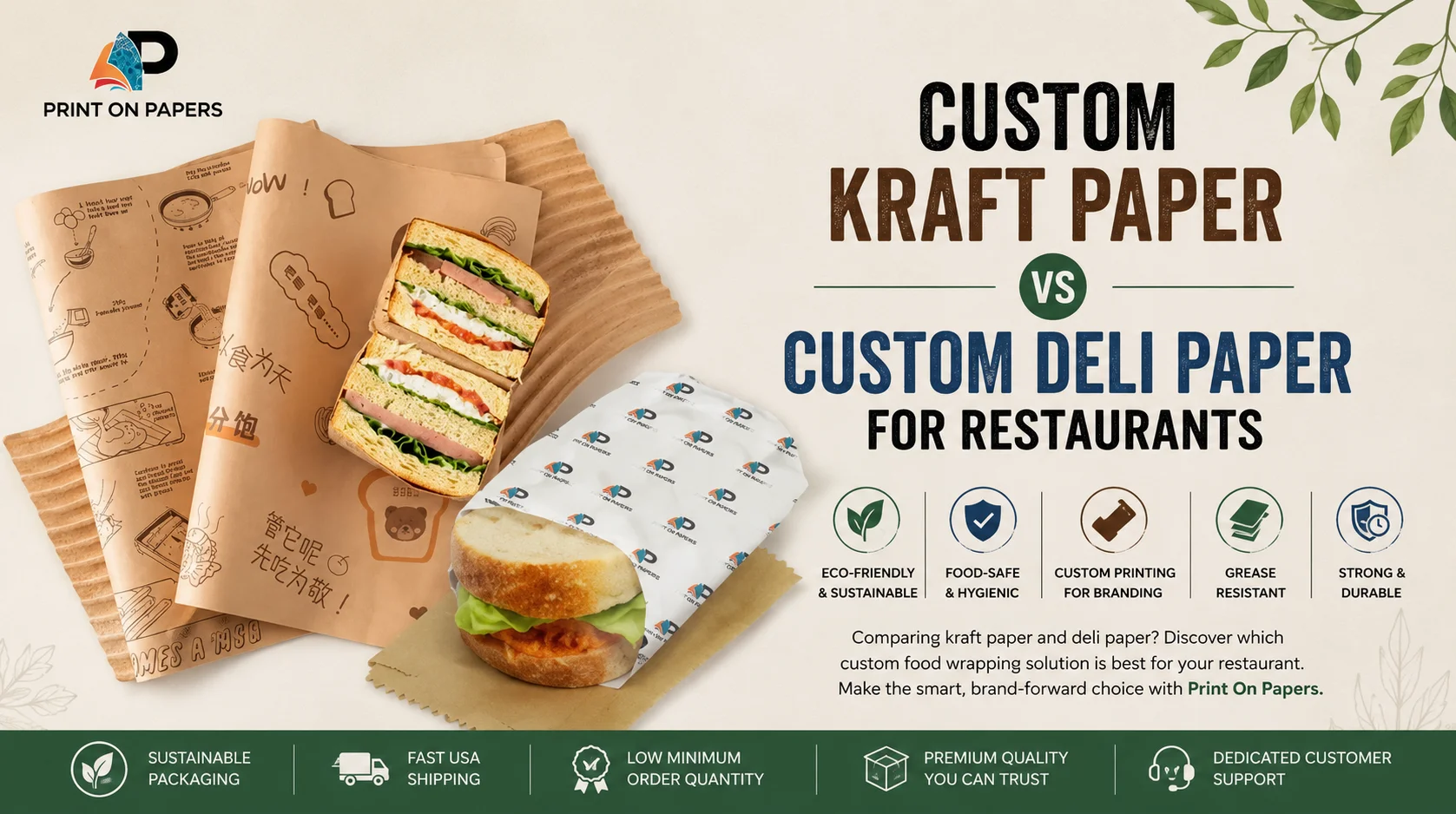
TL;DR: Kraft paper looks natural and handmade but dulls bright colors. White deli paper prints full color cleanly but reads more modern. Both meet FDA rules and cost about the same. Pick based on your logo and your concept, not on which one wins in general, because neither does.
Table of Contents
Custom Kraft Paper is brown and unbleached. Custom deli paper is usually white or bleached kraft. One looks earthy, the other looks crisp, and picking between them is really a branding call dressed up as a supply order.
Most restaurant owners never expect this to be a hard choice. You already picked a logo. You already picked colors for your walls, your menus, your uniforms. Then a paper rep sends over two swatches and asks which one you want, and suddenly you’re holding two blank sheets trying to decide which one is more “you.” It matters more than it looks like it should, because that paper is the first thing a customer touches after they order.
Kraft paper comes from wood pulp that never gets bleached, so the brown color you see is just the paper’s natural state. It also keeps longer fibers than bleached paper, which is part of why it holds up a little tougher when it gets wet or greasy.
Deli paper goes through bleaching to strip that brown tint out. What’s left is a smoother, whiter surface that gives a printer more to work with. Fast casual spots and dessert shops gravitate toward it for a reason. It photographs well, and it looks current in a way brown paper sometimes doesn’t.
Calling either one “the good paper” misses the point. They’re built for different outcomes. Kraft leans rustic, deli leans clean, and the right pick is whichever one matches the food you’re putting in front of people.
Truthfully, they’re both professional. What actually looks off is picking the wrong one for your concept.
Take a barbecue joint and wrap its brisket in stark white paper. It ends up looking almost clinical, like a hospital cafeteria, which fights against the smoky, hands on feel most barbecue spots are chasing. Flip it around and put a bright, modern acai bowl shop on plain brown kraft, and now it looks like it wandered out of a 1970s farmers market.
Professionalism isn’t really about the paper color at all. It’s about whether the paper agrees with everything else the brand is saying, the menu, the interior, the way the staff talk to customers. When it all lines up, either paper reads as a deliberate choice instead of whatever was cheapest that week.
This comes up constantly, and there’s real truth behind the worry. Light colors do lose punch on kraft. A soft pink or a pale yellow logo that pops on your monitor will look flatter once it’s printed on brown stock. Thin line work suffers too, since the brown base competes with anything delicate.
Bold logos are a different story. Solid black ink, one or two flat colors, thicker strokes, all of that holds up well on kraft and honestly looks more intentional against the brown than it would on plain white. Picture a coffee bag with a single stamped logo. That’s kraft doing its best work.
If your logo runs full color, has gradients, or leans on fine detail, white deli paper is going to serve you better. Nothing on a white background is fighting your ink for attention, so what comes off the press looks closer to what you actually designed.
| Factor | Custom Kraft Paper | Custom Deli Paper |
| Base material | Unbleached wood pulp | Bleached pulp, white or off white |
| Best for logos | Bold, one or two color designs | Full color, fine detail, gradients |
| Brand feel | Rustic, artisanal, eco leaning | Clean, modern, premium |
| Best fit concepts | Barbecue, bakeries, farm to table, organic cafes | Fast casual, dessert shops, modern sandwich chains |
| FDA compliance | Yes, 21 CFR 176 | Yes, 21 CFR 176 |
| Typical price | From $0.25 per sheet | From $0.20 per sheet |
Keep this table handy before you order samples. Once you match your concept and your logo against it, the answer usually falls out on its own.
Don’t let price be the tiebreaker on this one, the gap is too small to matter much. Kraft paper wholesale pricing generally starts around $0.25 a sheet. Deli paper tends to start a little lower, closer to $0.20, mostly because it needs less processing to hit the clean print most brands want from it. Both prices shift with order size and how many colors your logo runs.
A brand new sandwich shop counting every dollar might lean deli paper for that small savings. Fair enough. But five cents a sheet rarely outweighs how the paper actually makes your food look on the table, so figure out the brand fit first and let cost settle the tie, not lead the decision.
Kraft paper skips bleaching entirely, which means less chemical processing and less energy spent making it. That part is real and measurable. There’s also something less obvious going on, and it has nothing to do with chemistry.
A 2022 study in the journal Resources, Conservation and Recycling ran a best worst scaling experiment on paper packaging and found something worth knowing here. People consistently rated brown, unbleached paper as more environmentally sustainable than white paper, even in cases where the two materials were basically comparable. So brown paper isn’t just cheaper on chemicals behind the scenes. It also reads as greener to the person holding it, and that read happens instantly, before anyone thinks about it. You can look at the full study on ScienceDirect if you want the details.
For a restaurant leaning into a sustainability message, Kraft backs that message up twice, once in the actual production and once in what the customer assumes just by looking at it.
They are, both of them, and it’s worth saying clearly because plenty of owners assume brown paper is somehow less regulated than white. It isn’t. Kraft and deli paper both fall under 21 CFR 176, the federal rule that spells out what’s allowed to touch food when it comes to paper and paperboard. You can pull up the actual regulation at eCFR.gov if you want to read it yourself instead of taking anyone’s word for it.
Coatings on compliant versions of both papers also stay away from PFAS, the chemical family that’s been getting phased out of food packaging across the country. The real question isn’t kraft or deli when it comes to safety. It’s whether your supplier can actually document that compliance when you ask, which you should.
Running a sandwich shop and still stuck? Try answering three things honestly. Does your logo use more than two colors? Does your brand feel modern and fast, or handmade and a little rough around the edges? Are you actually telling customers a sustainability story anywhere, on the menu, on signage, on social media?
Mostly modern answers point toward deli paper. Mostly handmade, sustainability minded answers point toward kraft. In practice, most sandwich shops end up on deli paper, since counter service moves fast and bright branding tends to photograph better for social posts. That said, plenty of artisanal sandwich brands do great on kraft, so don’t treat this as a hard rule, just a starting point.
If everything above points you toward deli paper, the next move is straightforward. Get it printed with your logo, in your actual brand colors, cut to fit how your team wraps at the counter. Sandwich shops run into sizing and folding quirks that a full service restaurant doesn’t, and getting that part right ends up mattering just as much as the paper color you picked. If you want to read more, click here: Custom Deli Paper for Sandwich Shops.
| Question | Answer |
| Is custom kraft paper more expensive than deli paper? | A little. Kraft usually starts near $0.25 a sheet, deli closer to $0.20, a gap too small to base your whole decision on. |
| Can kraft paper print full color logos? | It can, though pastels and light colors lose some punch against the brown base. Full color, detailed logos look sharper on white deli paper. |
| Is kraft paper FDA approved for food contact? | Yes. It falls under the same 21 CFR 176 rule that covers white deli paper. |
| Which paper is better for a fast casual restaurant? | White deli paper usually fits better here since it prints bright and clean, which suits a quick service pace. |
| Does kraft paper actually look more eco-friendly to customers? | Yes, according to published research, people rate brown, unbleached paper as more sustainable looking than white, separate from the actual environmental difference. |
| What’s the minimum order for custom kraft or deli paper? | Both start around 500 sheets, with the per sheet price dropping as the order gets bigger. |
Still torn between Kraft Paper and Deli Paper? Send your logo over and the team at Print On Papers will mock up both so you can actually see the difference instead of guessing from a screen.
Nobody wins the custom kraft paper vs deli paper argument outright, because they’re not really competing for the same job. Kraft brings texture and a sustainability story that customers pick up on without being told. Deli paper brings print clarity and a modern look that suits a faster, brighter brand. Both pass FDA rules, both land around the same price, and both can carry a restaurant’s identity well when they’re matched to the concept instead of chosen at random. Grab a few samples, print your real logo on each one, and trust what your own eyes tell you.
Print On Papers is a custom printed paper and wrapping paper company serving restaurants, bakeries, delis, food trucks, butchers, florists, apparel brands and food brands across the US and worldwide. We deliver food-safe, eco-friendly, fully branded custom paper, from your first 500 sheets to your next 500,000