
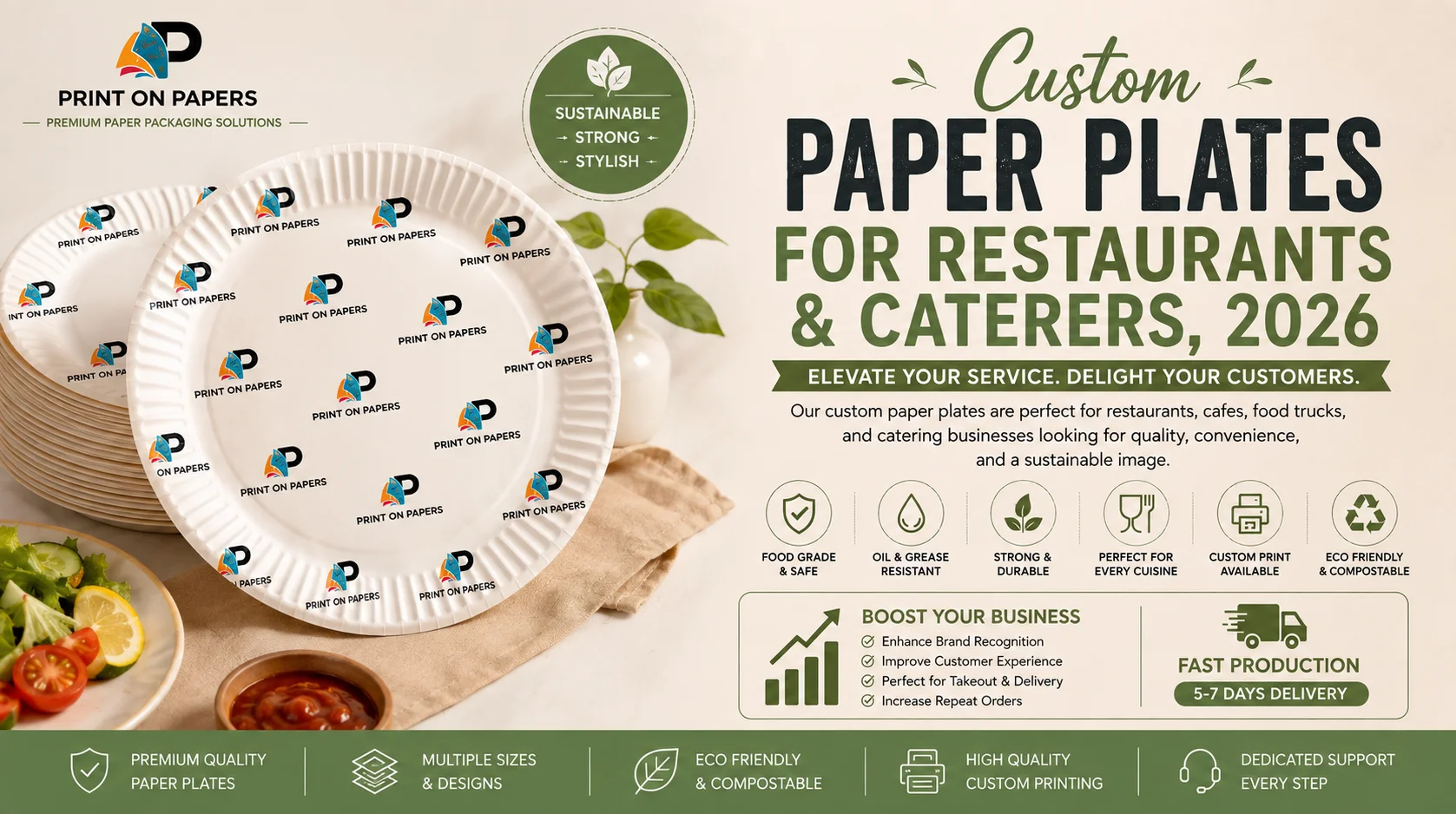
TLDR: A generic plate can quietly undercut a well planned catering menu. Branded, food safe plates fix that by pairing FDA compliant stock with your logo. This guide covers pricing, minimum orders, plate weight, and how to order for events or daily service in 2026.
Custom paper plates are food safe, printed plates that carry a restaurant or caterer’s own logo instead of a blank design. Food service brands order them for two reasons. Events need a plate that looks intentional, and daily service needs a plate that holds up through real food without falling apart or looking cheap.
A branded plate in this category is a disposable plate made from food contact paper stock, printed in a business’s own colors and logo using CMYK or Pantone matched ink. It looks like a plain plate at first glance, then the branding registers, and it reads like a decision rather than a shortcut.
Caterers order these plates for weddings, corporate lunches, and buffet stations, where guests handle the same plate for an entire meal. Restaurants and food trucks order the same category of branded paper plates food service supplies for daily takeout and dine in service, where the plate needs to survive a full meal rather than just a photo. These plates sit inside a wider custom paper line, alongside deli paper and kraft paper, so many buyers order plates as one piece of a bigger weekly supply run rather than as a standalone item.
For events specifically, plates rarely cover the whole presentation on their own. Caterers doing plated dinners or dessert tables often pair plates with custom printed tissue paper for gift boxes or favor stations, so the branding carries through every touchpoint a guest sees, not just the plate itself.
Bakeries and dessert counters usually order a smaller plate size for pastries and cake, while full service caterers order a heavier stock built for plated dinners. The market itself backs up this split by business type. A 2026 industry report from Future Market Insights puts paper based plates at close to half of the entire disposable plates market, with the foodservice industry accounting for more than half of that total demand, ahead of household and retail use combined.
Here is the part most suppliers skip over. A caterer can get the food right, the staffing right, and the linens right, and still hand a thirty dollar plated dinner to a guest on a plate that looks identical to what sits under a gas station hot dog. That mismatch is not really about the plate failing at its job. A plain paper plate holds food just fine, structurally.
The problem is perception, not function. A guest reads the plate before they read what is on it. An unbranded, generic plate quietly resets their expectations downward right as the food arrives, and that first impression is hard to walk back with taste alone, no matter how good the kitchen is. Packaging research backs this up in a measurable way. A peer reviewed study on visual packaging design and brand preference, published in the International Journal of Retail & Distribution Management, found that a diner’s attitude toward the packaging itself directly shapes their perceived quality of the food, and that perceived value carries through into brand preference afterward.
The fix here is not complicated or expensive. Match plate weight to the food being served, since a flimsy plate under a heavy plated dinner reads as cheap no matter what sits printed on the rim. Add a logo, a color matched border, or an event name, so the plate signals it was chosen on purpose. For recurring bookings, the cost of custom printed plates spreads across every future event, which turns a small per unit expense into a repeat brand impression instead of a one time cost that disappears after a single service.
A food safe paper plate has to meet a real, checkable standard, not just a label on a product page. In the United States, that standard is FDA 21 CFR 176, which governs substances allowed in paper and paperboard that touches food directly. A plate built to this standard can carry hot or cold food without special handling, and that’s the same bar every custom paper plate order should be measured against before it ships.
Coatings matter as much as the base paper stock. PFAS free coatings are now a legal requirement in a growing number of states, not just a marketing preference buyers can take or leave. Packaging Dive’s coverage of 2026 state packaging law reports that Maine’s rule banning PFAS in plant fiber food packaging, a category that includes plates, took effect in the middle of 2026, and several other states already have comparable rules active or moving through their legislatures. A supplier that can name the exact regulation, the coating type, and the compliance date is doing more for trust than any general safety claim ever will.
Base paper stock should also carry FSC certification, confirming the pulp traces back to a responsibly managed forest instead of an unverified source. Printing should run on soy based, food grade ink rather than petroleum ink, which keeps any transfer to food well inside FDA limits during normal use.
The paper stock underneath a branded plate and a plain plate is usually identical. What changes is what happens on top of it, and what that does to how a guest actually reads the meal in front of them.
| Feature | Plain Paper Plate | Custom Paper Plate |
| Branding | None | Logo, color, or pattern printed in CMYK |
| Perceived value | Generic, interchangeable | Reads as intentional and brand aware |
| Typical use | One off events, back of house | Recurring events, daily service |
| Minimum order | Usually none required | Custom paper plates wholesale USA food safe no minimum penalty options exist at most suppliers |
| Cost per plate | Lower upfront | Slightly higher, offset by repeat impressions |
Custom printed plates cost more per unit than plain stock, but the gap is smaller than most buyers expect once you weigh it against a single hour of event staffing, or a single photo posted from the table that includes the place setting.
This is one of the most common questions event planners actually search for, and most supplier pages skip past it entirely. For a plated dinner, plan on one plate per course per guest, plus a ten percent buffer for spills or last minute headcount changes. For a buffet, plan on 1.5 to 2 plates per guest, since return trips to the buffet line are the norm, not the exception.
A one hundred guest buffet running two courses usually needs somewhere between 150 and 200 event catering paper plates, not a flat 100 as many first time buyers assume. Ordering slightly over is nearly always cheaper than running short mid service, and most wholesale minimums already make a small buffer close to free anyway.
Ordering follows the same pattern as any other custom food paper order. Minimums typically start at 500 units, and pricing depends on plate size, stock weight, and how complex the printed design is. Most suppliers, including Print On Papers, run wholesale orders with no added penalty for staying at the entry level.
Production usually takes seven to ten working days from proof approval, with rush options available in five to seven days for tighter event timelines. Shipping typically ships free through DHL, FedEx, or UPS, and design support is generally included at no extra charge, so a logo file and a color code are often all a buyer needs to get started.
Plates rarely travel alone in a real food service order either. Fry stations, food trucks, and BBQ counters that stock custom paper plates for plating often need custom fry paper for the same event or daily service. If you are not sure how to size that second order, our guide on how to order fry paper for your kitchen walks through the same minimum order and turnaround questions covered here.
Ready to lock in pricing and a timeline? Get a free quote before your next event date fills up your supplier’s production schedule.
| Question | Answer |
| Are custom printed plates microwave safe? | Most food safe paper plates handle short reheating in a microwave, but check the coating type first, since some wax coated stock is not rated for microwave use. |
| How many paper plates do I need for 100 guests? | Plan for 150 to 200 plates for a two course buffet, or closer to 220 for a plated multi course dinner with a small buffer built in. |
| Can you print a logo on paper plates? | Yes. Custom printed plates print in CMYK or Pantone matched color, usually on one printable side of the plate, sized to stay legible at typical viewing distance. |
| How much do branded plates cost per plate? | Pricing depends on plate size and stock weight, but most orders land close to plain paper plate pricing once the branding cost is spread across the full run. |
| What is the minimum order for custom paper plates? | Most suppliers start at 500 units, with no added penalty for staying at that minimum order level. |
| Are paper plates or plastic plates better for catering? | Paper works well for dry to moderate food and shorter service windows, while plastic tends to hold up better under wet, heavy, or long outdoor service. |
Ready to stop handing guests a blank plate? Send Print On Papers your logo and event date, and get pricing, minimum order details, and a production timeline back within one business day.
A plate is a small object, but it carries a large part of how a guest reads your food. Custom paper plates give food service brands a food safe, checkable way to close the gap between what the kitchen delivers and what the table actually communicates, whether that is a single event or daily service across every location you run. Start with the plate weight your menu needs, confirm the compliance standards behind the coating, and order enough to cover buffet return trips without running short mid service.
Print On Papers is a custom printed paper and wrapping paper company serving restaurants, bakeries, delis, food trucks, butchers, florists, apparel brands and food brands across the US and worldwide. We deliver food-safe, eco-friendly, fully branded custom paper, from your first 500 sheets to your next 500,000