
TLDR
GSM tells you how heavy kraft paper is. It does not tell you how well it blocks grease or moisture. If your custom kraft paper food wrap keeps tearing, bleeding logo ink, or letting sauce soak through, the fix usually isn’t a heavier sheet. It’s matching the right GSM to the food type and checking for a real grease barrier. This guide gives you the GSM ranges by food type, the difference between natural and bleached kraft, and what to check before you place a wholesale order.
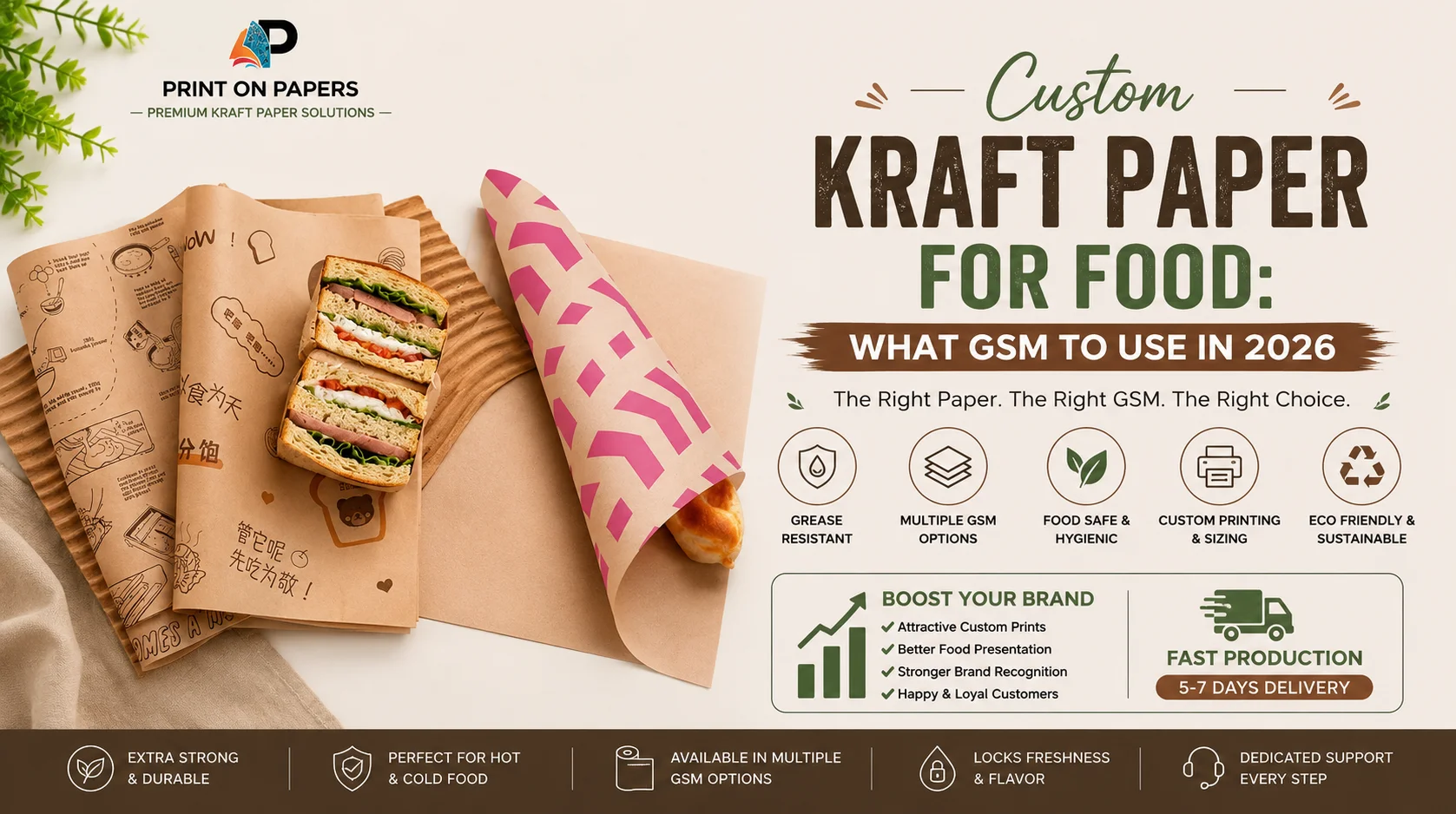
Custom kraft paper food wrap needs a GSM matched to the food, not just a heavier sheet. Light items like pastries work at 25 to 35 GSM. Wet or greasy food needs 40 to 60 GSM plus a grease resistant coating, since GSM alone does not block oil or moisture.
Custom kraft paper food wrap fails for one of two reasons. Either the sheet is too light for the job, or it’s heavy enough but has no grease barrier at all. Most buyers assume GSM solves both problems. It only solves one. This guide walks through the actual GSM ranges by food type, explains why grease resistance is a separate spec, and shows what to check before your next order.
Picture a lunch counter running two items off the same roll of kraft paper. A dry bagel wrapped and handed over fine. Ten minutes later, a sandwich with dressing went into the same paper and soaked through before it reached the customer’s car. Same GSM, same roll, two completely different outcomes. That gap is what this guide fixes.
GSM stands for grams per square meter. It’s a weight measurement, plain and simple. Lay a one meter square of paper on a scale, weigh it, and that number in grams is the GSM. A 30 GSM sheet is light and flexible. An 80 GSM sheet is stiff and holds its shape under a stacked sandwich.
This measurement matters for kraft paper weight food wrapping because it controls how the paper folds, how it survives handling, and whether it tears when someone grabs a wrapped order off a counter. Kraft paper is one of several custom printed papers a food business relies on, and GSM is the first spec worth understanding across all of them. But GSM says nothing about oil, water, or heat resistance. That’s a separate property, and mixing the two up is the single most common mistake buyers make.
Here’s the part most guides skip. A heavier sheet feels sturdier in your hand, so it seems logical that it would also block grease better. It doesn’t work that way. An 80 GSM uncoated kraft sheet will let hot oil soak through in minutes, same as a 40 GSM sheet, because thickness and grease resistance are two unrelated properties.
Grease resistance comes from a coating or a treatment applied to the paper, not from how much the paper weighs. A thin, treated sheet can outperform a thick, untreated one every time a greasy order goes out the door. If your custom kraft paper food wrap has soaked through before, the paper wasn’t necessarily too light. It may have had no barrier at all.
This kraft food wrap GSM guide breaks the choice down by what’s actually crossing the counter, since that’s a better starting point than a generic light, medium, heavy scale.
| Food Type | Recommended GSM | Grease Exposure | Notes |
| Dry baked goods, pastries | 25 to 35 GSM | Low | Light sheet holds shape fine |
| Sandwiches, cold cuts | 30 to 45 GSM | Low to moderate | Add a barrier if mayo or dressing is involved |
| Burgers, tacos, wraps | 40 to 50 GSM | Moderate | Barrier coating recommended |
| Fried chicken, fries, wings | 45 to 60 GSM | High | Barrier coating required, not optional |
| Butcher counter, raw meat | 40 to 90 GSM | Variable | Strength matters more than grease here |
Notice the overlap. A 45 GSM sheet shows up for both burgers and fried chicken, and the difference isn’t weight. It’s whether that sheet has a grease resistant treatment on it. For a full breakdown by food category, see our full kraft paper GSM guide for food businesses.
Kraft paper handles most bakery items well at 30 to 45 GSM, but it’s not the only wrap bakeries reach for. Waxed items, like candy or chocolate dipped pastries, usually need a moisture seal rather than a grease barrier, and that calls for a wax coated sheet instead of kraft. If that’s closer to your use case, our custom wax paper for bakeries guide covers the GSM and coating specifics for that side of the counter.
The paper industry measures grease resistance with something called a Kit rating, tested under a standard called TAPPI T 559. It runs from 1 to 12. Higher numbers mean the paper resists more aggressive oils for longer without staining through. This is the spec that actually answers “will this hold up under fried chicken,” not GSM.
Ask your supplier for the Kit level, not just the weight. A supplier who only quotes GSM and calls the paper grease resistant, without naming a Kit level or a coating type, hasn’t actually told you anything checkable. This one question separates a paper that will perform from one that will fail on your first greasy order.
The natural vs bleached kraft food question comes up constantly, and it’s mostly about appearance, not performance. Natural kraft is unbleached. It keeps its brown color because the wood pulp isn’t processed further. Bleached kraft goes through an extra step that turns it white or near white.
Neither color tells you anything about food safety or grease resistance on its own. Bleached kraft does hold printed logos and fine detail more cleanly, since ink sits better on a lighter, smoother surface. Natural kraft gives a rustic look that a lot of food brands want on purpose. Pick based on how you want the branding to read, then check GSM and coating separately for performance.
Buyers researching custom kraft paper food wrap run into the same three problems over and over.
The first is ordering paper too thin for wet food. A 25 GSM sheet handles a dry croissant fine and then falls apart under a sauced sandwich within the same shift. Match the GSM to the wettest item you’ll actually wrap, not your driest one.
The second is a logo that bleeds or fades through the sheet. This usually isn’t a GSM problem at all. It’s an ink absorption issue on uncoated, lower GSM stock. Moving to a slightly heavier GSM or a coated surface, paired with food safe soy based ink, fixes it in most cases.
The third is ordering paper labeled food safe with no proof behind the claim. A supplier who can’t name a regulation number or a Kit level is asking you to take their word for it. That’s not a spec, that’s a guess with a nicer name.
Yes, when it’s actually built to the standard, not just labeled that way. In the US, paper that touches food falls under FDA 21 CFR 176.170, the federal rule covering paper and paperboard in contact with aqueous and fatty foods. Print On Papers builds every custom kraft paper food order around this standard, not just a passing mention of it.
There’s a second layer buyers often miss. As of 2026, twelve US states restrict intentionally added PFAS chemicals in food packaging, a trend that has moved fast over the past three years. If you sell across state lines, ask your supplier for a PFAS free confirmation in writing, not just a verbal yes.
Look for three things before you order: an FDA 21 CFR 176.170 reference, PFAS free coatings, and FSC certified base paper. Those three, together, are what “food safe” actually means on paper, not just in a sales pitch.
| Question | Answer |
| Does higher GSM mean better grease resistance? | No. GSM measures weight, not grease resistance. A thin, coated sheet often outperforms a thick, uncoated one under oily food. |
| What GSM is best for wrapping sandwiches? | 30 to 45 GSM works for most sandwiches. Add a barrier coating if the filling includes sauce, mayo, or dressing. |
| Is natural kraft paper food safe? | Yes, natural and bleached kraft are both food safe when the base paper and any coating meet FDA 21 CFR 176.170. Color doesn’t change compliance. |
| What is the minimum order for custom kraft paper? | Most US suppliers set a 500 sheet minimum, with wholesale pricing starting around 20 cents per sheet depending on GSM and print complexity. |
| Can custom kraft paper handle wet or saucy food? | Only with a grease and moisture barrier coating. GSM alone, even at 60 or 80 GSM, will not stop liquid from soaking through over time. |
Once you know the GSM and coating your custom kraft paper food order needs, ordering is straightforward. If you searched custom kraft paper wholesale food safe USA 500 sheets to find this guide, that minimum is accurate. Digital printing covers runs up to a few thousand sheets, and offset takes over for larger volumes. Production usually runs 7 to 10 working days after you approve a proof. For a deeper look at ordering custom printed kraft paper wholesale, including proof turnaround and sample requests, see our dedicated ordering guide.
If you want a closer look at how custom kraft paper compares to deli paper for wrapping needs, that comparison is worth reading before you finalize a spec, since the two get confused often. For the paper itself, check current GSM options and pricing on the custom kraft paper product page.
Stop guessing at GSM and start ordering with a spec that actually holds up. Send your food type and print details, and get pricing back the same week.
GSM is the starting point for choosing custom kraft paper food wrap, not the whole answer. Match the weight to how the food will be handled, then check separately for a real grease barrier and a checkable food safety standard. Get both right and the paper stops failing on your busiest shift, not just on the spec sheet.
Print On Papers is a custom printed paper and wrapping paper company serving restaurants, bakeries, delis, food trucks, butchers, florists, apparel brands and food brands across the US and worldwide. We deliver food-safe, eco-friendly, fully branded custom paper, from your first 500 sheets to your next 500,000