
Custom Wax Paper for Bakeries 2026: Pick the Right Coating
Custom Wax Paper for Bakeries 2026: Paraffin, Soy Wax, or Beeswax? TLDR: Paraffin wax paper is cheaper and blocks moisture better, but it comes from petroleum. Soy wax sits in the middle, good for cookies and pastries. Beeswax custom wax paper works best for artisan bakeries that want something compostable and a bit more premium. Pick based on what you actually bake, not just the price per sheet. Table of Contents Why This Decision Costs Bakeries More Than They Think A bakery owner in New Jersey called us last spring, pretty frustrated. She’d switched suppliers to save a few cents a sheet on her croissant wraps. Turned out the new paraffin wax paper was too thin for her morning rush. By 9am the wax had started coming off onto half her pastries, and onto her staff’s hands too. She lost a full tray of product, plus probably an hour of goodwill with the regulars standing in line watching it happen. That’s not some rare story. It’s basically the most common reason bakeries reach out asking us what custom wax paper for bakeries 2026 actually means for them, and which coating fits what they bake. There’s no single right answer here. It comes down to your product, your budget, and how much sustainability actually matters to your customers versus how much it matters on paper. This guide walks through paraffin, soy wax, and beeswax so you don’t end up guessing. What Is Custom Wax Paper for Bakeries 2026, and Why the Coating Matters Custom wax paper for bakeries 2026 starts out as plain kraft paper, either bleached white or left natural brown. A thin wax layer gets pressed into it through calendering, basically heated rollers running the wax evenly across the sheet. That coating is really the whole product. It’s what decides if your paper holds up against moisture, whether it breaks down naturally, and how it actually feels when a customer picks it up. Right now there are three coatings bakeries choose between, and they fall under bakery wax paper types. Paraffin is refined from petroleum. Soy wax comes from soybean oil. Beeswax comes straight from honeycomb. Each one changes how the paper performs, what it costs you, and honestly, what it says about your brand. Under US food contact rules, all three are allowed on food contact paper, covered under 21 CFR 176.170 and 176.180, the federal sections that deal with paper and paperboard touching food. That regulation doesn’t favor one wax over another. It just confirms all three are safe to use. The actual decision is yours, and it should come down to what you’re baking, not which one sounds the most impressive. Paraffin Wax Paper: The Affordable Standard Paraffin wax paper food use has been the industry default for decades now, and honestly there’s a reason it stuck around. It’s a petroleum byproduct, refined down into a wax that’s consistent and resists moisture really well. It’s also cheaper to produce than the other two, so your per sheet cost stays lower. The catch is sustainability. Paraffin doesn’t come from a renewable source, and it won’t compost. Hywax, a material supplier that publishes research on this, found that paraffin coated paper actually contaminates regular paper recycling, since the wax won’t separate cleanly from the fiber when it’s reprocessed. So if your bakery leans into an eco-friendly angle for marketing, paraffin can work against that even though it performs perfectly fine on the counter. Where it still makes sense is anything high volume and moisture heavy. Bread loaves, proofing trays, bulk cookie batches, all of that benefits from paraffin doing its job reliably at a lower cost. Soy Wax Paper for Bakeries: The Middle Ground We get the paraffin vs soy wax paper for cookies and pastries a lot, and soy usually comes out ahead for anything delicate. Soy wax is made from soybean oil, grown widely across US farms, and it’s biodegradable. It also doesn’t carry that petroleum baggage some customers actively try to avoid. As for performance, soy wax paper bakery use holds up fine as long as the item doesn’t sit in heavy moisture for hours on end. Cookies, scones, muffins, individually wrapped pastries, all of that is well wrapped in soy coated paper. It costs a bit more than paraffin, though at wholesale volume that gap is usually pretty small. The environmental side backs this up too. Hywax’s material analysis put plant based waxes, soy included, at roughly 0.35 to 0.56 kilograms of CO2 equivalent per kilogram produced, well below what petroleum extraction and refining costs for paraffin. That’s a real, usable number if a customer asks why your wrap costs slightly more. Beeswax Custom Wax Paper for Artisan Bakery USA Demand Beeswax food paper sits at the top end. It’s fully natural, fully compostable, and has this faint honey smell that fits well with an artisan brand. Beeswax custom wax paper for artisan bakery USA shops tends to show up most at specialty bakeries, farmers markets, and places building a more premium identity. That same Hywax data puts beeswax at the lowest footprint of the three, somewhere around 0.14 to 0.33 kilograms of CO2 equivalent per kilogram. It’s a touch less moisture resistant than paraffin though, so it works better on drier baked goods rather than anything releasing a lot of butter or oil. Cost is really the main tradeoff. Beeswax just doesn’t get harvested at the same scale as soy or petroleum, so the price per sheet runs higher. For bakeries where the premium feel and the story behind it justify that, it earns its place. Paraffin vs Soy vs Beeswax: Quick Comparison Coating Best For Sustainability Relative Cost Paraffin Bread, high moisture items Petroleum based, not compostable Lowest Soy Wax Cookies, pastries, scones Renewable, biodegradable Moderate Beeswax Artisan pastries, premium lines Compostable, lowest carbon footprint Highest Which Coating Fits Your Baked Good The real move here is matching the coating to what you actually bake, not chasing whatever trend feels right.
Custom Greaseproof Paper Wholesale USA, No Setup Fee
Custom Greaseproof Paper Wholesale USA: Order 500 Sheets With Your Logo, No Setup Fees What is custom greaseproof paper wholesale USA no setup fee, in 2026? It is branded, food safe greaseproof paper that small restaurants can order in batches as low as 500 sheets, without paying a separate plate or die charge on top of the per sheet price. The price you see in the quote is the price you pay. TLDR You do not need 5,000 sheets to get your logo on greaseproof paper. Print On Papers prints custom greaseproof paper wholesale starting at 500 sheets, with no setup fee, no plate charge, and pricing that starts at $0.25 per sheet. Every sheet is FDA food contact compliant and FSC certified. Production takes 7 to 10 working days, and shipping is free worldwide. Table of Contents If you run a deli, a food truck, or a small bakery, you have probably gotten a quote that made you close the tab. A $200 setup fee. A 5,000 sheet minimum. Three weeks before you even see a proof. That is the normal experience when you search for custom greaseproof paper wholesale, and it is the exact reason most small food businesses give up and stick with plain paper. This guide breaks down what custom greaseproof paper wholesale USA no setup fee actually costs, why minimums are usually set the way they are, and how a small restaurant can order printed greaseproof paper USA without committing to a warehouse full of paper it does not need yet. Why Setup Fees Exist, and Why Some Printers Skip Them Most commercial printers use a process that needs a physical plate or cylinder made for your design before a single sheet runs. That plate costs money to engrave, and the printer passes that cost to you as a setup fee, usually $100 to $300, charged once per design, sometimes once per color. Digital and flexographic printing on a lighter run does not need that step. The design loads straight from a file. That is the entire reason a custom greaseproof paper wholesale USA 500 sheets minimum order can skip the setup fee altogether. It is not a discount. It is a different production method. At Print On Papers, our custom greaseproof paper runs this way, so the number in your quote is the number you actually pay, with no plate charge added after the fact. The Real Minimum Order Problem for Small Restaurants Here is the part most suppliers will not explain. Large commercial printers set high minimums, often 5,000 to 10,000 sheets, because changing a press from one customer’s job to the next costs them time and wasted stock. They recover that cost by requiring volume. A single deli or food truck owner trying to test a new wrap design gets stuck paying for capacity they will never use. A custom greaseproof paper 500 to 1000 sheets small restaurant order solves a different problem entirely. It lets you test your logo, your colors, and your paper weight against real customer reaction before you commit a few hundred dollars to 5,000 sheets you have not field tested yet. If your current supplier will not go below 5,000, that is a sign of their press economics, not a reflection of what your business actually needs. What You Pay Per Sheet, By Quantity Pricing should not be a mystery you have to request three times. Here is what custom greaseproof paper wholesale typically costs at different order sizes, based on current published pricing. Order Quantity Price Per Sheet Setup Fee 500 to 999 sheets $0.25 to $0.40 None 1,000 to 4,999 sheets $0.22 to $0.30 None 5,000 to 24,999 sheets $0.20 to $0.25 None 25,000+ sheets Custom quote None Greaseproof paper sits in the $0.25 starting tier because it needs a denser cellulose structure than basic kraft paper, without the wax or plastic coating that wax paper uses. That density is what gives it real grease resistance for hot, oily food. Greaseproof Paper Versus Deli Paper, the Real Difference This is the single most common question first time buyers ask, and most product pages answer it badly. Deli paper is lightweight and lightly coated, built for cold or moderately warm deli items like sandwiches. Greaseproof paper has a denser, more compressed cellulose structure that resists oil without any wax or plastic layer, which makes it the right call for hot, greasy food like burgers, fried chicken, and pizza. If you wrap both cold cuts and hot sandwiches, you may need two papers, not one. Print On Papers also produces custom wax paper for moderate heat, moderate grease items like pastries, and custom heat seal paper for sealed wrap applications, so you are not forced to make one paper do a job it was never built for. Is It Actually Food Safe? What Changed in 2025 For years, many greaseproof papers used PFAS chemicals as the grease resistant coating. That changed. In January 2025, the FDA determined that 35 food contact notifications tied to PFAS based grease proofing agents on paper and paperboard packaging were no longer effective, after manufacturers had already stopped selling them, with a compliance deadline of June 30, 2025, for remaining stock. The agency had confirmed a year earlier, in its announcement on PFAS in food packaging, that the move would end the primary source of dietary PFAS exposure from packaging like fast food wrappers and take out paperboard. That means any custom greaseproof paper wholesale USA order placed today should be free of those older PFAS coatings, not because a supplier chose it as a marketing angle, but because the regulation closed that door. Every sheet from Print On Papers meets FDA food contact standards under 21 CFR 176, with PFAS free coatings and FSC certified paper stock sourced from responsibly managed forests. How to Order Custom Greaseproof Paper With Your Logo, No Setup Fee Three steps, start to finish. If you have a logo file ready, request your free quote
Custom Greaseproof Paper: Is It PFAS-Free in 2026?
TLDR: Custom greaseproof paper that’s PFAS-free gets its grease resistance from a dense cellulose fiber structure, not a fluorochemical coating. The FDA confirmed in February 2024 that PFAS grease-proofing agents aren’t sold for food contact use in the US anymore, and by January 2025 it had ruled that 35 related food contact notifications no longer apply. So for your restaurant, PFAS-free greaseproof paper should be the default now, not something you pay extra for, and honestly, you should just ask any supplier to confirm it in writing before you place an order. Table of Contents A health inspector walks into a sandwich shop one afternoon, and she’s not there for the fridge temps. She wants the paperwork on the greaseproof paper sitting next to the register. The owner just blinks at her. Paper needs paperwork now? Nobody ever told him that. It’s a small scene, but it’s happening more often across US kitchens in 2026, and that’s really the whole reason for this guide. What PFAS Actually Are PFAS is short for per and polyfluoroalkyl substances, and people call them forever chemicals for a reason, they barely break down, not in the ground, not in a body. For years, manufacturers leaned on certain PFAS compounds to coat paper food wrap so grease wouldn’t bleed through it. Here’s the catch though. Those coatings don’t just sit there doing their job quietly. They can move into whatever food is sitting on top, and that risk goes up fast when the food is hot or greasy, which, let’s be honest, is most of what ends up wrapped in this kind of paper anyway. What Does “PFAS-Free” Mean on an Actual Roll of Paper? When paper is genuinely PFAS-free, the grease resistance is coming from the fiber itself, not a chemical layer brushed on top. Manufacturers press the fibers tighter during production. That closes off the little gaps oil would otherwise slip through. No fluorochemical anything added afterward. Worth pointing out, because the phrase gets thrown around loosely in marketing copy. A supplier calling something eco-friendly or biodegradable hasn’t actually told you it’s PFAS-free, those are different claims entirely. What actually confirms it is a written compliance statement, and ideally a material safety data sheet to back it up. The FDA’s 2024 and 2025 Rulings, Without the Jargon Here’s the timeline, stripped down. Back in July 2020, manufacturers agreed to voluntarily phase out PFAS grease-proofing agents over a three year window. By February 2024, the FDA said that phase-out was done. PFAS-containing substances were no longer being sold into the US market for grease-proofing on paper packaging. Then January 2025 happened, and the FDA went a step further than just confirming a phase-out. Thirty-five food contact notifications tied to PFAS grease-proofing substances got declared no longer effective, officially as of January 6, 2025. Suppliers had until June 30, 2025 to clear out whatever stock predated that date. So this isn’t a soft suggestion or an industry trend the FDA is nudging along. The approvals that allowed PFAS in this use case are gone. A supplier still pushing PFAS-coated greaseproof paper isn’t just behind the times, they’re outside what’s currently allowed. Is Greaseproof Paper With PFAS Still Safe to Use? Short version: the regulatory door is shut, but old inventory doesn’t just vanish overnight, so it’s on you to actually check what you’re buying. Before that 2024 phase-out wrapped up, independent research had already raised concerns. A peer-reviewed review published in Environmental Science & Technology identified dozens of PFAS compounds across food contact materials including paper packaging, with the majority falling into chemical families linked to known health risks. That research is exactly why the 2024 and 2025 FDA actions carry real weight now, the substances researchers had been flagging are the same ones the FDA has since moved to eliminate from the supply chain. If your current supplier can’t hand you written confirmation that their greaseproof paper is PFAS-free, that gap right there is the actual risk. Not a technicality. Does PFAS-Free Paper Still Stop Grease? This is usually where restaurant owners get surprised. Going PFAS-free doesn’t mean the paper performs worse. What’s happening instead is a tightly packed cellulose fiber structure doing the job a chemical coating used to do. During production, the fibers get pressed more densely, which physically blocks the paths oil would normally travel through. Paper built this way usually sits somewhere in the 25 to 50 GSM range, GSM just meaning grams per square meter, basically how dense and heavy a sheet is. It holds up fine against burgers, fried chicken, pizza, the exact stuff greaseproof paper exists for in the first place. So this isn’t really a tradeoff at all. It’s a different way of solving the same problem, and it works. A Checklist Before You Order Run through this with any supplier, even the one you’ve already been using for years. Why Restaurants Pick Print On Papers for Custom Greaseproof Paper At Print On Papers, every sheet of custom greaseproof paper ships PFAS-free, period, with FDA 21 CFR 176 compliance and FSC-certified stock confirmed in writing before you ever commit to an order. Inks are soy based, and you get a digital proof first, so nothing goes to print until you’ve actually seen and approved your design. Orders start at 500 sheets. That works whether you’re a single shop testing a new logo or running multiple locations placing recurring orders. And if your kitchen deals with high heat applications, sealed wraps, hot sandwiches, that kind of thing, custom heat seal paper is built for exactly that, same PFAS-free standard applied across the board. Still figuring out which paper actually fits your menu? Our guide on what greaseproof paper actually is goes deeper into the material side of things. Frequently Asked Questions Question Direct Answer Is greaseproof paper with PFAS still safe for food? The FDA has ruled that PFAS grease-proofing agents are no longer authorized for sale in the US food contact market as of 2024
How Much Does Custom Printed Food Paper Cost In the US?
How Much Does Custom Printed Food Paper Cost in 2026? TLDR: Custom printed food paper costs between $0.20 and $0.50 per sheet in the USA in 2026. A first order of 500 sheets usually runs $100 to $250, depending on the paper type and how much ink your design uses. Greaseproof and freezer paper sit at the cheap end. Cheese paper and parchment sit at the top because of their coatings. The price drops fast once you order past 5,000 sheets. The real risk to your budget isn’t the per sheet rate, it’s the setup fee that shows up after you’ve already sent your logo. Table of Contents A customer walks up to a food truck window, hands over cash, and gets a sandwich back wrapped in plain paper. Now picture the same sandwich, same price, same five second handoff, but the wrap has the truck’s logo on it. That small swap is the whole reason this guide exists. Most restaurant owners expect a complicated answer when they price this out. It usually isn’t. What actually trips people up is not knowing where the number on their quote comes from. So, What’s the Real Number? Here’s the direct answer. Most US food businesses pay between $0.20 and $0.50 per sheet in 2026. Where you land depends on three things: the paper type you pick, how many sheets you order, and how much ink coverage your design needs. A small bakery ordering 500 sheets of custom butter paper might cost close to $100 total. A regional sandwich chain ordering 30,000 sheets of deli paper might pay closer to $0.30 a sheet once bulk pricing kicks in. I have spent close to thirty years in print and packaging, and I have watched this industry change a lot. Plain brown wrap used to be normal. Now customers expect to see a logo on their food paper, the same way they expect to see one on a coffee cup. What hasn’t changed is how often a buyer gets quoted one number, then ends up paying a different one. So before you request a quote anywhere, it helps to know exactly what moves that number. Why Do Two Quotes for the Same Paper Look So Different? This is the part that confuses almost every first time buyer, and it deserves a real answer instead of a shrug. Say you ask two suppliers for a quote on 1,000 sheets of custom deli paper. One comes back at $0.30 a sheet. The other comes back at $0.48 a sheet. Same paper type, same quantity, wildly different price. Why? The honest reason is usually that the specs were never pinned down the same way on both sides. Print industry buyers run into this constantly, and the pattern is well documented. Paper grade names can mean different things at different mills, even when two suppliers use the exact same word. One supplier’s quote might already include the digital proof, the plate setup, and a basic one color logo. The other supplier’s quote might be the bare per sheet rate, with setup, proofing, and full color printing all billed separately once you actually place the order. Before you compare two numbers side by side, ask each supplier the same five questions. What GSM is the paper. Is the coating included or extra. How many ink colors does this price cover? Is there a setup or plate fee? What is the total cost for the exact quantity you want, not a per sheet estimate. Once you force both quotes to answer the same five questions, the gap usually closes, or it tells you exactly why one supplier is more expensive than the other. What Does Custom Deli Paper Cost Per Sheet in the USA? Custom deli paper price USA generally falls between $0.40 and $0.50 per sheet for a fully branded order at standard volume. You will also see ads claiming $0.03 to $0.05 a sheet, and that gap is worth understanding so it does not confuse your budget. Those low numbers almost always describe plain, unprinted paper, or order sizes in the tens of thousands of sheets, not a 500 sheet custom run with your logo on it. For a shop deciding whether custom deli paper is worth the upgrade from plain stock, the real comparison is not deli paper against deli paper. It is branded paper against the cost of staying invisible at the one moment in the entire order when a customer’s full attention is on what is in their hands. What Will 500 Sheets of Branded Paper Actually Run You? Five hundred sheets is the most common starting order for an independent restaurant, so it is worth working through a real number instead of a vague range. At $0.20 to $0.40 per sheet, depending on paper type, 500 sheets lands somewhere between $100 and $200 before shipping. A more detailed full color design can push that closer to $250. That is a one time cost that puts your logo on every sheet your customers touch for weeks of service. It is not a recurring ad bill that disappears the second you stop paying. According to Fortune Business Insights, the US custom packaging market is on track to reach $16.75 billion in 2026, and food and beverage businesses make up close to a third of total global demand for customized packaging worldwide. That growth is not coming from chains with seven figure marketing budgets. It is independent shops realizing the wrapper touching the food is part of what they are actually selling, not a detail nobody notices. If you run a bakery counter, the same math applies to custom butter paper, and if mornings are your busiest stretch,custom bagel paper follows the same pricing pattern as deli paper, since both are lightweight sheets with similar coating needs. Is Greaseproof Paper Cheaper Than Wax Paper at Wholesale? Greaseproof paper wholesale pricing typically starts around $0.25 per sheet and drops from there as your order grows. This paper resists
Order Custom Printed Food Paper USA | 2026 Guide
Where to Order Custom Printed Food Paper in the USA With Free Shipping (2026) TLDR: If you want to order custom printed food paper USA-wide without rolling the dice on a stranger overseas, look for a US-based supplier with a real street address, a proof-before-print policy, named certifications, and a shipping window under two weeks. Skip anyone who hides their MOQ until checkout. This guide breaks down exactly what to check, how deli paper differs from greaseproof paper, and what a fair price actually looks like in 2026. Table of Contents A deli owner in Ohio emailed me last spring at 11 p.m. She had a grand opening in nine days and had just found out her overseas paper supplier needed three more weeks to ship. That panic is exactly why this guide exists. What Is the Best Way to Order Custom Printed Food Paper in the USA in 2026? The best way to order custom printed food paper USA-wide is to pick a domestic supplier who shows you a digital proof before printing, states a clear delivery window in writing, and does not hide minimum order numbers until you reach checkout. That combination protects your launch date and your budget at the same time. Most people searching for where to order custom printed food paper online in the USA start in the wrong place. They search for “best supplier” and expect a tidy list. But a list does not protect you from the thing that actually goes wrong, which is picking a supplier who looks fine on the homepage and falls apart at week three. The Three Real Risks Behind This Search If you have typed some version of “order custom printed food paper USA” into Google recently, you are probably sitting on one of three worries. Reviews can be bought. Logos claiming certification can be pasted on without a real notification on file. You need a way to check, not just a claim to trust. A lot of “custom paper supplier US” listings are actually drop shippers routing through factories overseas. That means six to eight week waits are common, and tracking is often vague until the package lands on a boat. Plenty of sites advertise free shipping in bold letters, then bury a $500 order minimum in the fine print. That is not free shipping. That is a discount disguised as one. Every section below answers one of these three fears directly. What Makes a Custom Food Paper Supplier Reliable in the US A reliable printed food paper supplier gives you four things without you having to ask twice: a real US address and phone number, a digital proof you approve before anything prints, named food safety certifications you can verify, and a written delivery window instead of a vague “soon.” Run this quick check before you commit: That last point matters more than people think. A supplier’s Google Business Profile tends to be harder to fake than testimonials pasted on a homepage. How Fast Should Delivery Actually Be? For order custom printed food paper USA 7-10 days delivery searches, the honest answer is that production typically takes five to seven working days after you approve your proof, and tracked shipping through carriers like DHL, FedEx, or UPS adds a few more days depending on your location. Anything advertised as instant is almost always either a stock design with no real customization, or a promise that quietly slips once you are mid-order. Compare that to overseas freight. A shipment crossing an ocean, clearing customs, and reaching a US business commonly takes three to six weeks, sometimes longer if customs flags the shipment. If your opening date is fixed, that gap is not a small detail. It is the difference between wrapping your first sandwich in branded paper or in plain white paper while you wait. Do You Need a 500 Sheet Minimum? Searches for best custom food paper supplier USA 500 sheets minimum usually come from small operators worried they will be forced into a huge order just to get branding on their paper. The reality among US-based custom printed papers wholesale suppliers varies a lot. Some genuinely have no minimum and will print a small test batch. Others quietly require thousands of sheets and only mention it after you fill out a form. Ask for the minimum in writing before you share a logo file. A supplier comfortable with smaller first orders, then offering better per-sheet pricing as your volume grows, is usually the more honest one. That structure rewards loyalty instead of punishing a new business for starting small. Order Size Typical Use Case What to Expect Under 1,000 sheets New restaurant, single location, testing a design Higher per sheet cost, faster decision-making 1,000 to 10,000 sheets Established deli or bakery, repeat ordering Better per sheet pricing, standard 5 to 7 day production 10,000+ sheets Multi-location or franchise Wholesale pricing, may need advance scheduling Custom Deli Paper vs Greaseproof Paper: Which Should You Order? This comparison comes up constantly, and most explanations online overcomplicate it. Feature Deli Paper Greaseproof Paper Best for Sandwiches, cold cuts, bakery items Burgers, fries, oily or fried foods Grease resistance Moderate, via light coating High, dense fiber structure Heat tolerance Lower Higher, holds up to warm food Typical use setting Quick service, eat in soon Takeout and delivery, longer hold time If your menu leans toward fried or oily items, greaseproof paper holds up longer. If you are wrapping sandwiches that customers eat within minutes, custom deli paper free delivery options are usually the more cost-effective pick. How to Order Custom Printed Food Paper Online in the USA This is also where it pays to keep things simple. Print On Papers is a US-based custom paper supplier built around exactly this kind of order, with Custom Hot Paper suited to fried and oily menu items, and Custom Kraft Paper for a more rustic, eco-forward wrap. Frequently Asked Questions How do I know if a custom food paper supplier is
Custom Deli Paper vs Greaseproof Paper: 2026 Guide
Custom Deli Paper vs Greaseproof Paper: What’s the Real Difference for Your Restaurant? TLDR: Pick deli paper for cold wraps, pastries, and sandwiches. Pick greaseproof for burgers, fried chicken, and anything served hot with visible oil. Order the wrong one and you will know it the hard way, usually during your busiest hour. Table of Contents 1. The Paper Problem Nobody Warns You About Here is something most food business owners only figure out after it goes wrong. A restaurant owner in a busy New York deli told me this story. She switched paper suppliers to save three cents per sheet. Two weeks later, a customer posted a photo online. The greasy handprint on the wrap was front and center. Twenty-two people shared it. She called us the next morning. That three-cent saving cost her something no spreadsheet could calculate. Food packaging decisions feel small until they are not. The global food contact paper and board market hit USD 64.2 billion in 2024, per IMARC Group’s Food Contact Paper Market Report, growing at 4.8% annually. Restaurants are buying more printed food paper than ever. But a surprising number are still buying the wrong type because nobody sat them down and explained the actual difference between deli paper and greaseproof paper. That is what this guide does. 2. What Is Custom Deli Paper? (2026) Deli paper is a food-grade wrap made from kraft fiber, either bleached white or left in its natural unbleached brown. This gets either a wax coating or a light poly coating to push back moisture and surface grease. It is thin, and it folds cleanly. It tears easily. Busy counter staff love it. Cold turkey subs, cheese slices, croissants, bagels, and pastries all wrap well in it. The surface is smooth enough to take sharp logo printing. CMYK and Pantone colors come out clean. For any food business that wants to stop using plain white paper and start building a brand at the counter, custom deli paper is where most of them start. Here is the honest truth about its limits though. Press a hot, greasy burger into deli paper and wait ninety seconds. The oil migrates through. That is physics, not a manufacturing defect. 3. What Is Greaseproof Paper? (2026) Greaseproof paper does not rely on a coating at all. It is built differently from the ground up. During manufacturing, the cellulose fibers get beaten down and super-calendered, which means they are pressed together under heavy rollers until the sheet becomes so dense that oil molecules cannot pass through the gaps. No wax. No plastic film laminate. Just compressed fiber. That structure holds up against direct oil contact at temperatures well above 80°C. Fried chicken, beef patties, pulled pork with sauce, hot fries sitting in a basket liner, all of it stays contained. The food stays fresh and your customer’s hands stay clean. The FDA regulates food contact materials under 21 CFR Part 176. Custom greaseproof paper from a certified supplier meets those standards. One thing to check before you order anywhere: in February 2024 the FDA moved to phase out PFAS, the chemical compounds previously used to boost grease resistance. Responsible suppliers now use PFAS-free formulations. If your current supplier cannot confirm this, that is worth a conversation. 4. Custom Deli Paper vs Greaseproof Paper: Side-by-Side Breakdown Here is the food paper comparison USA restaurant operators keep asking for. Feature Custom Deli Paper Greaseproof Paper Grease Resistance Surface moisture, light grease only Heavy oils, fats, hot sauces Heat Tolerance Up to 60°C (wax variant) Stable above 200°C Best Menu Fit Cold subs, pastries, bagels, deli meats Burgers, fried items, hot wraps Print Sharpness Excellent, smooth surface Good, slight texture Starting Cost From $0.25 per sheet From $0.40 per sheet FDA Compliance Yes Yes, confirm PFAS-free Eco Credentials FSC-certified options Biodegradable, PFAS-free options Logo Printing Yes Yes One comparison that confuses people is deli paper vs wax paper. They are related but not identical. Wax paper is one type within the deli paper category. It uses paraffin for moisture resistance and cannot go near heat. Deli paper also comes in poly-coated variants that handle slightly more grease. Greaseproof paper is a separate product entirely, built through fiber compression rather than any surface coating. 5. Which Paper Fits Your Restaurant Type? Best Paper for Burger Restaurants and Hot Food Counters If your kitchen produces burgers, fried chicken sandwiches, hot burritos, or anything with visible grease on the surface when it leaves the line, greaseproof is the call. No question. For custom deli paper vs greaseproof paper for burger restaurant USA operators, the answer is greaseproof every time. The price difference per sheet is real. A soaked-through wrap in a customer’s hand is more expensive. Best Paper for Sandwich Shops and Delis Cold subs, room-temperature wraps, deli meat platters, cheese boards, and bagels all live comfortably in deli paper. The difference between deli paper and greaseproof paper for sandwich shop owners is simple: if the food is cold or dry when wrapped, deli paper handles it at a lower cost with sharper printed branding. Bakeries, Pastry Shops, and Cafés Baked goods need to breathe a little. Trap too much moisture and that croissant crust turns soft. A light-coated deli paper lets just enough air through to keep texture intact while still protecting against butter and oil from laminated pastries. Food Trucks and Pop-Ups Most food trucks run both types, and that is the right move. Hot, greasy items get greaseproof. Cold wraps, sides, and bread-based items get deli paper. Print On Papers prints both with matching brand colors so everything looks like it came from the same kitchen, because it did. 6. Before You Place Your Next Paper Order, Read This Most ordering mistakes happen because the buyer never matched the paper to the actual food temperature and grease level. Run through these five checks before confirming any order. First, name your greasiest menu item and what temperature it hits the wrap at. Second, ask your supplier
What Is Custom Printed Paper? Guide for US Food Businesses (2026)
What Is Custom Printed Paper? A Complete Guide for US Food Businesses (2026) TLDR: Custom printed paper is food-safe wrapping paper branded with your logo, colors, and design. Sheets start at $0.20 each, minimum orders begin at 500 sheets, and most shipments arrive within a week. No designer, big budget, or packaging experience needed. What does a first-time customer see when they pick up their order from your counter? If the answer is a plain white wrapper or a generic brown bag, you are handing someone your product inside packaging that could belong to any business on the block. That is the gap custom printed paper fills. This guide covers what it is, how to make sure it is food-safe, what it costs, and how to order without the headaches. What Is Custom Printed Paper? Custom printed paper is a type of branded food packaging specifically, food-safe wrapping paper printed with your business logo, brand colors, and design, made for direct food contact. It does the same protective job plain deli paper or butcher wrap does blocking grease, moisture, and contamination but it doubles as a branding surface every time a customer picks up, unwraps, or photographs their order. The global custom packaging market hit $48.17 billion in 2025, with food and beverage businesses driving nearly a third of that demand at 32.67%, according to Fortune Business Insights. That growth is not coming from massive chains. It is being pushed by independent operators who figured out that the paper touching the food is part of the experience they are selling. How Is It Different from Regular Wrapping Paper and Is It Actually Food-Safe? Regular wrapping paper was never engineered for food contact. The base material, coatings, and inks were not tested against hot oil soaking through or a warm wrap sitting in a bag for twenty minutes. Custom printed food paper is built differently at every layer. The base paper is selected for the food type greaseproof for fried items, breathable wrap for cheese, moisture-resistant wax paper for sushi. The inks are food-grade, typically soy-based or water-based formulations meeting FDA standards. And the coatings are chosen for safety and function, not appearance. In the US, any paper contacting food must comply with FDA 21 CFR Part 176, the federal regulation governing paper and paperboard in food contact applications. It covers three components independently: the base material, coatings, and inks. All three have to clear the standard. A supplier using FDA-compliant paper but printing with non-compliant inks is not selling you a food-safe product. Also look for FSC certification on the raw paper stock and confirm any grease-resistant treatments are PFAS-free. If a supplier cannot provide these in writing before you order, keep looking. Types of Custom Printed Paper for US Food Businesses Choosing the right paper is about matching the material to the food it will touch. Each type is best for a specific use case, and picking the wrong one means wasted money or poor performance. Paper Type Best Use Case GSM Range Food Safety Eco Credentials Custom deli paper Sandwiches, wraps, cold cuts 30–45 GSM FDA compliant FSC certified Greaseproof paper Burgers, fries, fried items 25–50 GSM PFAS-free Biodegradable Wax paper Moisture-heavy items, sushi 30–60 GSM Soy-wax options Compostable Kraft paper Butcher use, heavy wrapping 40–160 GSM FDA compliant Unbleached available Freezer paper Meat, seafood, cold storage 57–65 GSM BPA-free PE coat Recyclable Cheese paper Specialty cheese, artisan deli 40–70 GSM Breathable coating FSC certified Parchment paper Baking liners, bakery service 40–60 GSM Silicone coated Compostable If you run a sandwich shop or deli counter, custom deli paper is the best option to start with, it handles cold cuts and wraps without moisture bleed, and it is the most commonly ordered custom food packaging option for US restaurants. Our complete guide to custom sandwich paper for food businesses covers GSM weights, printing options, and order quantities in detail. If your menu is heavy on fried food, custom greaseproof paper is the best choice for burgers, fries, and anything cooked in oil. Our complete greaseproof paper guide covers everything from fiber density to real-world performance. For bakeries, parchment paper doubles as both a baking liner and a branded presentation layer. Butcher shops should look at kraft paper for heavier cuts and freezer paper for cold storage. And cheese paper is a smart pick for specialty delis, it lets cheese breathe while retaining moisture, something generic wrap works against. Who Is Actually Using Branded Food Paper Right Now? Branded food paper is not a chain restaurant play. The operators leaning in hardest are independents, food truck owners, cafe owners whose customers photograph everything, deli counters competing against grocery store branding, butcher shops building neighborhood loyalty, and bakeries where the unboxing moment is part of what people pay for. Hospitality and cafe businesses are the fastest-growing segment in US food service packaging, expanding at a 6.18% CAGR according to Mordor Intelligence outpacing even quick-service chains. Will customers consciously notice your branded wrap? Not always. But they register the difference between plain paper and something with a name on it. Where it really pays off is social media, when a customer photographs their food and your branding is visible, that is free advertising you never had to create or boost. How Much Does It Actually Cost in 2026? Custom tissue paper starts at roughly $0.20 per sheet. Greaseproof runs around $0.25. Deli paper, wax paper, and kraft paper fall in the $0.30 to $0.40 range. Specialty items like cheese paper start closer to $0.50. Minimum orders start at 500 sheets, a realistic first run for a small sandwich shop, not a warehouse-sized commitment. To put that in context: if you serve 50 customers a day at $0.35 a sheet, that is $17.50 a day — $122.50 a week. For that, your name is on every item leaving your counter. Compare that to what even a modest Instagram ad costs for a week of visibility that vanishes when you stop paying. Custom
Best Custom Food Wrapping Paper for Restaurants: Complete Buyer’s Guide (2026)
Picture this. A customer walks into your deli, orders your legendary turkey club, and watches you wrap it in plain white paper. No logo. No color. Just… paper. Then the customer two doors down ordered the same sandwich, honestly not as good, and they handed their food over in beautifully branded custom deli paper stamped with their logo and tagline. Guess which one ends up on Instagram that afternoon. This guide is for every restaurant owner, food truck operator, bakery founder, and deli manager who is tired of letting plain packaging undersell premium food. Custom food wrapping paper is one of the most cost-effective branding upgrades in the food service industry, and by the end of this buyer’s guide, you’ll know exactly which type to choose, what to look for, and how to get it done right. Why Custom Food Wrapping Paper Is No Longer Optional The numbers tell the story plainly. According to industry research, 75% of restaurant traffic in the US now comes from off-premise channels, such as takeout, delivery, and drive-thru. That means the first physical thing most customers interact with is not your interior décor or your staff’s smile. It’s your packaging. And then there’s social media. Studies show that nearly 70% of millennials photograph or video their meals before eating them. Every order that goes out in plain paper is a missed branding opportunity, a moment where your logo could have been in someone’s Story and wasn’t. Custom food wrapping paper changes that equation. It turns every wrapped sandwich, every basket of fries, every bakery item into a small billboard for your brand. And unlike a Facebook ad that disappears in 24 hours, branded packaging travels with your food to offices, parks, car seats, and kitchen tables across your city. What Is Custom Food Wrapping Paper, Exactly? Custom food wrapping paper is food-grade, FDA-compliant paper printed with your restaurant’s branding, your logo, colors, tagline, or pattern designed to replace generic white or brown paper in your everyday operations. All food-contact paper used in the US must comply with regulations set by the U.S. Food and Drug Administration (FDA), which governs what materials, coatings, and inks can legally touch food. Reputable suppliers like Print On Papers use only soy-based, water-based, or food-safe inks that meet or exceed these standards, so you get a branded product without compromising your customers’ safety. Beyond safety, quality custom food paper is: The 6 Most Popular Types of Custom Food Wrapping Paper Not all paper is created equal, and choosing the right type depends entirely on what you’re wrapping. Here’s your quick-reference breakdown: 1. Custom Deli Paper: The sandwich shop staple. Lightweight, flexible, and ideal for wrapping subs, hoagies, and cold cuts. Holds print beautifully and gives your brand that classic, nostalgic deli feel. 2. Custom Butcher Paper Thicker and more durable, built for wrapping raw or cooked meats at the counter. Butcher shops, BBQ restaurants, and artisan meat counters love it for its rugged, handcrafted aesthetic. 3. Custom Wax Paper Grease-resistant by design. Perfect for burgers, fried foods, and anything that produces oil or moisture. Available in white or kraft brown, it pairs well with bold full-color logos. 4. Custom Parchment Paper The bakery and patisserie go-to. Non-stick surface, excellent print quality, and a premium look that communicates artisan quality the second a customer opens their box. 5. Custom Basket Liners A fast casual and food truck essential. Lines, baskets, and trays absorb grease and give even the most casual meal a polished, branded presentation. 6. Eco-Friendly Custom Paper: Increasingly, customers are choosing restaurants that share their environmental values. According to the FSC Global Consumer Recognition Study (Ipsos × FSC, 33 countries), 63% of consumers try to buy products packaged with renewable materials, and 66% expect companies to ensure their paper products are not contributing to deforestation. Forest Stewardship Council PFAS-free, FSC-certified paper lets your brand communicate responsibility without sacrificing design. How to Choose the Right Custom Food Paper for Your Restaurant What Does Custom Food Wrapping Paper Actually Cost? The cost per sheet drops significantly with volume, but even small runs are accessible: Here’s the ROI math that most food business owners overlook: a single sheet of branded custom deli paper costs a fraction of a cent more than plain paper but it delivers a branded impression to a customer who may photograph, share, or simply remember your restaurant because of it. Compare that to a paid social media impression, and the packaging wins on value every time. Design Tips That Actually Work Ready to Make Every Order Count? Let’s Print Your Brand. You’ve already built something worth being proud of. Your food is good. Your team works hard. Your regulars keep coming back. Now it’s time for your packaging to work just as hard. At Print On Papers, we help independent restaurants, delis, bakeries, food trucks, and catering businesses across the US replace forgettable packaging with branded custom food wrapping paper that turns every meal into a marketing moment. With 24 paper types, food-safe inks, fast 5–7 day turnaround, and digital proof approval before every run, we make it simple, professional, and priced for small businesses. Get your free quote today → Frequently Asked Questions About Custom Food Wrapping Paper Is custom food wrapping paper food safe? Yes, when ordered from a reputable supplier. All food-contact paper in the US must comply with FDA regulations (21 CFR 176), which govern the inks, coatings, and materials that can safely touch food. Look for suppliers using soy-based or water-based food-safe inks, and always confirm FDA compliance before ordering. What is the minimum order quantity? It varies by supplier. Many professional printers offer runs starting at 500–1,000 sheets, which makes custom food paper accessible even for small independent restaurants and food trucks. Avoid suppliers who insist on massive minimums if you’re just starting out. How long does it take to receive my custom food paper? Most reliable suppliers work on a 5–7 business-day turnaround after you approve your digital proof.
What Is Greaseproof Paper? The 2026 Sandwich Packaging Guide for Food Businesses
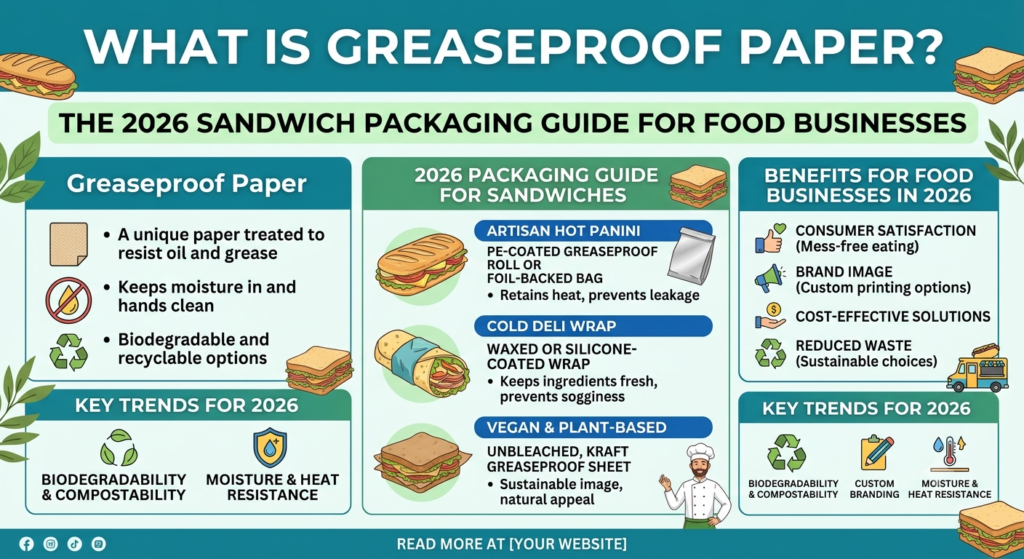
I’ve talked to hundreds of deli owners, sandwich shop managers, and food truck operators over the years. One complaint comes up almost every single time. Their food is good. Their service is fast. But the moment a customer picks up that sandwich and the wrapper starts soaking through, greasy and translucent before they even get to the car something breaks. Not the food. The impression. Here’s the thing nobody tells you when you’re sourcing packaging: that moment is entirely preventable. And fixing it does not require spending a fortune. What Is Greaseproof Paper and Why Does It Matter in 2026? Greaseproof paper is a food-grade, grease-resistant sheet made from 100% virgin wood pulp, produced through supercalendering a process that compresses paper fibres under high pressure, closing the pores naturally without fluorochemical coatings. It ranges from 30 to 60 GSM and meets FDA 21 CFR standards for direct food contact. Why does that manufacturing detail actually matter to you right now? Because the U.S. Environmental Protection Agency’s PFAS restriction roadmap is actively pushing food packaging away from fluorochemical treatments. Businesses still running PE-coated or PFAS-treated papers are going to face compliance headaches sooner than they expect. According to The FDA’s full guidance on PFAS in food contact packaging is publicly available here if you want to read the specifics yourself. It naturally produced barriers like supercalendered greaseproof paper to represent the compliant path forward. So switching is not just a brand decision. For many food businesses, it is going to be a regulatory necessity. Why More Sandwich Shops Are Choosing Custom Sandwich Wrapping Paper Walk into any independent sandwich spot that’s grown a loyal following in the last three years. Almost all of them have one thing in common: their packaging looks intentional. Custom printed sandwich wrapping paper is not something they added after they got big. It’s something that helped them get there. The numbers back this up. A Dotcom Distribution packaging study found that nearly 40% of online shoppers had shared an image or video of a product on social media, with branded packaging playing a direct role in that decision. Run 200 covers a day and you are looking at potentially 80 organic brand impressions daily generated at a per-sheet cost somewhere between $0.20 and $0.50. Most restaurant owners spend more than that on a single Instagram ad that disappears in 24 hours. You can read the full Dotcom Distribution packaging findings here.PRWeb Beyond the social angle, brand consistency matters operationally too. When every member of your team wraps a cold sub, a toasted panini, or a deli club with the same custom printed sandwich paper, your customers start to associate that visual with quality. That association builds repeat business. It is that straightforward. At Print On Papers, our custom greaseproof paper is printed using soy-based food-safe inks with full CMYK and Pantone color matching so your brand color is exactly right, not approximately right. Choosing the Right Grease Resistant Paper for Your Sandwich Type Not all sandwich packaging needs are the same, and picking the wrong paper GSM is one of the most common and easily avoided mistakes in food service. For hot sandwiches and toasted wraps, you need paper that holds up under both heat and moisture pressure simultaneously. Our sheets handle temperatures up to 220°C. For something wet and heavy, a pulled pork sub, a meatball wrap, and a 40 GSM supercalendered sheet performs completely differently than a 28 GSM budget option. In our production testing, the 40 GSM holds a standard oil-heavy filling for over 45 minutes with zero visible grease penetration. The 28 GSM shows through in 12 to 15 minutes. That difference is what your customer feels in their hands. Cold deli applications are a different story. For cold cuts, layered club sandwiches, and cheese-based builds, a lighter 30 GSM works well and keeps your per-unit cost sensible. Our custom deli paper is built specifically for that end of the menu. Then there are pressed and toasted sandwiches, paninis, cubanos, grilled wraps. These go through compression and direct heat at the same time. Standard greaseproof paper can open and lose the wrap under that pressure. Our custom heat seal paper solves that problem. The seal holds through the press. Matching your paper to your actual menu saves money and prevents the kind of packaging failure that lands on Google reviews. FSC-Certified and PFAS-Free: What This Actually Means for Your Business Sustainability language has become so overused in packaging that most buyers tune it out. So let me be specific rather than vague. FSC chain-of-custody certification, as defined by the Forest Stewardship Council, tracks paper from a responsibly managed forest through every step of production to the finished sheet in your kitchen. It is an audited supply chain standard, not a self-declared claim. Every greaseproof paper product from Print On Papers carries that certification. PFAS-free means no per- and polyfluoroalkyl substances were used in manufacturing. This matters because PFAS compounds have been linked to environmental persistence and human health concerns, and U.S. regulators are moving to restrict them in food packaging. Our paper achieves grease resistance through the supercalendering process itself — not through chemical treatment applied after the fact. Combined with soy-based food-safe inks, your custom printed paper sandwich bags carry certifications your customers can actually look up and verify. For eco-conscious buyers in your base, that is not a minor detail. Food Wrapping Paper: More Than Just Sandwich Applications Greaseproof paper handles your sandwich line but the same food-grade paper works across basket liners, tray covers, baked goods wrapping, and charcuterie presentation. Many of our clients start with sandwich wrap and expand their order once they see how the print quality holds up across different kitchen conditions. If you want to explore how custom food wrapping paper can work across your full menu, click here to read more about our food wrapping paper solutions. Conclusion: The Wrapper Tells Them Who You Are Greaseproof paper is not a line item to
Food Wrapping Paper Benefits for Restaurants and Takeaways
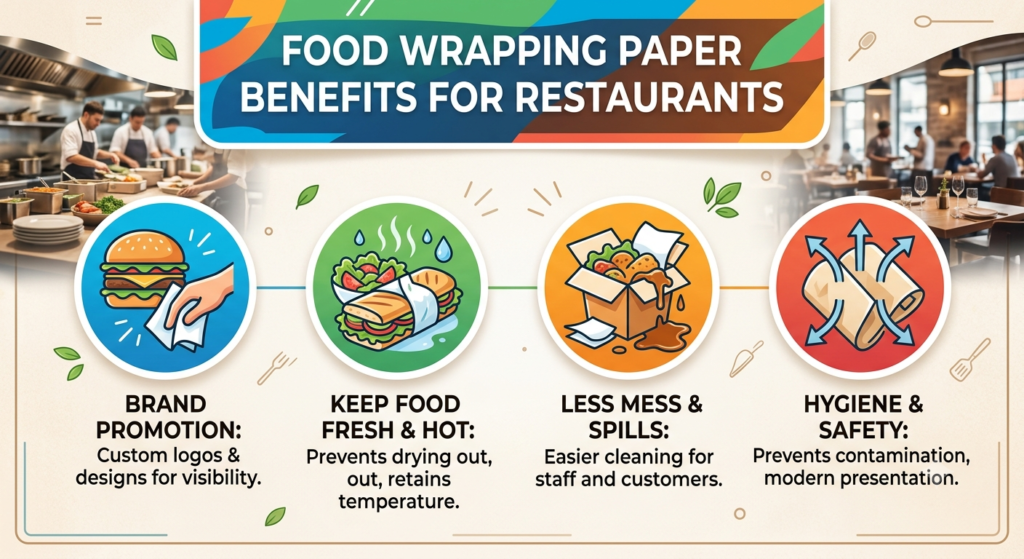
Food wrapping paper is a food-safe, grease-resistant sheet restaurants and takeaways use to wrap and serve food directly to customers. It meets FDA food-contact standards and comes in custom-printed formats that turn every order into a brand moment. Why Your Food Wrapping Paper Tells a Story Before the First Bite Last year, a sandwich shop owner in Brooklyn told us something we have heard dozens of times: “My food is the best on the block. But my packaging looks like every other deli in the city.” That one sentence captures a problem thousands of restaurants are sitting with right now. When a customer picks up their order, they touch the wrapping before they taste the food. That paper is your handshake. It is either saying something about your brand or it is saying nothing at all. Plain white packaging says nothing. Worse, it is generic. The National Restaurant Association’s 2025 Off-Premises Restaurant Trends Report found that 90% of off-premises customers would order a wider variety of items if restaurants used better packaging. Nine out of ten. That is not a marginal improvement opportunity that is a near-universal signal from your existing customer base telling you what they want. Restaurant industry sales in the US are tracking toward $1.5 trillion in 2025. The market is enormous, but so is the competition. The restaurants building loyal repeat customer bases right now are winning on experience, and food wrapping paper is one of the cheapest experience upgrades available. The Business Case Nobody Talks About: Retention Over Reach Most restaurant marketing conversations focus on getting new customers through the door. That is the wrong conversation to start with. Your packaging talks to people who are already buying from you. Every takeaway order is a retention opportunity disguised as a logistical necessity. A customer who unwraps a beautifully printed, branded sandwich wrap goes home with a different memory than someone who unwraps a plain sheet. Shorr Packaging surveyed 2,016 American consumers in late 2024. They found 90% of shoppers are more likely to buy again from brands with eco-friendly packaging. More than half reported actively seeking out sustainable packaging options in the previous six months. Among younger buyers Millennials and Gen Z specifically those numbers were even higher, at 59% and 56%. Your takeaway customers are in those demographics. They notice what you wrap your food in. And frankly, they are judging it. Here is the practical translation: a restaurant owner who upgrades from plain paper to custom-branded, food-safe takeaway wraps is not spending more on marketing. They are making their existing orders do marketing work for them. That is a different kind of leverage. Choosing the Right Type of Food Wrapping Paper for Your Menu Not every paper works for every kitchen. Getting this wrong costs you food quality before the customer even opens the bag. It is the standard for burgers, hot sandwiches, and anything fried. Its dense fiber structure blocks grease without a wax coating, so hot food stays clean and dry without sticking. It handles heat well and keeps presentation sharp on delivery orders. It is the right call for bakeries, artisan delis, and brands with a handcrafted identity. The natural texture photographs well. It has that premium, heritage feel that premium-priced food needs to justify itself visually. It suits cold deli items and cheese-heavy subs where moisture control matters more than heat resistance. For kitchens that pre-portion proteins and work with cold storage, Custom Freezer Paper solves a problem most operators do not think about until it costs them. It is moisture-resistant, food-safe, and fully printable meaning your brand stays consistent even in the walk-in cooler. Bakeries working with pastries, croissants, and high-butter items should look at Custom Butter Paper. It handles direct food contact with fatty items without compromise, and it carries print just as well as any other format. The right choice comes down to what you serve, at what temperature, and what your brand needs to communicate. There is no single answer. But there is always the wrong one and plain, unbranded paper is almost always it. Food-Safe Paper and Compliance: What Every Restaurant Owner Should Actually Know Food safety is not a box to tick. It is the foundation of customer trust. Every paper that touches food in your restaurant needs to meet FDA 21 CFR standards for food-contact materials. That covers the base paper, the inks, and any coatings. What this means practically: the chemistry of your wrapping cannot transfer into your customer’s meal. At PrintOnPapers, soy-based inks are standard across every product. They are non-toxic, food-safe, and cleared for direct food contact. All materials are PFAS-free which is becoming a legal requirement in a growing number of US states as regulators close in on per- and polyfluoroalkyl substances. Paper sourcing is FSC-certified, which means the raw material comes from responsibly managed forests. When a health inspector walks through your kitchen or a customer looks you up online, these certifications are what protects your reputation before you say a word. What Eco-Friendly Packaging Is Actually Worth to Your Business in 2026 Sustainability has moved from a nice-to-have to a customer expectation. The numbers make this hard to argue against. Mintel’s 2025 US Food Packaging Trends Report put it plainly: packaging has become a signal of a brand’s values, not just its logistics. For a takeaway owner, eco-conscious custom food packaging FSC-certified, PFAS-free, compostable-friendly is a genuine point of difference you can lead with. You put it on your menu, your social posts, and your packaging itself. That is a marketing message that costs nothing beyond the paper you were already buying. Custom Sandwich Paper: The High-Frequency Brand Touchpoint Most Restaurants Ignore If you run a deli, a fast-casual spot, a café, or a sandwich chain, pay attention to this section. Custom Sandwich Paper is the most frequently used branded item most food businesses will ever have. Every order, to every customer. Every single day. No other marketing asset touches that frequency at that cost