
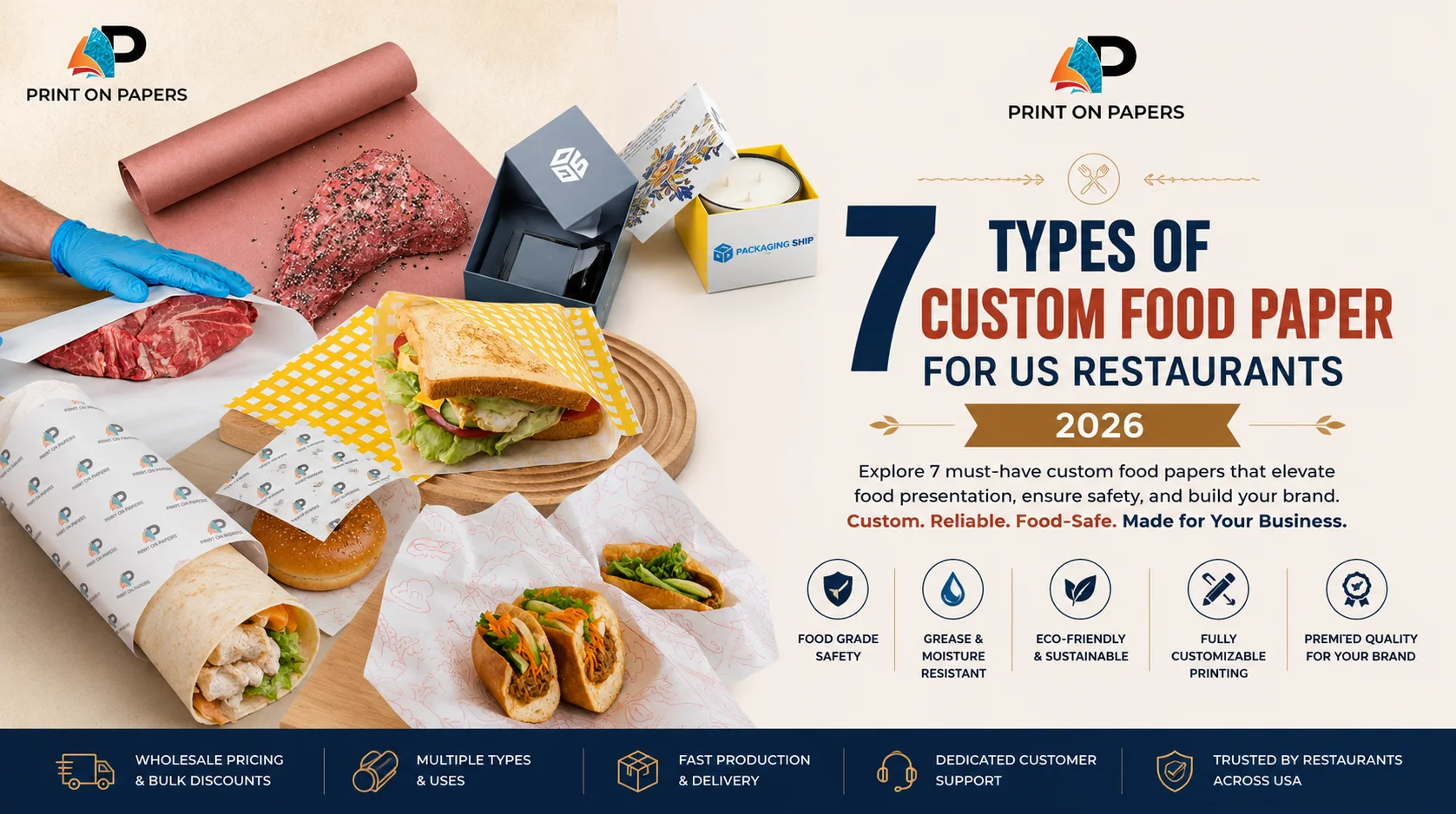
TLDR: Custom food paper is not one product. It is seven, and each one is built for a different job in your kitchen. This guide breaks down deli paper, greaseproof paper, butcher paper, freezer paper, wax paper, parchment paper, and fry paper, with clear rules for when to use each one. You will also learn what FDA compliance actually means for the paper touching your food, and how to order without wasting money on the wrong type.
A sandwich shop owner in Ohio ordered 2,000 sheets of custom wax paper last year for a new burger line. Good price. Fast turnaround. Logo looked sharp on the proof. Three weeks later, grease was soaking straight through onto the serving trays, customers were getting oily fingers before they even unwrapped the burger, and 1,400 sheets were still sitting in the back room.
That is not a paper problem. That is a wrong paper problem. Custom food paper is not one product with different logos on it. It is seven distinct materials, each built for a different job, and picking the wrong one is an easy, expensive mistake. Print On Papers built this guide specifically to stop that mistake before it happens.
This is a complete guide to food paper types for US restaurants 2026, written so you only have to make that mistake zero times.
Most restaurants need two or three paper types, not all seven. Sandwich counters need deli paper. Anything fried needs greaseproof paper. Bakeries need wax or parchment paper. The right choice depends on how much grease, moisture, and heat the food puts out, not on price alone. Match the paper to the food first, then compare pricing.
Here is the full lineup side by side, so you can find your food type and jump straight to the right paper.
| Paper Type | Best For | Heat Handling | Typical GSM | Starting Price |
| Deli Paper | Sandwiches, cold cuts | Cold to moderate | 30 to 45 GSM | $0.20/sheet |
| Greaseproof Paper | Fried, oily food | Hot, grease resistant | 35 to 40 GSM | $0.22/sheet |
| Butcher Paper | Raw meat, smoking | Moderate to high | 40 to 90 GSM | $0.24/sheet |
| Freezer Paper | Frozen meat storage | Sub-zero | 45 to 55 GSM | $0.26/sheet |
| Wax Paper | Bakery, candy | Cold, low heat | 30 to 45 GSM | $0.20/sheet |
| Parchment Paper | Oven baking | Up to 425°F | 40 to 50 GSM | $0.28/sheet |
| Fry Paper | Fry baskets, trays | Hot, oil exposed | 30 to 35 GSM | $0.20/sheet |
This is the kind of restaurant paper guide you can screenshot and keep on your phone at your next supplier call.
Deli paper is the lightest paper on this list, and that is by design. It runs 30 to 45 GSM with a light wax or PE coating, enough to handle a sandwich, a slice of cheese, or cold cuts without falling apart. It is not built for prolonged grease contact, so do not reach for it under a basket of wings.
Sandwich shops use it at the counter because it wraps fast and holds branding well. If your business is mostly cold or lightly warm food, browsing custom deli paper options is the right place to start.
Greaseproof paper carries a heavier, PFAS free coating at 35 to 40 GSM. That thicker barrier is what stops oil from bleeding through when you wrap fried chicken, pizza, or a burger fresh off the grill. This is the paper type most often confused with deli paper, and the mix up is what causes the wasted order problem described earlier.
If grease is involved at all, greaseproof paper is the safer default over deli paper, even if it costs a few cents more per sheet.
Butcher paper sits at 40 to 90 GSM, a much wider range than the other types because it covers two very different jobs. BBQ restaurants use it to wrap brisket during smoking, since it lets the meat breathe while holding moisture in. Butcher shops use the heavier end of that range for handing raw cuts across the counter. Full specs on this and the freezer paper below live on the custom food papers page.
This is one of the few paper types built to handle direct raw meat contact for extended periods, not just a quick wrap and hand off.
Freezer paper solves the opposite problem from every other type on this list. Instead of resisting heat or grease, it is built to survive sub-zero temperatures without cracking, peeling, or letting the freezer burn. It runs 45 to 55 GSM with a BPA free PE coating, since it is the one product here made for direct, extended contact with frozen meat.
Meat markets and butcher shops order this for wrapping cuts before cold storage, where legible branding matters even after weeks in the freezer.
Wax paper is a close cousin to deli paper, but the wax coating gives it slightly better moisture resistance for baked goods and candy. It is not built for high heat or heavy grease, which is exactly where that Ohio sandwich shop went wrong. Use it for bread, pastries, and anything that needs light moisture protection rather than an oil barrier.
Parchment paper is the only type on this list rated for direct oven contact, holding up to 425°F. It runs 40 to 50 GSM and works for baking, roasting, and lining trays that go straight into heat. If a food item is going in the oven at any point, this is the paper, not wax or deli paper, both of which will scorch.
Fry paper is a lighter weight cousin to greaseproof paper, built specifically for lining fry baskets and trays rather than wrapping individual items. At 30 to 35 GSM, it handles hot, oil exposed surfaces without soaking through during a fast turnover shift.
Match your menu item to the paper, not the other way around. Sandwiches and cold cuts call for deli paper. Fried chicken, fries, and pizza call for greaseproof or fry paper. Brisket and raw meat call for butcher paper. Frozen cuts call for freezer paper. Pastries call for wax paper. Anything baked in the oven calls for parchment paper.
This is exactly the kind of question restaurant owners search for when they are trying to figure out which custom paper for which food type USA suppliers actually recommend, rather than guessing.
Every food-contact paper type described here needs to meet 21 CFR 176, the actual federal regulation covering what substances are allowed to touch food in paper and paperboard form. That is not a marketing phrase. It is a real, checkable rule.
The bigger shift happened recently. On February 28, 2024, the FDA confirmed that grease proofing substances containing PFAS were no longer being sold for food contact use in the US market, closing out a voluntary phase out that manufacturers began back in 2020. The FDA followed up in January 2025, ruling that the remaining authorizations for those substances were no longer effective, with a compliance deadline of June 30, 2025 for exhausting any old stock. If you are restocking custom food paper USA wide in 2026, this history matters because it tells you the coating standard your supplier should already be meeting, not something they can promise vaguely and never document.
Ask any supplier for PFAS free confirmation on paper coatings before you order in bulk. A supplier who cannot answer that directly, in writing, is not one you want holding your food safety compliance.
Every paper type in this guide starts at 500 sheets minimum, with no penalty for staying at that floor. That matters if you run a single location and do not want to lock up cash in a 5,000 sheet order you are not ready for. Pricing runs from $0.20 per sheet and moves up depending on paper type and print complexity.
Choose flat sheets or rolls based on what your kitchen equipment actually runs. Standard production takes 7 to 10 working days from proof approval, with a 5 to 7 day rush option when you need it faster. Free design support is included, so you send a logo and get back a print-ready proof before anything goes to print.
| Question | Answer |
| What is the difference between deli paper and greaseproof paper? | Deli paper is lightweight, 30 to 45 GSM, made for cold and moderate temperature food like sandwiches. Greaseproof paper has a denser structure and heavier coating, holds up to 200°F, and is built for fried or oily food. Use deli paper for light contact and greaseproof paper for anything hot and greasy. |
| Are custom food papers safe for direct food contact? | Yes. All food-contact paper types meet FDA 21 CFR 176, use PFAS free coatings, and print with soy based, food-grade inks. Freezer papers add a BPA free PE coating on top of that for cold storage use. |
| What is the minimum order for custom food paper? | 500 sheets, with no penalty for ordering right at that level. Pricing starts from $0.20 per sheet, and larger orders bring the per-sheet cost down. |
| Can I get custom food paper for a food truck? | Yes. Greaseproof and fry paper are the most common choices for food trucks, available from 500 sheets with custom dimensions built for a small mobile kitchen. |
| Is custom butcher paper safe for raw meat? | Yes. It is FDA compliant for raw meat, poultry, and seafood, BPA free, and available in 40 to 90 GSM with natural or pink and peach color options. |
| How long does production take? | 7 to 10 working days from proof approval, with rush production available in 5 to 7 days. Shipping is free worldwide through DHL, FedEx, and UPS, tracked from Valley Stream, New York. |
You now know which of the seven paper types fits your menu. The next step is getting exact pricing for your order size, paper type, and branding.
Picking the right custom food paper comes down to matching the material to the food, not picking whatever is cheapest or fastest to ship. Deli paper handles sandwiches, greaseproof and fry paper handle anything fried, butcher paper handles raw meat, freezer paper handles cold storage, and wax or parchment paper handles bakery items. Get that match right the first time, and you avoid the exact mistake that Ohio sandwich shop made with a stack of unused wax paper. That is what actually separates the types of custom food paper restaurant USA owners should be ordering from the ones sitting unused in a storeroom.
Print On Papers is a custom printed paper and wrapping paper company serving restaurants, bakeries, delis, food trucks, butchers, florists, apparel brands and food brands across the US and worldwide. We deliver food-safe, eco-friendly, fully branded custom paper, from your first 500 sheets to your next 500,000