
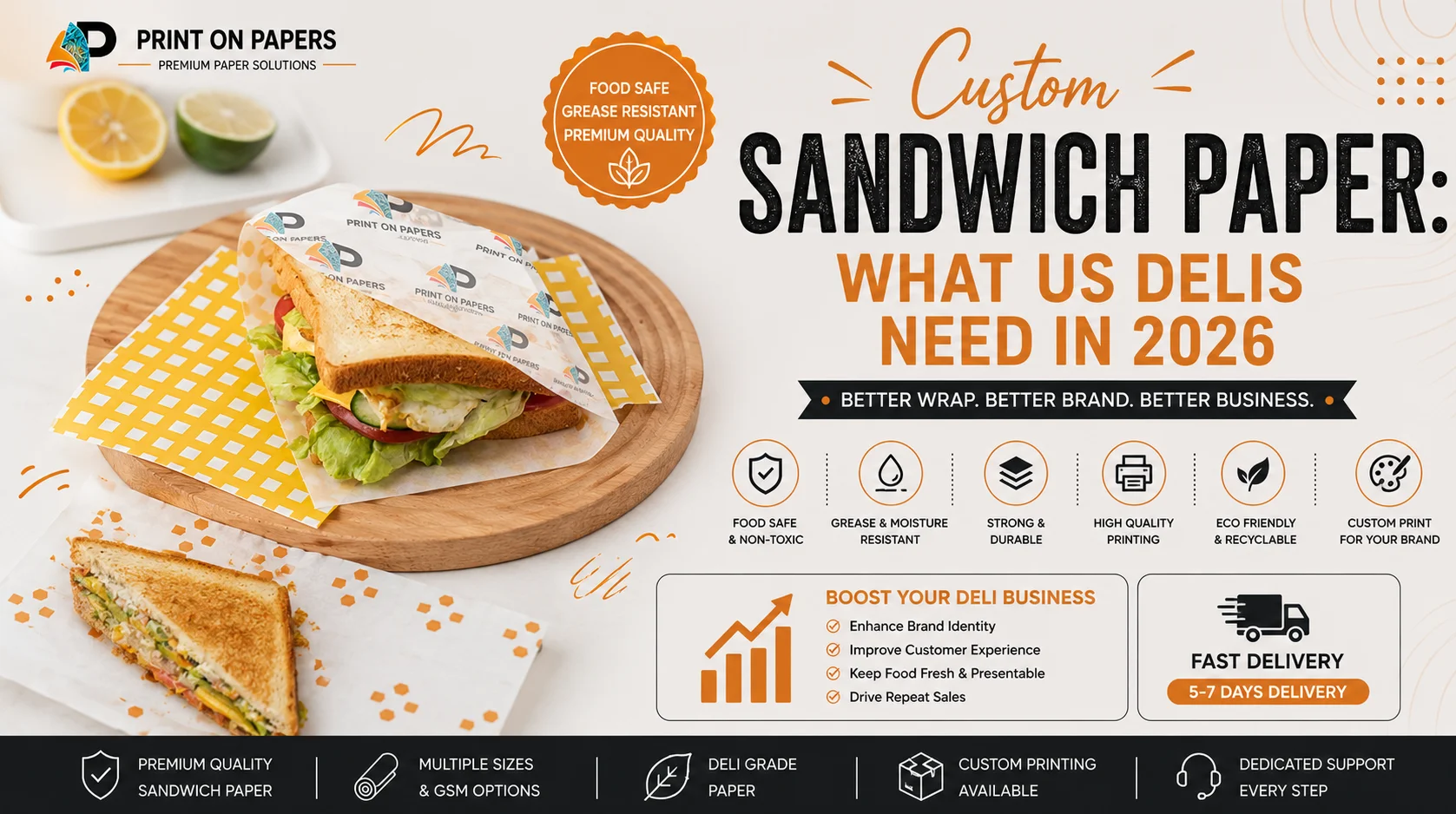
TL;DR: This wrap is a printed, food contact sheet built to hold up against grease, steam, and heat while carrying your logo. Most wraps fail because a shop picks the wrong coating for the wrong food, not because the paper is bad. This guide breaks down grease resistance, the 2026 PFAS free reality, and how to order from 500 sheets with no setup fee.
Custom sandwich paper is a food safe wrap sheet, printed with a shop’s logo, made to hold sandwiches and subs without leaking grease onto a customer’s hands. It falls under FDA food contact rules for paper and paperboard, and today it ships with wax, PE, or soy wax coatings instead of the PFAS coatings that were common a few years back. Delis, sub shops, and food trucks use it for both food safety and free advertising on every order that goes out the door. Suppliers such as Print On Papers build their custom sandwich paper line specifically around this job, rather than treating it as a generic sheet pulled off a shared production run.
Most owners blame the paper the first time a wrap fails at the counter. Usually the real issue is a mismatch, not a bad batch. A meatball sub or a loaded Philly cheesesteak puts two kinds of stress on paper at once, and most wraps only handle one of them well.
Grease bleed happens when oil from meat or cheese soaks straight through a coating that is too light for the job. Dark, spreading spots show up within a couple minutes on a busy lunch line, right through the print.
Steam sogginess is a different problem entirely. A hot sub trapped inside a tight wrap holds its own steam in. That trapped moisture softens the bread from the inside, even on paper that blocks grease perfectly well on the surface. A wrap can pass the grease test and still hand a customer a soggy sandwich, because steam was never the job that coating was built to solve.
The real fix is matching coating weight to the food and leaving a little room for steam to escape, not just grabbing a heavier sheet across the board and hoping it works.
For a full breakdown of every sandwich paper option, coating type, and print specification available, the complete guide to custom sandwich paper covers the category end to end. This piece focuses specifically on the failure points and ordering decisions that come up once a shop is actually narrowing down a supplier.
Grease resistant sandwich paper works because of coating weight and paper density, measured in GSM, not because of a word printed on a spec sheet. A thin sheet around 30 GSM with a light wax coating handles a cold sandwich just fine. A hot, cheese heavy sub needs a denser sheet with a stronger barrier built in.
| Paper Type | Best Use | Heat Rating | GSM Range |
| Deli Paper | Cold cuts, cold sandwiches | Cold to moderate | 30 to 45 GSM |
| Greaseproof Paper | Hot, oily, cheese heavy subs | Hot, grease resistant | 35 to 40 GSM |
| Wax Coated Paper | Bakery items, light wraps | Cold to warm | 30 to 45 GSM |
| PE Coated Paper | Wet or saucy fillings | Hot | 35 to 45 GSM |
If a shop keeps losing wraps to bleed through, the fix is usually moving up one row on that table, not switching suppliers entirely.
This question matters more now than it did five years ago. The FDA confirmed that grease proofing substances containing PFAS are no longer sold by manufacturers for food contact use in the US market. In the agency’s own words, this phase out “eliminates the primary source of dietary exposure to PFAS from authorized food contact uses” (FDA, Market Phase Out of Grease Proofing Substances Containing PFAS).
That phase out became fully effective by mid 2025, after the FDA determined in January 2025 that 35 related food contact notifications were no longer effective. So by the time you read this in July 2026, any custom sandwich paper sold in the US for food contact should already be PFAS free by law, not just as a marketing claim.
You can confirm current federal rules directly on the FDA’s PFAS phase out page, and the underlying paper and paperboard rules sit in 21 CFR 176.170 in the electronic Code of Federal Regulations. Ask any supplier for written confirmation of PFAS free coatings before ordering in bulk. It is a fair, simple question, and a supplier who cannot answer it clearly is not one to build a repeat order with.
These three terms get used like they mean the same thing, and that mix up causes most wrong orders.
Deli paper is lightweight and built for cold cuts, cheese slices, and sandwiches served cold or at room temperature. It is not made for sustained grease or heat.
Custom sandwich paper sits in the middle of the two. It handles both cold and moderately hot sandwiches and usually carries a wax or light PE coating.
Greaseproof paper is the heavy duty option, built specifically for fried, oily, or cheese heavy food. Shops that also run a specialty cheese counter often pair their sandwich wrap with dedicated custom cheese paper, so each product does the one job it was built for instead of one paper trying to cover everything. Kitchens that also run tacos or wraps often add custom taco wrapping paper to the lineup for the same reason, matching coating to the specific food rather than forcing one sheet to do every job. Delis weighing cheese paper specifically can see how specialty delis order cheese paper wholesale for a closer look at that product.
Sub shops and sandwich counters are the biggest buyer group, ordering sandwich wrap as their single highest volume item, often paired with printed food basket liners for fries and sides.
Food truck sandwich paper orders tend to run smaller and lean toward greaseproof or PE coated stock, since a mobile kitchen cannot afford a wrap that fails halfway through a lunch rush.
Sub shop wrap paper needs are usually larger sheet sizes than a cafe or bakery would order, simply because a foot long sub takes more paper to close fully than a small pastry does.
Specialty delis that also run a cheese counter tend to order sandwich wrap and cheese paper together, since the two rarely overlap in actual daily use. Most of these buyers end up browsing the full custom food papers category rather than ordering one product in isolation, since a kitchen’s wrap, liner, and cheese paper needs usually get decided in the same order.
Custom sandwich paper wholesale USA orders typically start at 500 sheets, with no setup fee attached to standard print jobs. That minimum exists because digital printing becomes cost efficient at that volume, not because suppliers are trying to lock a shop into a bigger order than it needs.
Standard production runs 7 to 10 working days once you approve a proof, so a new sub shop opening in three weeks should place the order now, not after the buildout is finished. Ask for a digital proof before full production starts. That one step is what keeps a shop from getting stuck with thousands of sheets in the wrong size or a logo printed off center. Shops that want exact pricing for their size and quantity can reach out directly before committing to a full run.
| Question | Answer |
| What is the minimum order for custom sandwich paper? | Most suppliers set the minimum at 500 sheets for standard digital printing, with no setup fee added to that base order. |
| Is this wrap safe for hot sandwiches? | Yes, when the coating matches the food. Greaseproof or PE coated paper handles hot, cheese heavy subs better than light wax paper does. |
| Does sandwich paper contain PFAS? | No. The FDA confirmed that PFAS based grease proofing substances are no longer sold for food contact use in the US, so current stock should be PFAS free. |
| How is sandwich paper different from deli paper? | Deli paper is built for cold food only. Sandwich paper handles a wider range, from cold cuts to moderately hot subs. |
| Can food trucks order in small batches? | Yes. Most suppliers apply the standard 500 sheet minimum, which is small compared to warehouse level ordering and fits most food truck volumes. |
If grease bleeds through, soggy subs, or a plain unbranded wrap are costing a shop repeat customers, the fix is the right custom sandwich paper for the menu, not a bigger order of the same wrong sheet. Print On Papers ships it from 500 sheets, with no setup fee, PFAS free coatings, and a proof approved before production starts.
Custom sandwich paper only works when the coating matches what is actually crossing the counter. Grease bleed through and steam sogginess are two different problems with two different fixes, and both come down to picking the right GSM and coating, not just buying a heavier sheet out of habit. Now that PFAS coatings are fully phased out under FDA rules, the food safety question is simpler to answer than it was a few years ago. What is left is a practical choice: match the paper type to the actual menu, order from a supplier who confirms compliance in writing, and start with a size the shop can actually use. For shops that also run a cheese counter or need basket liners alongside their wrap, pairing products from the same supplier is worth ten minutes of research before placing that first order.
Print On Papers is a custom printed paper and wrapping paper company serving restaurants, bakeries, delis, food trucks, butchers, florists, apparel brands and food brands across the US and worldwide. We deliver food-safe, eco-friendly, fully branded custom paper, from your first 500 sheets to your next 500,000