
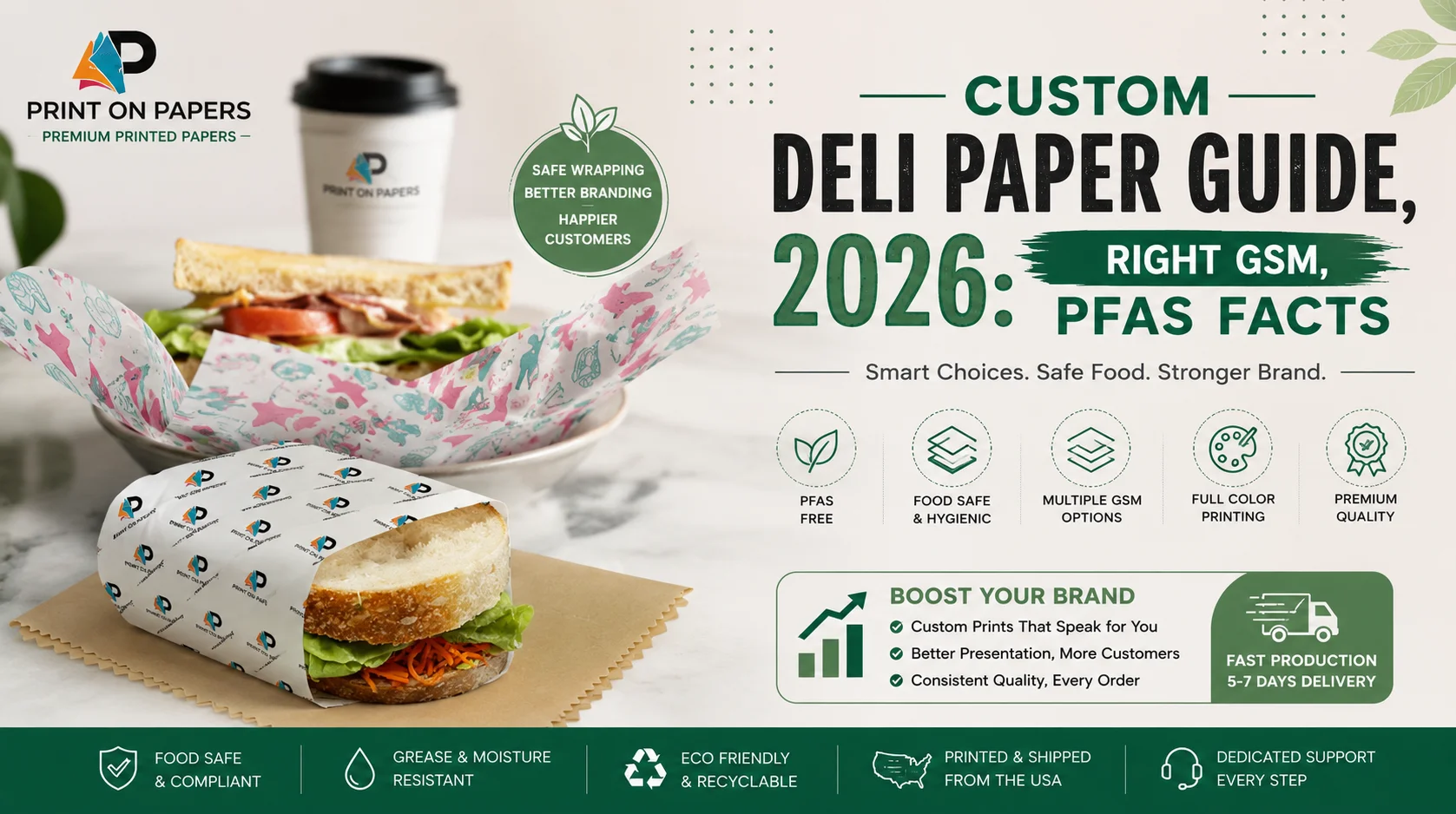
TL;DR: Custom deli paper works best between 30 and 45 GSM, matched to what you are wrapping, not picked at random. Grease soak-through is almost always a GSM or coating mismatch, not a bad batch of paper. As of July 2026, twelve US states restrict PFAS in food packaging, so ask any supplier to name the coating, not just say it is safe. Print On Papers ships wholesale from 500 sheets with no setup fee and free design support.
Custom deli paper is food-contact paper printed with a shop’s logo, used to wrap sandwiches, cold cuts, and cheese at the counter. It is light enough to fold fast during a rush, treated to resist grease, and approved for direct food contact under FDA rules. For a sandwich shop, it doubles as free advertising that leaves the building in a customer’s hand.
Most guides stop there. But it is not one product with one spec. It is a range, and picking the wrong point on that range is how a shop ends up with a soggy wrap during the Friday lunch rush, or paper that costs more than it needed to. This guide walks through GSM, PFAS compliance, and ordering, in plain language, so you order once and get it right.
There is a branding angle too, and it is easy to overlook when you are focused on food safety alone. Plain paper does its job and nothing more. Printed food wrap USA operators use for the same price tells every customer who packed that sandwich, and it keeps working long after the order leaves the counter, in a bag, on a desk, in a photo.
Print On Papers builds every sheet around the same standard used across sandwich counter paper for shops nationwide. FDA-compliant materials, PFAS-free coatings, and clear specs before you order, not after.
GSM stands for grams per square meter. It tells you how much a sheet weighs, which is a decent stand-in for thickness and stiffness. It is not the same thing as grease resistance, and a heavier sheet is not automatically a better one. It just costs more, unless your food actually needs that extra weight.
Deli paper GSM generally runs from 30 to 45 GSM for sandwich and cold cut service, and that range is not arbitrary. Full specs for each weight sit on the custom deli paper product page if you want to check exact pricing per GSM before you commit. Light enough to fold tightly around a sandwich without adding bulk. Heavy enough to hold up through the wrap, the hand off, and the unwrap.
Use this as a working rule, not a guess. Cold sandwiches, wraps, and cheese sit comfortably at 30 to 35 GSM. Anything with sauce, dressing, or a warm filling does better at 35 to 40 GSM. Deli paper 30-45 GSM covers nearly every counter service item a sandwich shop sells. Going outside that range usually means you need a different paper type, not a heavier version of the same one.
Grease soak-through during service is the most common complaint sandwich shop owners bring us, and it almost never comes down to a bad batch of paper. It comes down to one of two things. The GSM was too light for the item, or the paper was never built to handle oil in the first place.
Deli paper is built for cold and moderate contact. It is not built to sit under a fried item, or a heavily sauced sandwich, for ten minutes on a counter. If your menu runs fried chicken sandwiches, loaded burgers, or anything sitting in sauce before it gets wrapped, grease resistant deli paper at the top of the GSM range can help. In many of those cases, greaseproof paper is simply the better call.
There is also a quieter cause worth checking. Custom deli paper ordered without confirming coating type sometimes arrives lighter than expected, since suppliers vary in how they label wax-coated versus poly-coated stock. A quick fix that solves most soak-through complaints: match GSM and coating to grease exposure, not to habit. If you have always ordered the same spec regardless of what is on the menu, that is usually the root cause, not a defective shipment.
It should be, and you should be able to get that in writing, not just hear it as a sales line. PFAS-free deli wrap means the coating contains no intentionally added per- and polyfluoroalkyl substances, the chemicals once used across the industry to boost grease resistance.
The federal baseline here is 21 CFR 176.170, the FDA regulation covering what substances can legally touch food through paper and paperboard. Any FDA food contact paper claim should trace back to this rule, and a supplier who cannot point to it is not really giving you an answer. You can read the regulation itself on the government’s Electronic Code of Federal Regulations site: 21 CFR 176.170, eCFR
State law adds another layer most sandwich shop owners are not tracking closely enough. As of April 2026, twelve US states, including California, Colorado, Maine, Maryland, Minnesota, New York, Oregon, and Washington, restrict intentionally added PFAS in food packaging or food service ware. Maine’s rule for plant-fiber food-contact packaging takes effect May 25, 2026, and Washington phased its own restrictions in starting back in 2023, according to trade coverage tracking these packaging law changes: Packaging Dive, state packaging laws 2026. This is not a hypothetical compliance risk. It is current law, and the list keeps growing.
Print On Papers builds every sheet on FSC certified paper stock and prints with soy-based food ink instead of petroleum ink, so the compliance claim holds up if a health inspector or a customer ever asks to see it.
One habit worth adopting before your next order: ask the supplier to name the coating type in the quote itself, not just confirm it verbally. Wax-coated, PE-coated, or PFAS-free greaseproof are three different answers, and only one of them tells you exactly what you are getting.
These three get mixed up constantly, and the mix-up is usually what leads to the wrong order. Deli paper is light, 30 to 45 GSM, and built for cold to moderate contact: sandwiches, cold cuts, cheese counters. Custom kraft paper runs heavier, usually 40 to 60 GSM, and fits bread bags, takeout liners, and anything needing more structure than a wrap.
Fry paper sits in its own category. It is built specifically for hot, oil-heavy food straight out of a fryer, which deli paper was never designed to handle for long. If a fried item is going straight into a wrap or a basket, fry paper or greaseproof paper is the right call, not a heavier deli sheet.
The short version: pick based on what the food is doing to the paper, cold, hot, dry, or oily, not on what you already have sitting in the back room.
Ordering is simpler than most first-time buyers expect. Custom deli paper wholesale USA 500 sheets no setup fee is the standard starting point, meaning there is no large upfront design charge just to get your logo on the sheet. Pricing starts from $0.20 per sheet and moves depending on GSM, print coverage, and order size.
You can order custom paper rolls and sheets depending on your counter setup: flat stacks for hand-wrapping, or rolls if you are feeding a dispenser. Standard production runs 7 to 10 working days from proof approval, with a rush option in 5 to 7 days when timing is tight. Shipping runs free across the US through DHL, FedEx, and UPS, dispatched from Valley Stream, New York.
This same standard carries across the wider lineup too. Custom printed papers wholesale USA 500 sheets free design covers kraft paper, greaseproof paper, and fry paper under the same minimum, the same no-setup-fee policy, and the same free proof process, so a shop stocking more than one paper type is not juggling five supplier relationships.
If your volume runs high enough that per-sheet cost matters more than turnaround speed, ask about custom food paper wholesale pricing at higher tiers. It tends to drop meaningfully past the 5,000 sheet mark, and orders at that scale usually move to offset printing for a lower per-sheet rate.
Design support is included at every tier, not just the larger ones. Send a logo file and a proof comes back before anything goes to print, so a single-location shop gets the same review process as a ten-location group ordering for every counter at once.
Custom deli paper is one part of a wider custom printed papers lineup built for food businesses that want branding on every touchpoint, not just the counter wrap. The same FDA compliance, PFAS-free coatings, and 500-sheet minimum apply across kraft liners, fry paper, greaseproof sheets, and paper plates, with GSM weights running from 30 to 90 depending on the product. Every type ships as flat sheets or rolls, printed in CMYK. Full specs and ordering steps for the range are covered in this wholesale guide.
| Question | Answer |
| What GSM is best for custom deli paper? | Most counters do well at 30 to 35 GSM for cold items and 35 to 40 GSM for anything with sauce or moderate oil. |
| Is this paper PFAS-free? | It should be. Ask for written confirmation that the coating has no intentionally added PFAS, backed by FDA 21 CFR 176.170 compliance. |
| What is the minimum order? | 500 sheets, with no setup fee, and pricing starting from $0.20 per sheet. |
| How long does production take? | 7 to 10 working days from proof approval, or 5 to 7 days with rush production. |
| Can I order it in rolls instead of sheets? | Yes. Custom paper rolls and sheets are both available, depending on whether your counter runs a dispenser or hand wraps orders. |
You have the GSM range, the compliance answer, and the real minimum order. The only thing left is a supplier who states all three upfront instead of making you ask twice. For a closer look at how one sandwich shop switched over and what changed at the counter, see custom deli paper for sandwich shops.
Custom deli paper is a small line item that does a lot of quiet work: keeping food fresh through the hand off, keeping the counter clean, and keeping your name in front of every customer who walks out the door. Get the GSM right for what is actually on your menu, confirm PFAS-free compliance in writing, and order at the real minimum instead of guessing. That is the whole decision, and it does not need to be more complicated than that.
Print On Papers is a custom printed paper and wrapping paper company serving restaurants, bakeries, delis, food trucks, butchers, florists, apparel brands and food brands across the US and worldwide. We deliver food-safe, eco-friendly, fully branded custom paper, from your first 500 sheets to your next 500,000