
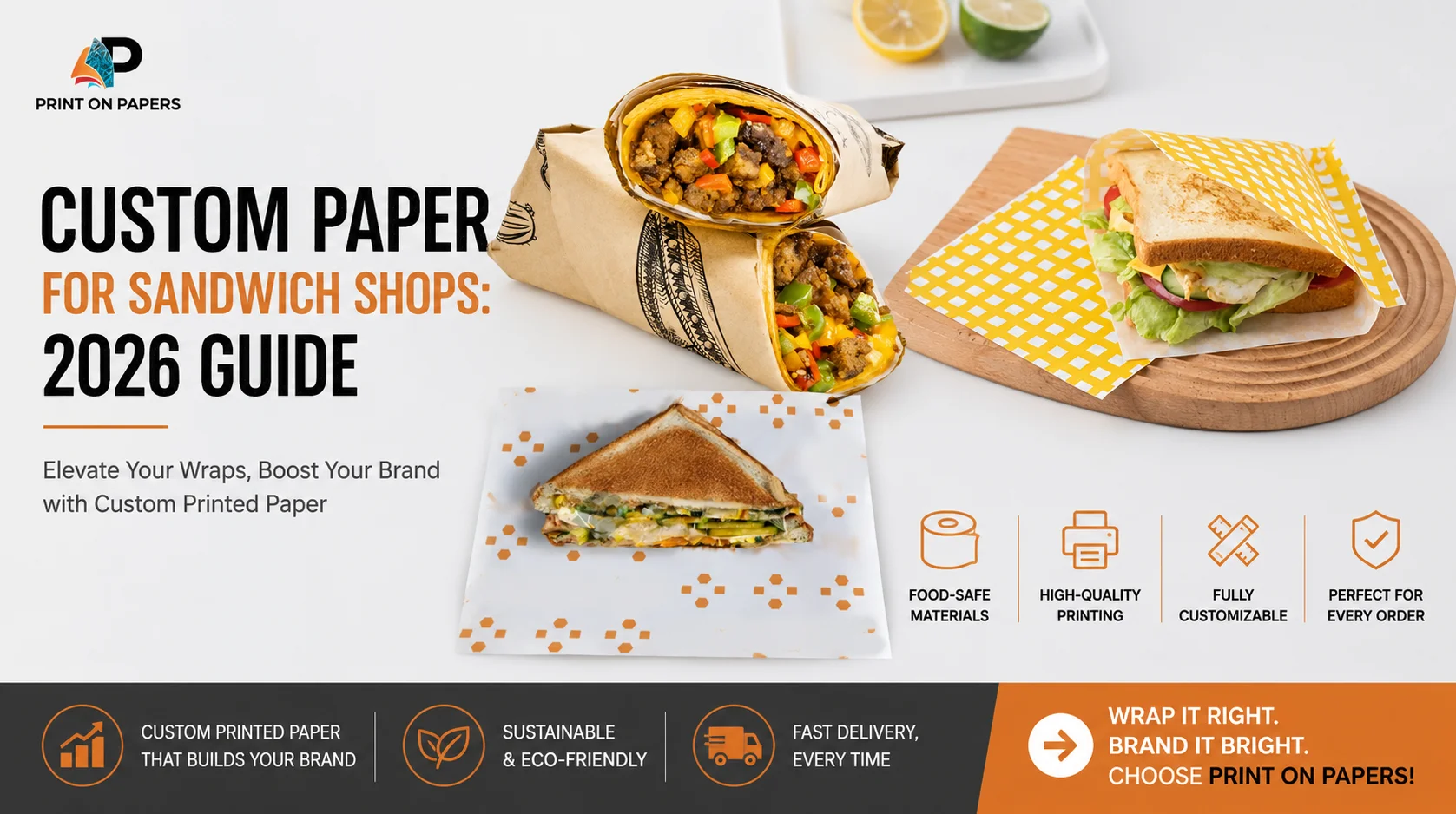
TLDR: Most sandwich shops need two papers, not one. Deli paper wraps cold cuts and quick counter orders, greaseproof paper holds up under hot, oily sandwiches and delivery runs, and wax paper works best for pastries and cold items. Match the paper to your menu instead of guessing.
Ask any sandwich shop owner what keeps them up at night and packaging rarely makes the list, until the day a customer walks back in holding a soaked bag with the logo smeared across it. That’s usually when someone starts googling custom printed paper for sandwich shops in 2026, trying to figure out why the paper they’ve used for years suddenly isn’t cutting it. The short version is that most shops are using one paper for a job that really needs two. This guide walks through deli paper, wax paper, and greaseproof paper, what separates them, and how to match each one to what’s actually crossing your counter.
There isn’t one best paper, and anyone who tells you otherwise is probably trying to sell you a single product line. The best custom paper for sandwich shop USA 2026 really comes down to three questions. How hot is the food? How much oil or sauce does it carry? And how long does it sit before someone actually opens it? A cold turkey club sitting at the counter for two minutes doesn’t need the same protection as a meatball sub riding in a delivery bag for twenty. Most shops that get this right end up running two sandwich shop food paper types side by side rather than forcing one sheet to do everything.
People mix these three up all the time, and it’s an expensive mistake once you’re a thousand sheets into an order that doesn’t fit your menu. So here’s what deli paper vs wax paper vs greaseproof for sandwiches actually looks like once you get past the marketing copy.
Deli paper stays light, usually somewhere between 30 and 45 GSM, with a thin wax or PE coating on just one side. It’s fine for cold cuts, cheese, and anything that gets eaten within a few minutes of being wrapped. Ask it to survive sustained heat or heavy grease, though, and it won’t.
Wax paper goes the other direction, with a full paraffin or soy wax coating on both sides. It blocks moisture nicely and gives sandwiches that classic, clean look people associate with a good deli. The catch is the wax itself, which starts softening somewhere around 200 degrees Fahrenheit. Keep it nowhere near anything hot off a grill.
Greaseproof paper doesn’t use wax at all. Instead, the fibers get mechanically compressed into a dense structure that naturally blocks oil, no coating required, and it holds its shape up to roughly 400 degrees. This is the sheet you reach for with burgers, hot subs, or anything that’s going to sit inside a delivery bag for twenty minutes before someone gets to it.
| Paper Type | Heat Rating | GSM Range | Best For |
| Deli Paper | Cold to moderate | 30 to 45 GSM | Cold cuts and quick counter sandwiches |
| Wax Paper | Up to 200°F | 30 to 45 GSM | Pastries, cold wraps, candy |
| Greaseproof Paper | Up to 400°F | 35 to 40 GSM | Hot subs, burgers, delivery orders |
For a shop running mostly cold sandwiches and fast counter service, custom deli paper is usually where to begin. It’s the pick most custom deli paper sandwich shop owners land on for daily cold and quick service work. It’s cheap enough to order often, it prints clean in full color, and honestly, it just does the job as long as heat and heavy oil aren’t part of the equation.
Ask around the country and you’ll find what paper sandwich shops use for wrapping really tracks the menu more than any regional habit. Delis lean on deli paper for cold cuts and cheese counters. Burger joints and BBQ spots reach for custom greaseproof paper since it handles grease without falling apart. Bakeries and cafes go with custom wax paper for pastries, cold sandwiches, or anything that needs that clean, matte finish. Food trucks tend to stock both deli and greaseproof paper for sandwich wrapping at once, because their menu can flip within the hour and their packaging has to flip with it.
There’s a branding angle here too, and it’s bigger than it sounds. Custom printed paper sandwich wrap with your logo on it turns a normal order into a small ad, and with how often people photograph their lunch these days, that matters more than it used to. Plain food paper sandwich wraps still work fine. They just don’t get remembered, and they definitely don’t get posted.
This is the fear that keeps a lot of owners up before a big catering order or a new delivery deal goes live. And honestly, the fear is fair. The wrong paper will fail. The right one won’t.
Hand someone a hot, saucy sandwich wrapped in wax paper and watch it soak through within minutes. That’s not a defect, it’s just outside what wax paper was ever designed to handle. Deli paper does a little better with light moisture but starts giving out under sustained grease, the kind that comes off a fully loaded Italian sub or a dripping cheesesteak. Greaseproof paper is the one actually built for this. Its dense fiber structure resists oil without relying on a coating that can melt or peel away, which is exactly why it’s become the default for delivery orders that sit closed up for a while before anyone gets to them.
Not sure which category your menu falls into? Try this test. Does the sandwich release visible oil or sauce within the first five minutes of being wrapped? If the answer is yes, greaseproof paper is worth the switch, even if it runs a few cents more per sheet.
There’s also a regulatory reason 2026 specifically matters here. Back in February 2024, the FDA announced that PFAS based grease proofing substances are no longer sold for food packaging use in the United States, following a voluntary phase out by manufacturers, according to the FDA’s own announcement. By January 2025, the agency confirmed that 35 related food contact notifications were no longer effective, with a compliance window that closed in mid 2025. And Maine’s ban on PFAS in plant fiber food packaging takes effect on May 25, 2026, joining more than a dozen states that now restrict PFAS in food contact paper in some form, according to Packaging Dive’s 2026 state law roundup. If your current supplier can’t confirm their coatings are PFAS free, and back that up with an actual standard rather than a slogan, this is the year to start asking.
Pricing for food wrap paper USA suppliers offer tends to start around 20 cents per sheet for deli paper and wax paper, with greaseproof running a bit higher because of the extra fiber processing involved. Most sandwich wrap paper USA orders ship within a week once artwork gets approved. Minimums vary a lot more than people expect, and some suppliers still want thousands of sheets before they’ll even touch your logo, which effectively locks out a single shop trying to test a rebrand.
Before placing an order for paper for sandwich wrapping, ask four things. What GSM range does each paper actually run? What coating, if any, sits on the surface? Is that coating confirmed PFAS free, and against which standard? And how many working days pass between proof approval and delivery? A supplier who answers all four with real numbers instead of adjectives is one worth building a recurring order with.
| Question | Answer |
| What paper keeps sandwiches fresh the longest? | Greaseproof paper holds up longest under heat and moisture, often resisting oil and grease for 20 minutes or more before it starts to break down. Deli paper works for shorter stretches, generally under 10 minutes, before grease begins to show through. |
| Is custom printed paper safe for direct food contact? | Yes, as long as it meets FDA 21 CFR 176 and uses PFAS free coatings along with soy based inks. Push your supplier for the specific standard behind that claim, not just a general food safe label. |
| Can I get branded paper without a huge minimum order? | Most suppliers, Print On Papers included, start custom runs at 500 sheets, which is realistic for a single location shop and not just something reserved for big chains. |
| What is the best paper for sandwiches USA wide? | There isn’t one clear winner. Cold sandwich counters do well with deli paper, hot and greasy items call for greaseproof paper, and pastries or cold wraps are better suited to wax paper. |
| How fast can I get custom sandwich paper printed? | Standard production runs 7 to 10 working days from proof approval, with rush options available in 5 to 7 days through most suppliers. |
| Does custom paper cost more than plain paper? | Custom printed sheets usually run a few cents more per sheet than unprinted stock, a cost most shops recover fairly fast through repeat visits and organic social sharing. |
Choosing between deli paper, wax paper, and greaseproof paper was never really about finding one perfect sheet. It’s about matching the paper to what’s actually on your menu instead of guessing and hoping it holds. If you’re still wrapping hot sandwiches in wax paper, or cold cuts in greaseproof stock built for fried food, you’re either paying more than you need to or leaving your food under protected. Sometimes both at once.
Get a Free Custom Paper Quote from Print On Papers and find out exactly which paper fits your menu, your volume, and your budget, with real pricing instead of a sales pitch. Request your quote here.
Print On Papers is a custom printed paper and wrapping paper company serving restaurants, bakeries, delis, food trucks, butchers, florists, apparel brands and food brands across the US and worldwide. We deliver food-safe, eco-friendly, fully branded custom paper, from your first 500 sheets to your next 500,000