
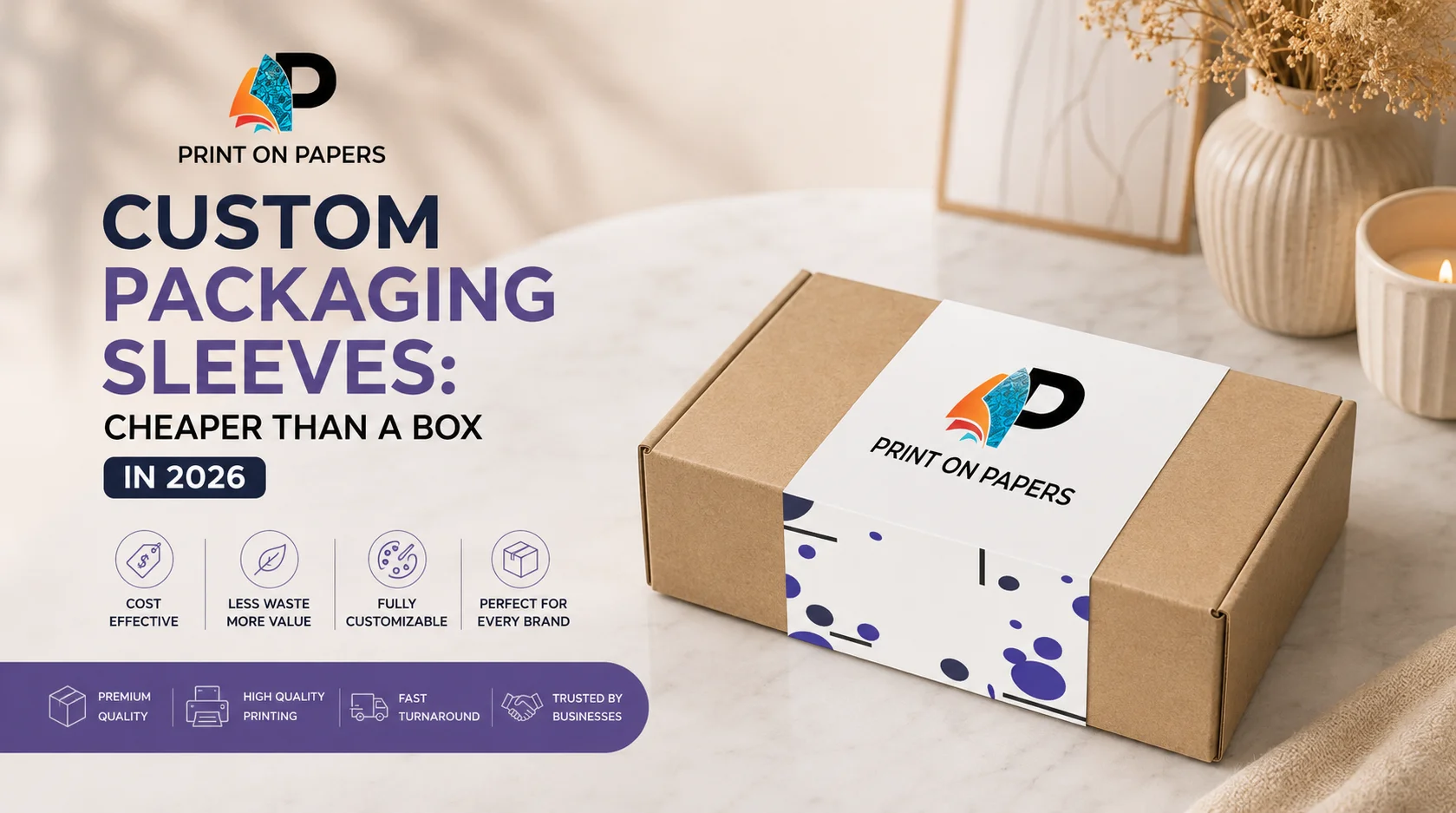
TL;DR: A custom packaging sleeve is a printed wrap that goes around a plain box or jar instead of replacing it. It costs less than a full custom box, starts at 500 units with no minimum order penalty, and works best when your product already has protective packaging and just needs branding.
Custom packaging sleeves cost less than a full custom box, and most small brands do not learn a sleeve is an option until a box quote comes back too high. A sleeve wraps around a plain box or product instead of fully enclosing it. That difference cuts the cost, lowers the minimum order, and still gets your logo on the product. This guide covers how sleeves work, when to use one over a box, and when a full box is still right, current as of July 2026.
A custom packaging sleeve is a printed paper or cardboard band that wraps around a box, jar, or bundle without covering the top or bottom, adding branding to packaging you already have. Sizes typically range from 4 by 2 inches for small items up to 26 by 12 inches for larger boxes, with custom sizes beyond that. Most orders start at 500 units with no minimum penalty, one of the fastest ways for a small brand to look retail ready without box tooling costs.
Picture a plain kraft box or a glass jar. Now picture a printed strip of paper wrapped once around the middle. That is a sleeve, needing no lid, no base, and no fold lines, since the container underneath already does that job. Some call this a box sleeve wrap, others a belly band or a packaging band sleeve, and in retail packaging it is sometimes called a sliding box or slipcase style. All point to the same idea, a layer over something already holding the product.
Measuring one is simple. Wrap paper around the box or jar, mark where the ends meet, and add about half an inch for overlap. Sleeves close with a peel and seal strip or a plain tuck fold.
This changes what you pay to print. A full box needs every panel, fold, and seam printed. A sleeve prints one flat piece, wrapped and sealed. Fewer panels mean less material and a lower cost per unit. Browse the full category of finishing packaging options, including custom packaging sleeves, on the custom packaging supplies page to see how they fit alongside tissue paper, labels, and inserts.
The decision usually comes down to cost, minimum order, and how much branding coverage you actually need.
| Factor | Custom Packaging Sleeve | Full Custom Box |
| Typical cost per unit | Lower, single flat piece | Higher, full panel printing |
| Minimum order | 500 units, no penalty | Often 1,000 or more |
| Branding coverage | Wraps the middle band | Covers the entire box |
| Best for | Plain boxes or jars you already use | New product lines needing full structure |
| Turnaround | 7 to 10 working days | Often longer, extra die line setup |
A box needs a die line for every fold and corner. A sleeve is one piece with a single seam, cutting setup work and material waste, which is why product sleeve packaging is often called a shrink sleeve alternative to plastic shrink wrap or a full mold.
Grand View Research values the global shrink and stretch sleeve labels market at 15.12 billion dollars in 2023, growing roughly 5.5 percent a year through 2030, driven by brands wanting full coverage branding without redesigning the container. Paper and cardboard sleeves compete in that space at a fraction of the cost. Mordor Intelligence reports secondary packaging, the category these sleeves fall under, made up 42 percent of the global paperboard packaging market in 2025, growing close to 5 percent a year through 2031. Sleeve style branding is not a niche trend, but a growing share of how brands add identity after the primary package exists.
A sleeve makes sense in a few clear cases. You already have plain or stock boxes and just need branding. You are testing a new product before committing to full box tooling. You need a seasonal design without reprinting your box inventory. Your budget cannot support full box printing yet, but the product should still look ready.
This is the exact question behind sleeve packaging vs box packaging. For many small brands, custom packaging sleeves solve it without a big upfront cost. If a plain box or jar already protects the product, the sleeve just needs branding. Pairing a sleeve with interior wrap works for gift style orders too. Many brands wrap the product in custom tissue paper first, then slide the sleeve over the outside for a finished look.
A sleeve will not fix a problem it was not built to solve. Custom packaging sleeves are not a substitute for a box built to hold the product’s weight, since a sleeve leaves top and bottom exposed. Heavier or breakable items usually need a box with custom packaging inserts to hold the product in place during transit. If every visible surface needs your design, a full box covers that. Being upfront here is part of a good recommendation, not a pitch.
These sleeves are not right for every product, but for a business with plain packaging already in hand, they solve a real problem at a fraction of box cost. Start with one question. Does your box or jar already protect the product? If it does, a sleeve gets you branding without tooling cost. If not, invest in the box first and treat the sleeve as a later upgrade.
Most sleeves use kraft or coated paper stock, chosen by how much print detail the design needs. Thickness is measured in GSM, heavier stock holding sharper printing. A logo only design suits lighter stock, a full color photo benefits from heavier coated stock. The paper stock carries the same FSC certification used across the rest of the Print On Papers catalog, traceable to responsibly managed forests.
Many small brands hit this fork in the road. If your product only needs a name, a barcode, or basic details, a label may be enough and costs less. Custom packaging sleeves add full brand coverage in one piece, which is why some brands pick a sleeve over a label. Some brands use both, custom roll labels for product identification and a sleeve for the outer branding layer. Sleeve packaging for small business comes up often enough that it deserves its own breakdown. Want more detail? Click here for the guide on ordering custom roll labels for small businesses.
Ordering starts at 500 units with no minimum order penalty, pricing scaling down as order size grows. Standard production runs 7 to 10 working days, with rush in 5 to 7. Shipping is free across the USA via DHL, FedEx, and UPS, tracked from Valley Stream, New York. Add custom crinkle paper inside a sleeve wrapped box for cushioning and fill. Print On Papers designs every sleeve from your specs with free design support included, so you send a logo and get a print ready proof before production starts. Visit Print On Papers to see the full range of packaging, or go straight to the contact page to start a quote.
| Question | Answer |
| What is a custom packaging sleeve? | It is a printed paper or cardboard band that wraps around a box, jar, or bundle without covering the top or bottom, adding branding to packaging you already use. |
| Is a packaging sleeve cheaper than a custom box? | Yes. A sleeve prints as one flat piece with a single seam, while a box needs every panel and fold printed, which raises the per unit cost. |
| What is the minimum order for a packaging sleeve? | Most orders start at 500 units with no minimum order penalty, lower than what many full box programs require. |
| How long does production take? | Standard production runs 7 to 10 working days from proof approval, with rush production in 5 to 7 days. |
| Can a sleeve replace a full box completely? | Only if the item underneath already gives structural protection. Fragile or heavy products still need a box, since a sleeve covers just the middle band. |
Print On Papers is a custom printed paper and wrapping paper company serving restaurants, bakeries, delis, food trucks, butchers, florists, apparel brands and food brands across the US and worldwide. We deliver food-safe, eco-friendly, fully branded custom paper, from your first 500 sheets to your next 500,000