
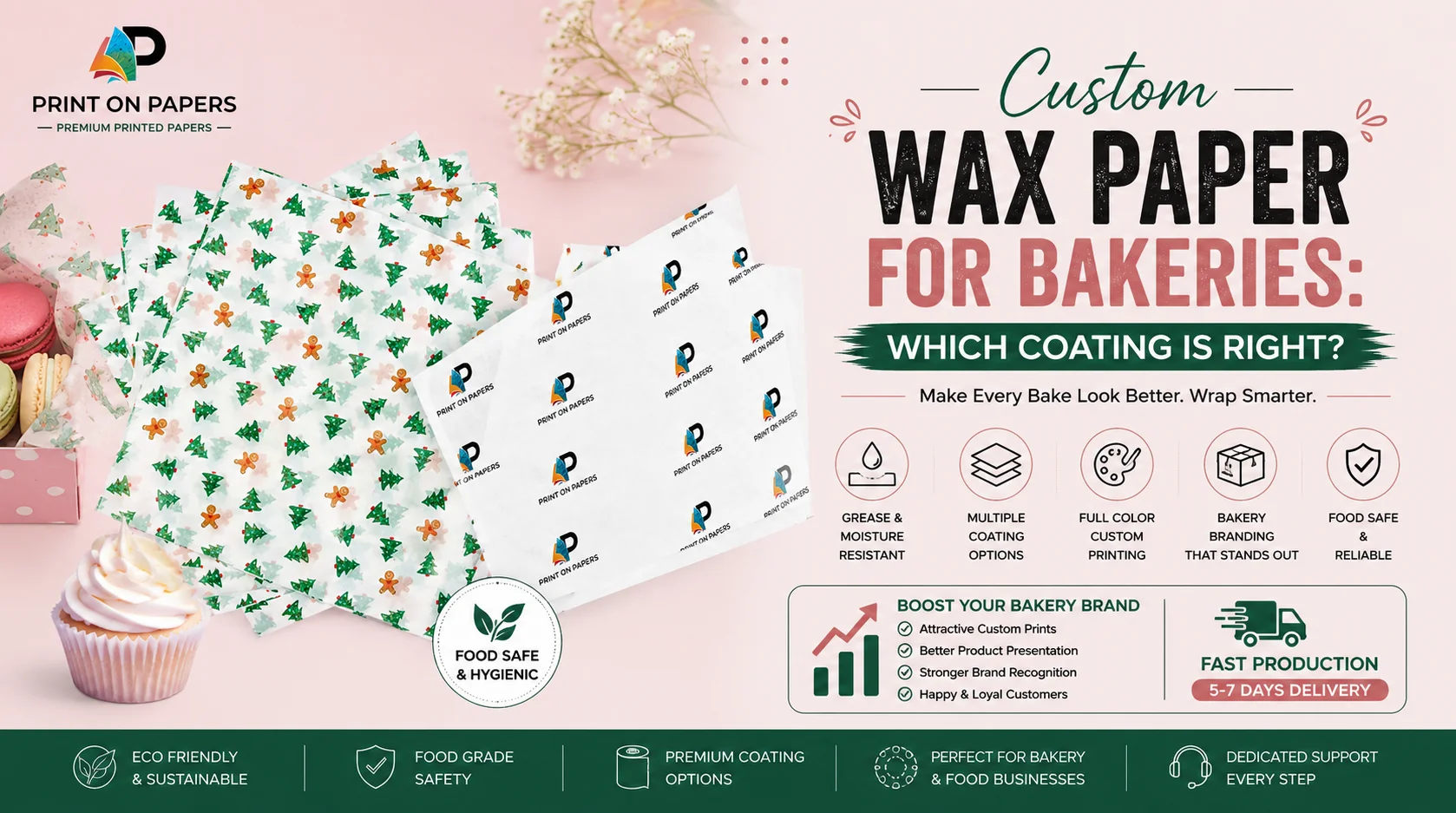
TLDR
There are three coatings behind custom wax paper for bakeries, and they don’t perform the same way. Paraffin is cheap and common, but it softens around 200°F and has no business near an oven. Soy wax costs a bit more, comes from soybeans instead of petroleum, and holds up close to paraffin on moisture. Beeswax is the toughest against heat and grease, though you’ll pay more per sheet for it. All three work fine in a microwave for short bursts. None belong in an oven. Wholesale orders for custom wax paper wholesale bakery USA start at 500 sheets, priced from $0.20 a sheet, and typically ship in 7 to 10 working days.
Table of Contents
A Missouri bakery once called the Print On Papers team about a tray of croissants ruined by melted wax. The paper had been sitting too close to the proofing oven, and the paraffin coating gave out. Nobody had told them paraffin couldn’t handle that kind of heat. One wrong order cost a full batch and a rough morning shift. Here’s how to make sure that never happens to your bakery.
Here’s the short version. Custom wax paper for bakeries is a printed sheet coated in paraffin, soy, or beeswax, made for direct food contact. That coating is really the whole story. It decides how much heat the sheet can take, how well it holds back grease, and whether you can honestly call your packaging eco friendly. Get it wrong, and you end up with wax on a pastry instead of a clean wrap.
Strip it down and custom wax paper is just paper run through a wax bath, then printed with your bakery’s logo in CMYK or a matched Pantone color. The base paper barely changes between products. What changes, and what actually matters, is the coating on top of it.
That coating does three jobs at once. It sets how much heat the sheet can sit near before it softens. It decides how well butter, oil, and glaze stay put instead of soaking through. And it determines whether “biodegradable” on your packaging is a true claim or just a nice sounding word.
Here’s a mistake we see constantly: bakeries treat wax paper as one product. It isn’t. A pastry case near a heat lamp needs something different than a cold sandwich counter, which needs something different again from a display sitting close to a proofing oven. Mismatch the coating to the job, and that’s where most complaints start, not the paper itself.
Curious what else falls under this category? Our custom printed papers page covers the full lineup, kraft, parchment, and glassine included.
Three coatings, three different trade-offs. Here’s how they actually stack up against each other.
Paraffin comes from refined petroleum, plain and simple. It’s the cheapest option, and it’s also what most off-the-shelf custom wax paper uses by default. Around 200°F, it starts to give. That’s fine for a cold sandwich or a layer between cookies. Near an oven, a heat lamp, or a warm display case, though, it’s asking for trouble.
Soy wax takes a different route, using soybean oil instead of petroleum. A peer reviewed study in ACS Environmental Au put soybean based wax coatings up against standard paraffin for water resistance and grease barrier performance, and soy held its own. It costs a little more per sheet, but the biodegradable claim actually means something.
Then there’s beeswax, which simply outperforms the other two. It handles more heat, blocks more grease, and holds up better in a humid kitchen over time. That performance costs more, which is why most bakeries save beeswax for specialty lines where the extra price is easy to justify.
| Coating | Heat Limit | Grease Resistance | Eco Claim | Best For |
| Paraffin | 200°F | Moderate | No | Cold wraps, everyday use |
| Soy Wax | 200 to 210°F | Good | Yes | Eco focused branding |
| Beeswax | 210 to 220°F | Excellent | Yes | Specialty retail lines |
Short answer, yes. Custom wax paper for bakeries handles short microwave bursts fine, and the USDA backs this up, confirming wax paper is safe to cover food with while reheating. It works because a microwave heats the food itself, not the paper on top of it.
Oven safe is a different story, and the answer there is no, full stop. All three coatings, paraffin, soy, and beeswax, start softening around 200°F, which most ovens blow past in minutes. There’s one narrow exception. If the paper is completely covered by batter, like lining the bottom of a cake pan, it can survive because the batter shields it from direct heat. Anywhere it’s exposed, expect smoke, blackening, or worse.
We wrote a longer piece on is custom wax paper microwave safe if you want the full rundown before your next order.
If there’s one mistake we see over and over, it’s this: someone orders standard paraffin paper for a job that involves heat. A pastry case sits a few inches from a proofing oven. A heat lamp keeps trays warm on the counter. Nobody thinks twice about the paper underneath until it softens, sticks to the product, and ruins the display right as a customer walks up.
Mistake two shows up when nobody confirms the coating in writing before placing a wholesale order. “Wax paper” sounds like one thing, but it isn’t, and 5,000 sheets in the wrong coating is an expensive way to learn that. Get the coating type, GSM, and melt point in writing before you sign off.
Mistake three is a marketing problem. A box says “eco friendly packaging,” but the wax paper inside is plain paraffin. That claim doesn’t hold up, since paraffin comes from petroleum. Soy and beeswax back up an eco claim honestly, and more customers are starting to notice the difference.
The fourth mistake is timing. Custom wax paper wholesale bakery USA 500 sheets minimums take 7 to 10 working days to produce before shipping starts. Order the week before a holiday rush, and there’s zero room for a reprint if something’s off on the proof. Our full bakery wax paper buying guide goes deeper into planning around seasonal spikes.
Wax paper isn’t the only wrap worth knowing about here. Custom greaseproof paper uses a heavier, denser coating built to stop oil and grease from foods like fried dough or buttery pastries, and it handles roughly 200°F without breaking down. Deli paper is lighter, meant for cold to moderate contact like sandwich wraps and pastry bags, but it wasn’t built to fight off sustained grease the way greaseproof paper was. If your bakery deals with heavier grease output regularly, this comparison is worth a look. If you want to read more, click here.
Start with the job, not the price tag.
If your product ever sits near heat, whether that’s a proofing area, a heat lamp, or a warm case, skip wax paper and reach for parchment instead. No coating grade of wax paper is built for that. We broke down where that line sits in our custom parchment paper vs wax paper for bakeries comparison.
If sustainability matters to your brand, soy or beeswax are your options. Both back up a real biodegradable claim, and beeswax adds extra shelf life in humid kitchens. Want your logo front and center on that eco-friendly paper? Check out our custom wax paper with logo USA page.
And if price per sheet is what decides things and your product stays cold to moderate, paraffin still gets the job done. It’s FDA compliant, food contact safe, and the least expensive of the three by a fair margin.
Custom wax paper for bakeries starts at a 500 sheet minimum, with no penalty for sticking to that floor. Pricing begins at $0.20 per sheet, climbing a bit for soy or beeswax coatings and for more detailed artwork.
You can order flat sheets or rolls, whatever fits your kitchen setup. Standard turnaround runs 7 to 10 working days after proof approval, with a 5 to 7 day rush option if you’re in a hurry. Shipping is free worldwide via DHL, FedEx, or UPS, tracked from Valley Stream, New York. Design help is included too, so send over a logo and get back a print ready proof before production starts.
Wrapping butter or portioned items too? Many bakeries pair their wax paper order with something from our custom butter paper for delis and bakeries in USA line so every wrap on the counter matches.
| Question | Answer |
| What is the difference between paraffin, soy, and beeswax wax paper? | Paraffin is the cheapest, made from petroleum. Soy wax comes from plants and performs close to paraffin on moisture resistance. Beeswax costs the most but wins on both heat and grease resistance. |
| Is wax paper microwave safe? | Yes, for short reheating jobs. The USDA has confirmed it’s safe to cover food within the microwave, since the heat comes from the food itself rather than the paper. |
| Can I put wax paper in the oven? | No, and this applies to all three coatings. They soften around 200°F, well under most baking temperatures. Grab parchment paper instead for anything going straight into the oven. |
| Is soy wax paper food safe? | It is. Soy wax paper meets FDA standards for food contact under 21 CFR 176, and unlike paraffin, it’s genuinely biodegradable. |
| What is the minimum order for custom wax paper wholesale? | 500 sheets to start, with pricing from $0.20 a sheet. Order more and the per sheet cost drops, and you can choose flat sheets or rolls either way. |
| Does custom wax paper support an eco-friendly claim? | Only if it’s soy wax or beeswax. Paraffin comes from petroleum, so it doesn’t qualify no matter how recyclable the base paper is. |
Tired of guessing on coatings? Our team locks in the GSM, coating type, and melt point with you in writing before anything goes to production, so what shows up matches what you ordered.
The coating you pick isn’t a minor detail buried in the order form. It’s the difference between packaging that survives near heat and packaging that melts onto your product, between a grease barrier that holds and one that doesn’t, between an eco claim that’s honest and one that isn’t. Paraffin still makes sense for cold, everyday wraps where price matters most. Soy wax paper food coatings are the better call for brands trying to back up a sustainability story. Beeswax food paper costs more, but it earns that back on specialty lines that need real heat and grease resistance. Whatever you land on, confirm the coating type and melt point in writing before the wholesale order goes through, and keep wax paper nowhere near direct oven heat. Nail the coating once, and you won’t be scraping wax off a tray of pastries again.
Print On Papers is a custom printed paper and wrapping paper company serving restaurants, bakeries, delis, food trucks, butchers, florists, apparel brands and food brands across the US and worldwide. We deliver food-safe, eco-friendly, fully branded custom paper, from your first 500 sheets to your next 500,000