
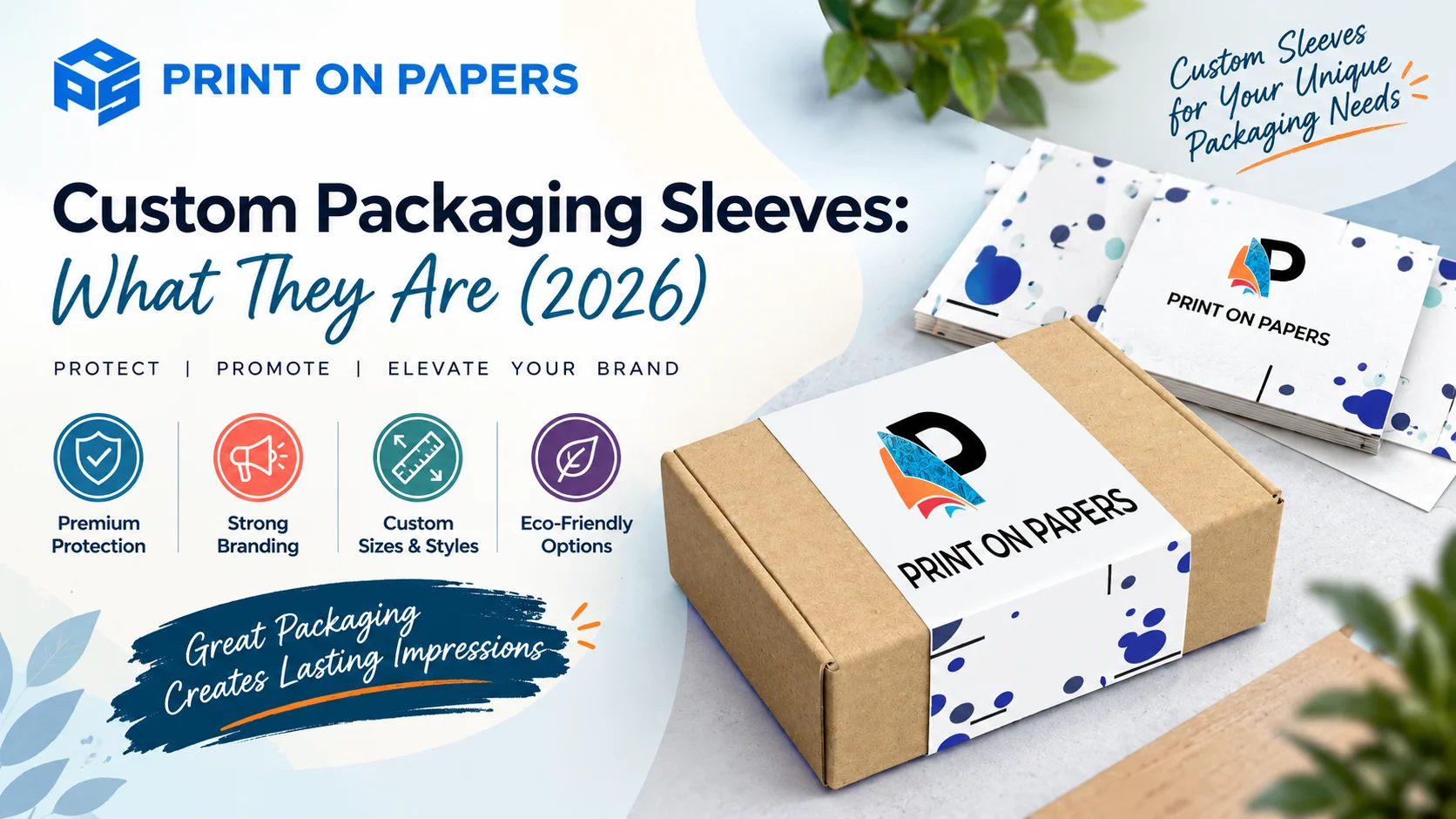
TL;DR: A custom packaging sleeve is a printed wrap that slides around a plain box, jar, or tub so a brand doesn’t have to pay for a new box mold just to look finished. Launches, short batches, one season items, that’s where sleeves usually show up first. At smaller order sizes they’re almost always the cheaper route too.
People ask this a lot, and fair enough. A custom packaging sleeve is a printed band, paperboard, film, or kraft stock, that wraps around a box or jar a brand already has sitting in a warehouse. The box does the heavy lifting. The sleeve does the talking. That’s really all there is to the idea, and it’s why so many small brands lean on sleeves long before they ever price out a custom box mold.
A sleeve is not a box. People mix this up constantly, so let’s just get it out of the way.
It’s a wrap that goes over a container someone already owns, usually something stock sized and plain. Three materials show up again and again. FSC certified paperboard, which gives you that flat, clean surface to print on. LDPE film, better when the product has curves it needs to hug. And shrink film, which heats down tight around whatever odd shape you’ve got, jars, tubs, bottles with a weird neck.
Here’s why a brand owner would even care. Buy plain stock boxes in bulk, keep that cost boring and predictable, then print sleeves in smaller batches and change the design whenever you feel like it, a new flavor, a holiday run, whatever. The box never moves. The sleeve is the only thing that changes.
It starts flat. A printed sheet, nothing fancy, until someone scores it, folds it into a loop, and seals one seam shut, either with glue or a perforated edge depending on who’s making it.
Once that loop exists it slides right over the box or jar it’s built for. Friction usually holds it there. Sometimes there’s a tab and slot setup that locks it without any adhesive at all. No mold needed. No die cut blank to design from scratch, because honestly, the container already solved that problem for you. That’s the real reason sleeve orders come back quicker than a brand new custom box would. One flat shape, print it, trim it, done. No folded structure sitting around waiting on a prototype round.
Small orders, sleeves win almost every time, mostly because there’s no mold fee eating into the budget. Crank the volume way up though and things shift. Eventually a full custom box can edge ahead once that tooling cost gets spread thin enough across enough units.
| Factor | Custom Packaging Sleeve | Full Custom Box |
| Tooling or mold cost | None | Usually required for a new shape |
| Best order size | Small to mid runs | Large runs where tooling spreads out |
| Lead time | Shorter, skips die line prototyping | Longer, especially the first order |
| Branding surface | Partial wrap, front and sides | Full surface, every panel |
| Material options | Paperboard, LDPE, shrink film | Corrugated, rigid, folding carton |
Testing something new before committing real money to box tooling. A seasonal flavor that only runs a few months and then disappears. Already sitting on stock boxes and just need them branded, fast, without a six week lead time. All three of those point to a sleeve.
Once the numbers get big enough that tooling cost barely registers per unit, a full box starts pulling ahead, especially if the brand wants every single panel printed instead of just a wraparound strip doing the work.
Three materials cover almost everything shipping in the US right now.
LDPE sleeves use a flexible film. Good for a snug fit, a little moisture resistance baked in. Paperboard and kraft sleeves go the opposite way, flat, clean, and easy to recycle since most of that stock carries FSC certification. Shrink sleeves heat seal around whatever shape you throw at them, bottles, tubs, anything that isn’t a plain cylinder, which is exactly why people searching for a shrink sleeve alternative often land on these when a flat label just won’t cooperate with the curve.
Worth mentioning a fourth one too, the product band sleeve. Narrower. More of a strip than a full wrap. Brands use it to bundle two items together or seal an opening so a customer can tell right away nothing’s been tampered with.
Food and beverage brands sleeve jars and bottles instead of redesigning packaging every time a recipe shifts. Candle and cosmetics brands do something similar, a fresh sleeve over the same glass jar each season beats reordering custom glass from scratch, every time. Subscription box companies brand a plain shipping box the same way, since custom die cut tooling on every drop just doesn’t pencil out.
Electronics accessory brands, small batch food producers, tend to follow the same script. Buy the container once, at volume, then order custom packaging sleeves separately whenever branding or flavor or season changes. Base packaging cost stays flat. The printed layer stays flexible. That’s really the whole appeal in one sentence. Sleeves also live inside a bigger group of custom packaging supplies, tissue paper, roll labels, crinkle fill, all things brands mix and match depending on what kind of unboxing moment they’re chasing.
| Question | Answer |
| What is a packaging sleeve? | A printed wrap, usually paperboard, film, or shrink stock, that slides around an existing box or container. It adds branding without touching the box’s actual structure. |
| How do custom packaging sleeves work? | A flat sheet gets scored, folded into a loop, sealed along one seam, then slid over the container and held there by friction or a tab and slot closure. |
| Are packaging sleeves cheaper than boxes? | At low to mid volumes, usually. They skip the mold or tooling fee a brand new box shape would otherwise need. |
| What is a shrink sleeve alternative? | A paperboard or LDPE sleeve often steps in here, giving a flat printed wrap instead of a heat sealed film, especially on simple cylindrical or rectangular shapes. |
| Can packaging sleeves be recycled? | Paperboard and kraft sleeves can go in recycling wherever the local facility takes coated or printed paperboard. FSC certified stock traces back to forests that are actually managed, not just marketed as sustainable. |
Worth knowing too, this market isn’t shrinking. Grand View Research put the global shrink and stretch sleeve labels market at 15.1 billion dollars back in 2023, with growth projected at a 5.5 percent compound annual rate through 2030 (Grand View Research, Shrink & Stretch Sleeve Labels Market Report). And since the paperboard versus plastic film question comes up constantly, the US Environmental Protection Agency reports an 80.9 percent recycling rate for paper and paperboard packaging nationally. That’s among the highest of any packaging material the agency tracks (EPA, Containers and Packaging: Product-Specific Data). Numbers worth having on hand if sustainability ever comes up in a packaging decision.
Nobody should have to guess at sleeve pricing. Nobody should sit around for weeks wondering if a design idea is even going to work in real life. Production typically runs 7 to 10 working days once a proof gets approved, shipping goes out free worldwide, and a design team can turn a logo into something print ready before anything touches a press.
Want real pricing on your own sleeve design? Get a free quoteand have a proof in hand before your next production run.
A custom packaging sleeve solves exactly one problem, changing how a product looks without touching the box underneath it. For a new launch, a seasonal flavor, a small batch that won’t run twice, that kind of flexibility usually matters more than shaving a few cents off a per unit price. Some brands grow out of sleeves eventually and move into full custom boxes once volume justifies the tooling spend. Plenty of others never do. The box underneath just never really needed to change in the first place, so why force it.
Print On Papers is a custom printed paper and wrapping paper company serving restaurants, bakeries, delis, food trucks, butchers, florists, apparel brands and food brands across the US and worldwide. We deliver food-safe, eco-friendly, fully branded custom paper, from your first 500 sheets to your next 500,000