
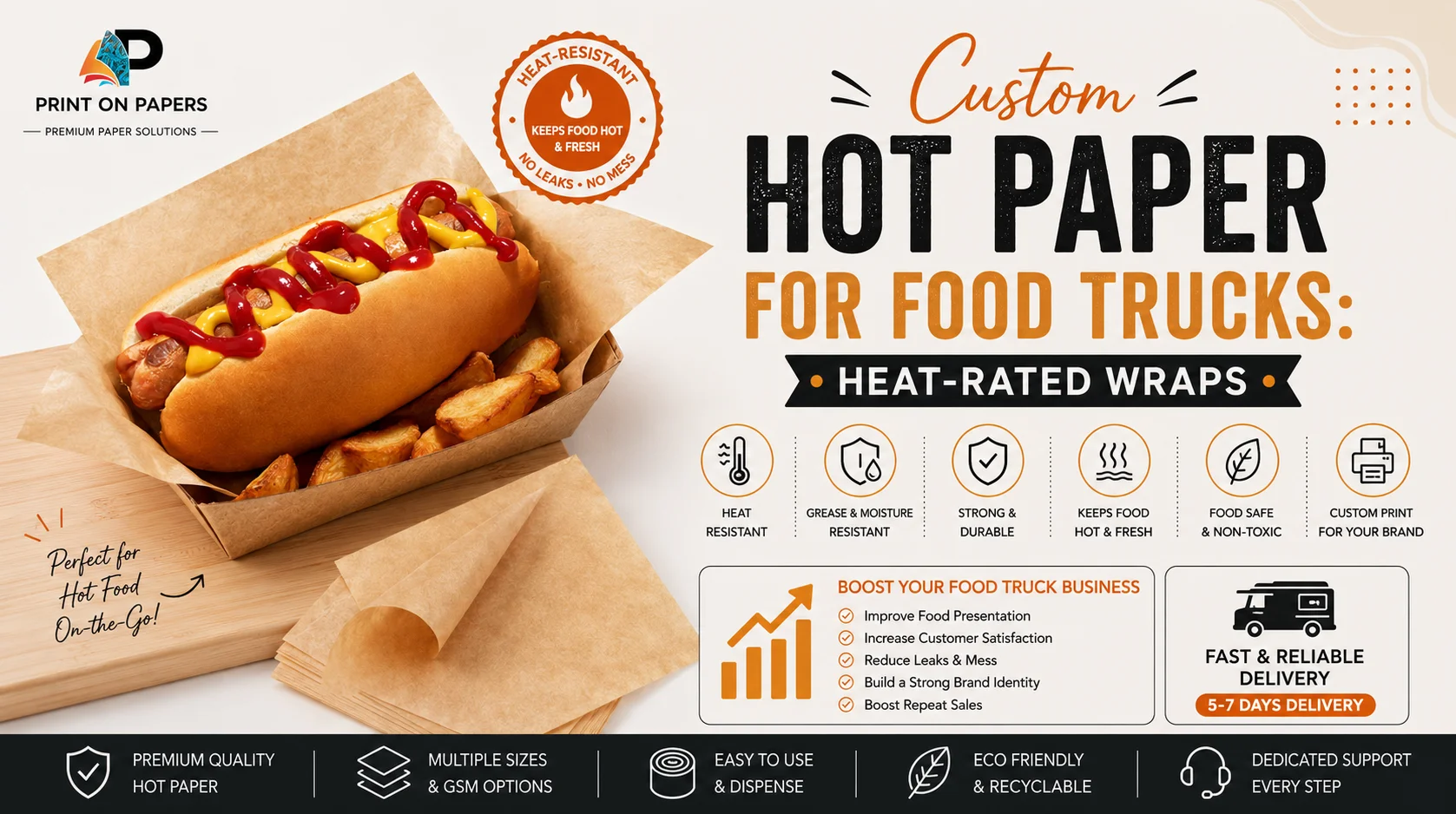
TL;DR: Standard wrapping paper breaks down fast on hot, greasy food, which is exactly what most food trucks serve all day. Custom hot paper for food trucks is built with a heat-rated coating that holds up under steam and oil while still carrying your printed logo. This guide covers why regular paper fails, what makes paper heat resistant, how hot paper compares to greaseproof and deli paper, and what to check before you order, including FDA compliance and minimum order size.
Custom hot paper for food trucks is a heat rated, grease resistant sheet built to hold hot food without tearing, going see through, or letting oil bleed onto a customer’s hands. It’s printed with your logo so the branding survives the same conditions the food does. This guide breaks down why regular paper fails and what to check before you order.
Hot paper is a food contact sheet built specifically for the temperature range a food truck actually works in. Not room temperature. Not the mild warmth of a bakery counter. The 300 to 400 degree range that comes off a flat top, a fryer, or a griddle, and stays trapped in the food for the first few minutes after it’s handed over.
That distinction matters more in 2026 than it used to. Food trucks aren’t the side hustle they were a decade ago. According to IBISWorld, the US food truck industry reached roughly 2.8 billion dollars in market size, and it’s grown at a double digit rate over the past five years. That kind of growth brings more competition at every festival and lunch line, and packaging is one of the few things a small operator fully controls.
Print On Papers builds hot food paper heat resistant coatings specifically for this use case. It’s one product in the broader custom food papers lineup, sitting next to deli paper, butcher paper, and freezer paper, each rated for a different part of the temperature range a food business deals with.
Standard paper doesn’t fail all at once. It fails in a short chain of small problems that add up fast during a lunch rush.
None of this is really about durability in the abstract. It’s about a hot food liner paper doing its one job for the five or ten minutes that actually matters, at the counter and in the customer’s hands. A paper that can’t survive that window isn’t saving money. It’s creating a return conversation and a bad review.
Three specs decide whether a sheet holds up, and they only work as a set.
GSM stands for grams per square meter, the base weight of the paper. Light deli paper runs around 30 to 45 GSM, fine for a cold sandwich but too thin to hold structure under steam. Food truck paper high temp applications generally need a heavier base, closer to 35 to 45 GSM, so the sheet has enough body to resist tearing when it’s hot and wet at once.
Coating is what actually blocks the grease and holds the heat. A PE coating, the same kind used on greaseproof paper, stops oil from migrating through. A silicone or clay based coating adds heat tolerance on top of that, which is why true hot paper performs differently from a plain greaseproof sheet even though both resist grease. Grease proof hot paper combines both properties in one sheet, doing two jobs a lighter paper simply can’t.
Heat rating tells you the actual ceiling the paper is built to survive, not just a general heat resistant label without a number behind it. Ask any supplier for that number specifically. If they can’t give you one, that’s useful information too.
These three get mixed up constantly, and picking the wrong one is the most common ordering mistake food trucks make. The table below breaks down where each one actually fits.
| Paper Type | GSM Range | Coating | Heat Rating | Best For |
| Deli Paper | 30-45 GSM | Light wax or PE | Cold to moderate | Sandwiches, cold cuts |
| Greaseproof Paper | 35-40 GSM | PE coating | Moderate, grease focused | Fried sides, moderate heat |
| Hot Paper | 35-45 GSM | Silicone or clay, plus PE | High, rated for direct hot contact | Straight off the fryer or flat top |
Deli paper works fine for a quick handoff on a cold item, but it’s not built to sit against something hot and oily for more than a minute or two. Greaseproof paper closes that gap on grease but still isn’t rated for sustained high heat. Hot paper is the only one of the three built for both problems at once, which is exactly the scenario a fryer or flat top creates.
Yes, and this is worth checking with any supplier by number, not by adjective. Food contact paper in the US falls under FDA regulation 21 CFR 176, which governs what substances are allowed in paper and paperboard components that touch food directly.
Food safe without a regulation number attached is a marketing phrase, not a compliance statement. Treat it that way when you’re evaluating a supplier for something that touches food your customers are about to eat.
| Question | Answer |
| What temperature can custom hot paper handle? | Most hot paper is rated to handle direct contact with food around 350 to 400 degrees Fahrenheit for the short window between serving and eating, thanks to a silicone or clay based coating layered over a heavier GSM base. |
| Why does my food truck paper get soggy? | Steam trapped against the underside of light paper condenses back into moisture, and without a proper coating, that moisture soaks straight into the sheet, making it weak and soggy within minutes. |
| Is wax paper safe for hot food on a food truck? | Wax coatings soften and can melt at high heat, so wax paper works fine for cold items but isn’t the right choice for anything straight off a fryer or flat top. |
| What’s the real difference between hot paper and greaseproof paper? | Greaseproof paper resists oil but isn’t built for sustained high heat, while hot paper adds a heat rated coating specifically so it holds up against both grease and temperature at once. |
| Can I order custom hot paper in a small quantity? | Yes, minimum orders typically start around 500 sheets, enough for most single truck operations to test a new logo or design without committing to a huge print run. |
| How long does custom hot paper take to arrive? | Standard production runs about 7 to 10 working days from proof approval, with rush options available closer to 5 to 7 days if you’re up against an event date. |
This isn’t a small niche anymore. Independent survey data on the industry puts average annual food truck revenue at roughly 346,000 dollars, with the large majority of trucks, over 90 percent, running as independent operations rather than franchises. That’s a lot of individual operators making their own packaging decisions, not a handful of corporate buyers.
I can’t hand you Print On Papers’ internal lab numbers here, since that kind of proprietary testing data belongs to the company and I don’t have access to it to quote accurately. What I can tell you honestly is what the third party market data shows: a growing, increasingly competitive industry where branded, functional packaging is turning into a real differentiator rather than a nice to have. When two trucks are parked side by side at the same event, the wrap in a customer’s hand is doing marketing work whether it’s built for that or not.
Heat is only one end of the packaging problem. If your operation also handles raw prep or holds meat before service, the same logic applies at the other temperature extreme. Butcher shops and meat markets deal with the cold chain version of this exact issue, and custom freezer paper is built for that side of it. Worth a look if your truck’s prep work spans both ends of the temperature range.
Run through this list before you commit to a supplier.
If you also run breakfast items or loaded sides, it’s worth checking custom bagel paper and custom cheese paper at the same time, since ordering multiple paper types from one supplier usually simplifies both design approval and shipping.
If your current wrap is tearing, going soggy, or losing its branding halfway through service, that’s a paper problem, not a food problem, and it’s a fixable one. Print On Papers builds custom hot paper specifically for food truck volume, with the heat rating and grease resistance this guide just walked through.
Custom hot paper for food trucks exists because standard paper simply wasn’t built for what a truck actually serves all day, hot, oily food handed straight from a fryer or flat top into someone’s hands. The fix isn’t complicated. Look for a real heat rating, confirm the coating type, check that it’s FDA compliant under 21 CFR 176, and start with an order size that matches how a single truck actually operates. Get those four things right, and the paper stops being a weak point in service and starts working the same way your menu does, as something customers remember.
Print On Papers is a custom printed paper and wrapping paper company serving restaurants, bakeries, delis, food trucks, butchers, florists, apparel brands and food brands across the US and worldwide. We deliver food-safe, eco-friendly, fully branded custom paper, from your first 500 sheets to your next 500,000