
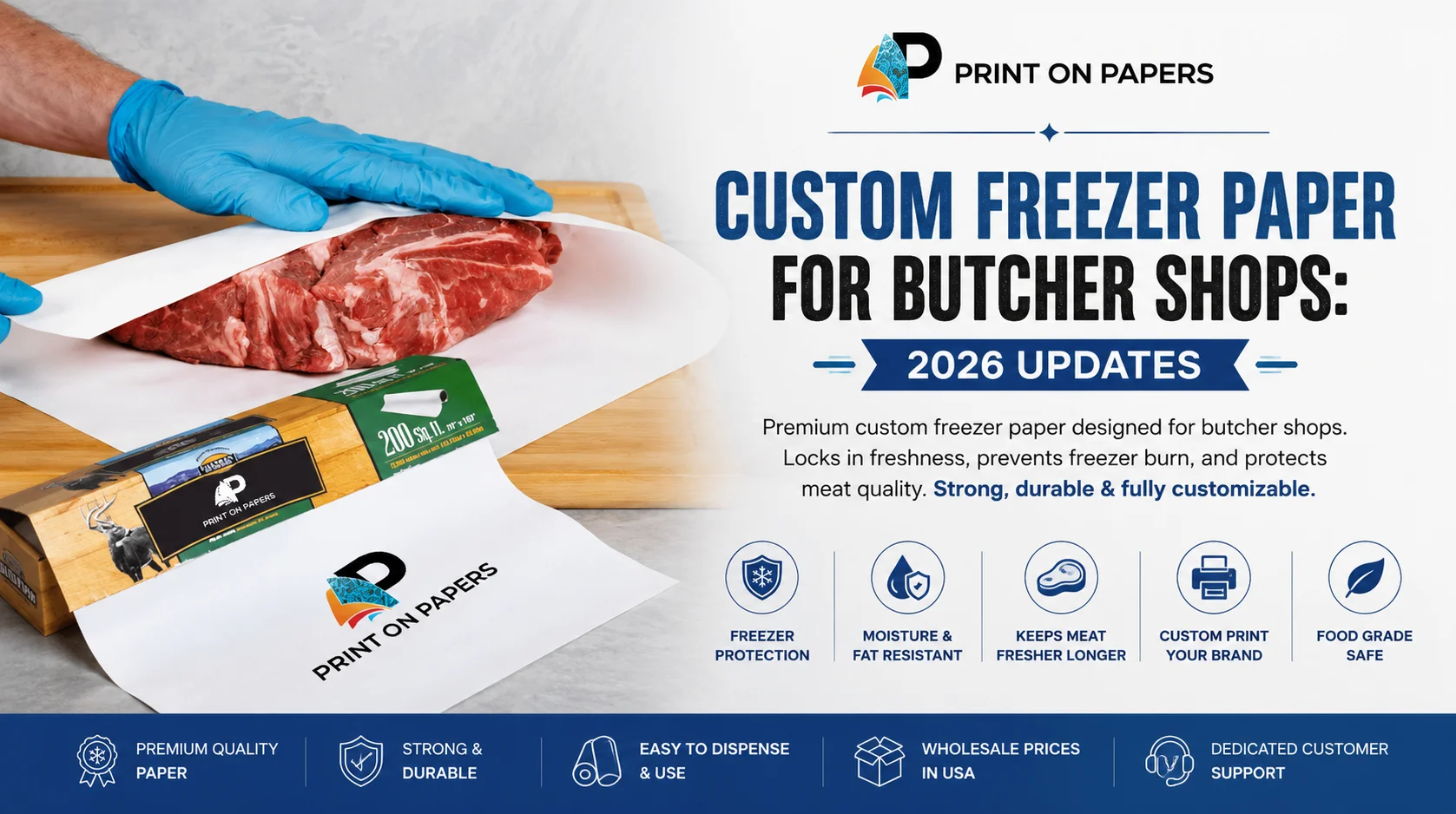
Custom freezer paper for butcher shops needs three things to be safe and legal in 2026: FDA compliance under 21 CFR 176, a polyethylene coating free of BPA, and no added PFAS. Several states have new packaging laws taking effect this year, so ask your supplier to confirm compliance in writing, not just in a sales pitch. This guide walks through what to check, what the coating actually does, and how to order custom freezer paper the right way.
Custom freezer paper is kraft paper with a polyethylene coating on one side, printed with a butcher shop’s logo, and built to wrap meat before it goes into the freezer. The coating blocks moisture and air, so the meat does not dry out or develop that gray, freezer burned look. The paper side stays plain so staff can write the cut and the date with a marker.
This is different from a simple kraft sheet. Plain kraft paper soaks up moisture and does nothing to slow freezer burn. Custom meat freezer paper solves that problem while also doing double duty as a branding tool every time a customer walks out with a wrapped cut under their arm.
Butcher shops, meat markets, and small processors are the main buyers here. So are delis that freeze overflow stock and specialty meat counters that pack orders for pickup. Each one needs the same core thing: a coating that holds up cold, and paper that meets food contact rules.
Here is the question most butcher shop owners never ask their current supplier: which regulation, specifically, does your paper meet? “Food safe” is not a regulation. It is a phrase.
The real standard is FDA 21 CFR 176, the federal rule that governs what materials are allowed to touch food, including paper and paperboard components. This is the actual government text, published on the Electronic Code of Federal Regulations site, and it is public and free for anyone to check. A supplier who is telling the truth will name this citation without hesitation.
Freezer paper FDA compliant butcher shop suppliers should be able to answer three direct questions on the spot. What is the coating made of? What regulation covers it? Can you confirm that in writing? If a supplier stalls on any of these, that hesitation is the answer.
PE stands for polyethylene, a thin plastic film fused to one side of the paper. This is what makes freezer paper different from plain butcher paper. The coated side faces the meat, and it creates a barrier against air and moisture that plain paper cannot provide on its own.
PE coated freezer paper needs to be applied evenly and bonded correctly, or it fails at the exact moment you need it most, which is long term storage. A thin or inconsistent coating lets air sneak in around the seams, and that is when freezer burn starts, even in a properly set freezer.
Paper weight matters here too. Heavier stock in the 40 to 50 pound range holds up better over months of storage than lighter economy paper, since it resists tearing when it gets cold and stiff. If your shop wraps whole cuts for long term freezing rather than short term counter service, weight is not a detail to skip past.
This is where a lot of confusion happens, so let’s clear it up plainly. BPA, or bisphenol A, is a separate compound from polyethylene. PE coating itself does not inherently contain BPA. The concern comes from how some manufacturers source and process their coating materials, not from the basic chemistry of PE.
That said, sourcing varies by supplier, and butcher shops are right to ask. BPA free freezer paper USA suppliers should confirm this status directly, the same way they confirm FDA compliance, rather than letting the word “food safe” do all the work in a sales conversation.
Ask for both confirmations together. A supplier who names the FDA regulation and separately confirms BPA free status is giving you two different, checkable facts. A supplier who gives you one vague reassurance covering both is giving you a sales line.
This is the part most guides skip, and it is the part that actually protects your shop. Here is a short list to run through before you place an order.
Ask for the specific FDA citation, not a general safety claim. Ask if PFAS free status can be confirmed in writing, since twelve or more states now restrict PFAS in food packaging in some form. Ask about paper weight and coating type together, since a supplier who knows their own specs will answer both without checking with someone else. And ask how long they have supplied butcher shops specifically, since general packaging suppliers do not always understand meat storage conditions the way a food paper specialist does.
Print On Papers builds custom freezer paper around FDA 21 CFR 176 compliance, BPA free PE coating, and PFAS free materials as the baseline, not as an upsell. Every order includes a proof before production, so you see exactly what you are getting before it ships.
These two get confused constantly, and the mix up matters more than people think. Custom butcher paper is uncoated kraft paper. It is what you use for counter service, short term wrapping, and handing a cut across the register.
Freezer paper starts as that same kraft base, then adds the PE coating on one side. That coating is the entire difference, and it is what makes freezer paper suitable for weeks or months of cold storage rather than a same day sale.
If your shop only wraps for immediate pickup, butcher paper alone may cover it. If you freeze cuts for later sale, meal kits, or bulk orders, you need the coated version. Many shops stock both, since they solve two different problems rather than one paper doing both jobs well.
The “2026” in this topic is not decoration. Maine’s rule restricting PFAS in plant fiber food packaging, including paper wraps and liners, takes effect on May 25, 2026, and applies to paper based packaging materials specifically. At least a dozen states now have some form of restriction on PFAS in food packaging, and according to Safer States, a nonprofit that tracks this kind of state policy across the country, more of these laws are phasing in through the rest of this year and into 2027.
Most butcher shops are not shipping products into every one of those states, but the trend line matters even if you are not. Suppliers are shifting their standard materials to stay ahead of these rules, and a shop that asks for PFAS free confirmation now is simply asking the same question regulators are already asking manufacturers.
Before you place a custom order, confirm these details rather than assuming your supplier has already sorted them out.
| What to Check | Why It Matters |
| Paper weight (GSM or lb) | Heavier stock resists tearing during long freezer storage |
| Coating type | PE coating outperforms wax for months long storage |
| FDA citation | Confirms the paper is legally rated for direct food contact |
| PFAS free status | Keeps you ahead of expanding state packaging laws |
| BPA free status | A separate, checkable claim from PFAS or FDA status |
| Sheet or roll format | Match your equipment and counter setup |
| Minimum order and lead time | Avoid a supply gap mid season |
| Question | Answer |
| Is custom freezer paper FDA compliant? | Yes, when it is made to meet FDA 21 CFR 176, the federal rule covering paper and paperboard used in direct food contact. Always ask a supplier to name this citation specifically rather than accepting a general safety claim. |
| Is PE coated freezer paper BPA free? | PE coating and BPA are chemically separate things, and PE itself does not inherently contain BPA. Sourcing still varies by manufacturer, so ask your supplier to confirm BPA free status directly. |
| What is the difference between butcher paper and freezer paper? | Butcher paper is uncoated kraft paper for short term counter wrapping. Freezer paper adds a PE coating on one side, which creates the moisture barrier needed for long term freezer storage. |
| How long does meat last in freezer paper? | Properly wrapped meat in PE coated freezer paper typically holds well for several months without major freezer burn, provided the coated side faces the meat and the wrap stays sealed. |
| What is the minimum order for custom freezer paper? | Orders typically start at 500 sheets, with pricing based on paper weight and print complexity. Ask your supplier for an exact quote based on your shop’s volume. |
If you have read this far, you already know what to ask a supplier before you reorder. The next step is simple. Custom freezer paper from Print On Papers ships with FDA 21 CFR 176 compliance, BPA free PE coating, and PFAS free materials confirmed upfront, not buried in fine print.
Get a Free Quote for Custom Freezer Paper →
Custom freezer paper for a butcher shop in 2026 comes down to three checkable facts: FDA compliance, a BPA free PE coating, and PFAS free materials, all confirmed in writing rather than assumed. State packaging laws are moving fast this year, and the shops that ask the right questions now avoid a scramble later. Whether you are switching suppliers or placing your first custom order, Print On Papers and its full line of custom food papers are built around answering those questions before you have to ask twice.
Print On Papers is a custom printed paper and wrapping paper company serving restaurants, bakeries, delis, food trucks, butchers, florists, apparel brands and food brands across the US and worldwide. We deliver food-safe, eco-friendly, fully branded custom paper, from your first 500 sheets to your next 500,000