
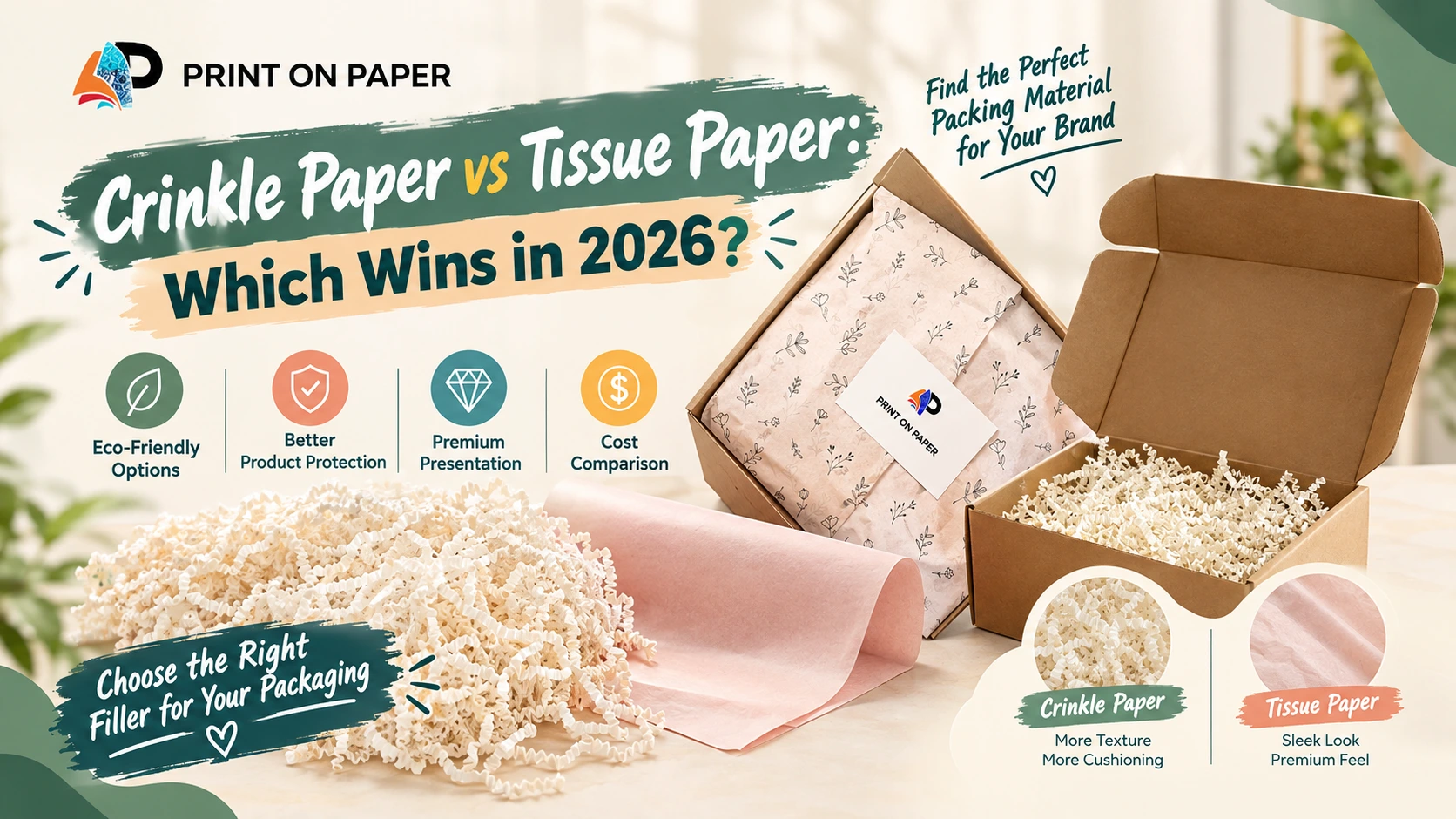
TLDR: Short version, crinkle paper cushions and adds texture, tissue paper wraps clean and prints well. Most brands end up using both. The table below breaks down why.
Table of Contents
Crinkle paper is shredded, crimped kraft or tissue stock, and its whole job is filling empty space and absorbing shock. Tissue paper does the opposite job. It stays flat so a brand can print across it or fold it around a product. Most gift boxes end up needing a bit of each, not one replacing the other.
Crinkle paper gets shredded into thin strips, then crimped so it holds spring, bouncing back after a box takes a hit in transit. The tissue stays flat and uncut. That’s really the whole distinction, one is built to move and fill, the other is built to lie still and look good doing it. Print On Papers makes both, and if you’re weighing them as competitors, that’s probably the wrong frame. They’re doing two different jobs inside the same box.
Numbers tell this better than opinions do. Here’s where each one lands on weight, eco rating, visual impact, and cost.
| Factor | Crinkle Paper | Tissue Paper |
| Weight per fill | 1 to 2 inches of loose fill cushions most small boxes | Sheets run light, typically under 20 GSM |
| Eco rating | Recyclable kraft stock, curbside accepted in most US cities | FSC certified stock available, also curbside recyclable |
| Visual impact | High texture, catches light, shows motion on camera | Flat, clean, better for printed branding |
| Cost per box | Lower cost per cubic inch of fill | Slightly higher per sheet for printed runs |
Depends what’s going in the box, honestly. Something fragile, a candle, anything glass, needs crinkle paper underneath it for the cushioning. Flat goods like apparel or jewelry tend to look better wrapped, since tissue won’t bunch the way loose fill does under a lid. Custom crinkle paper is built for exactly that protection job, the one tissue was never meant to do.
The camera test goes to crinkle paper, no contest. It moves the second the lid lifts, catches light, gives the footage texture a flat sheet just can’t produce, and that’s a big part of why subscription boxes lean on it so heavily. Tissue reads flatter on screen. Still, a printed sheet with a logo gives a cleaner reveal right before the product shows up, so a lot of creators stack tissue on top with crinkle doing the quiet work underneath.
Neither one wins this outright, it comes down to sourcing more than material type. The American Forest and Paper Association puts the 2024 US recycling rate at 60 to 64 percent for available paper and 69 to 74 percent for cardboard, numbers that come straight from their industry recycling report. FSC certified tissue traces back to forests that are actually managed, not clear cut, and kraft crinkle paper picks up curbside in most US cities without issue. Get the sourcing right on either one and the sustainability argument holds up the same way.
Layer crinkle on the bottom, tissue on top, that’s the combination most brands land on once they’ve tested a few boxes. Crinkle handles the cushioning, custom tissue paper handles the reveal, and running both costs only a little more than using one alone. It’s worth the extra cents, too. Retail Dive’s reporting on consumer packaging data found that 52 percent of online shoppers say they’re likely to buy again from a brand whose packaging stood out, which is a bigger number than most people expect from something as small as box filler.
| Question | Answer |
| Which is better for gift boxes, crinkle paper or tissue paper? | Fragile items need crinkle paper’s cushioning. Flat items like clothing or jewelry usually look better in tissue. A lot of brands just use both. |
| Is crinkle paper or tissue paper more eco friendly? | They’re close. Both can be fully recyclable if you’re buying certified kraft or FSC stock, so the deciding factor is really the supplier, not the material. |
| Which looks better in an unboxing video? | Crinkle paper, hands down, for the motion and texture on camera. Tissue still earns its place as the clean layer right before the product appears. |
| Can I use crinkle paper and tissue paper in the same box? | Yes, and most brands do. Crinkle on the bottom for cushioning, tissue on top for the reveal. |
| What is the minimum order for custom crinkle paper or tissue paper? | 500 units minimum for either one, and free design support comes with the order. |
Picked your filler yet? Explore custom packaging supplies or get a free quote, and expect a sample within 7 to 10 working days.
Crinkle paper and tissue paper were never really in competition. One protects what’s inside the box, the other makes the opening feel like something. Use crinkle paper when the product needs protecting, tissue paper when it needs a clean moment, and both together when you want the box to do its actual job.
Print On Papers is a custom printed paper and wrapping paper company serving restaurants, bakeries, delis, food trucks, butchers, florists, apparel brands and food brands across the US and worldwide. We deliver food-safe, eco-friendly, fully branded custom paper, from your first 500 sheets to your next 500,000