
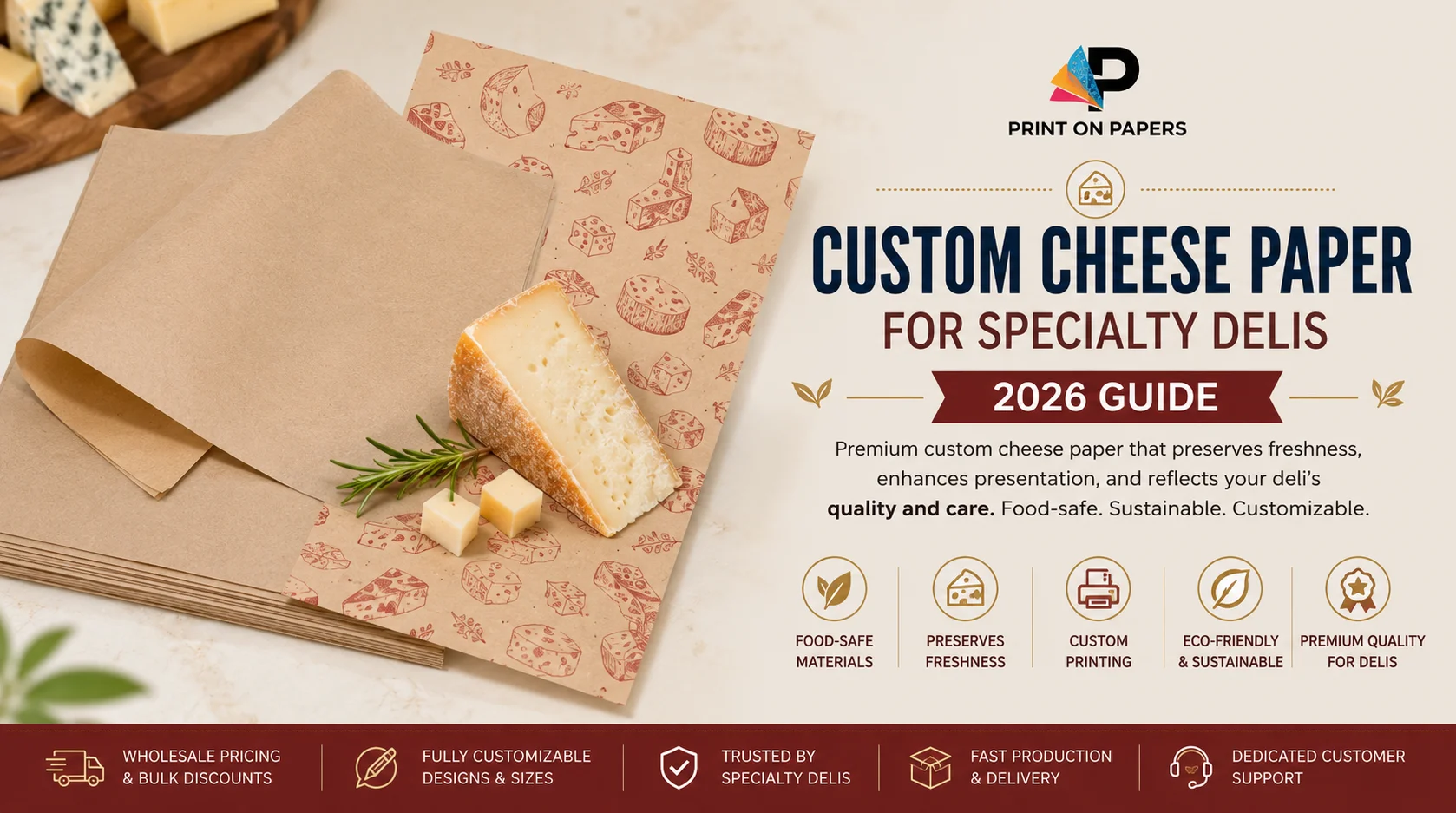
Custom cheese paper for specialty delis is not the same product as the wax paper sitting in most kitchen supply catalogs. It is a purpose built wrap that lets cheese breathe while it ages, instead of sealing in moisture the way regular wax paper does. Delis that switch to it usually notice the difference within one week in the case.
Custom cheese paper in 2026 is a two layer wrap built for a living, ripening food. The outer layer resists light and moisture. The inner layer stays porous enough to let gas and water vapor pass through slowly. That balance is what separates it from wax paper, which is built to block moisture, not manage it.
Most delis reach for wax paper because it is cheap and everywhere. It was never built for cheese though. Wax paper was built to keep sandwiches and baked goods from sticking together, which means it blocks moisture almost completely.
Cheese is different from a sandwich. It keeps ripening after it leaves the wheel, and ripening depends on the cheese losing a small, steady amount of moisture and releasing gases like ammonia. Wax paper stops that process cold. The rind sweats, mold can form in the wrong places, and flavor development stalls.
Here is the part most delis never hear from a supplier. A purpose built alternative has existed for years, and most food paper vendors just never carried it because wax paper is cheaper to produce.
Breathable cheese paper for aging artisan cheese USA solves the exact problem above. A study published in the Journal of Dairy Science tested wrapping films with different water vapor permeability rates on Camembert style cheese. Cheese wrapped in film that lost close to zero moisture over 23 days ended up over ripened and runny under the rind. Cheese left completely unwrapped lost up to 15 percent of its moisture and ripened poorly, drying out. The cheese that ripened best lost a moderate amount of moisture, in the range of 3 to 6 percent over that same period. That is the range custom cheese paper is built to hit.
Picture a wheel of aged cheddar sitting in the case on a Tuesday. It looks fine. By Friday, wrapped in standard wax paper the whole week, the rind has sweated, the surface looks tired, and a regular customer notices before anyone behind the counter does.
That is not a one time loss. It is a pattern. Product gets marked down or tossed. The case looks less appealing next to a competitor who wrapped the same cheese correctly. A soft ripened cheese like Brie can turn slimy under trapped moisture within days, while a hard cheese like Parmesan can dry out and crack at the edges from the opposite problem, uneven airflow. Over a full season, that adds up to real revenue walking out the door, not because the cheese was bad, but because the paper around it was fighting against it the whole time. Most delis never trace the loss back to the wrap. They blame the batch, the supplier, or the weather, when the paper was the actual variable.
The difference comes down to what each paper is built to do. Wax paper blocks moisture. Custom cheese paper for specialty delis manages it. Here is how they compare directly.
| Feature | Wax Paper | Custom Cheese Paper |
| Moisture control | Blocks nearly all moisture exchange | Allows controlled, slow moisture loss |
| Gas exchange | Very limited | Releases ammonia and carbon dioxide gradually |
| Best use | Sandwiches, baked goods, short term wrap | Aging and displaying artisan cheese |
| Rind development | Often trapped or uneven | Supported through steady airflow |
| Branding | Basic print options | Full custom printing for deli and retail branding |
Not every paper labeled cheese paper is actually built the same way. Before ordering, check for a few specific things.
Look for a documented breathable structure, not just a marketing claim. Ask what the paper is rated for and whether it is food contact compliant under FDA 21 CFR 176. Confirm the coating is food safe and that inks used for branding are food grade too. If your deli handles a range of cheese, from soft ripened Brie and Camembert to hard aged cheddar, Gouda, and Parmesan, ask whether one paper works across that range or whether you need different weights for different cheese types.
Ask about turnaround time too. A supplier that quotes weeks instead of days will not help you during a holiday rush when your case volume doubles overnight. Artisan cheese wrapping is not a one size fits all job, and a supplier who treats it that way is not the right fit for a serious cheese counter.
Specialty food paper USA suppliers should be able to answer all of that without hesitation. If a supplier cannot explain the difference between their cheese paper and their wax paper in plain terms, that is a sign to keep looking. That is exactly why custom cheese paper for specialty delis needs to meet a documented breathable standard, not just carry a marketing label. This is the baseline for specialty cheese packaging USA delis should expect from any supplier they work with.
Before you order, confirm four things. Confirm the paper is rated for breathability, not just labeled food safe. Confirm it meets FDA 21 CFR 176 for food contact paper. Confirm the coating and inks are food grade. Confirm the supplier can size the paper for your specific case, from small wedges to full wheels.
Once you know what to look for, ordering custom printed cheese paper for specialty deli USA operations is straightforward. Most suppliers set a minimum order around 500 sheets, priced from roughly 20 to 25 cents per sheet depending on size and print complexity. Production typically runs 7 to 10 working days from proof approval, with rush options available if your timeline is tighter.
For a deli or specialty cheese shop, custom cheese paper wholesale pricing usually beats buying small retail packs by a wide margin, and it comes with the added benefit of your logo on every wheel you wrap. Ordering cheese aging paper custom to your case sizes is now standard practice for delis that take product quality seriously, rather than an upgrade reserved for large chains. If you want to see the actual specs and sizing for this product, the Custom Cheese Paper page lays out weights, dimensions, and pricing in full.
Cheese is not the only product where paper choice matters. Sandwiches, baked goods, and hot food all need a wrap built for their specific job, the same way cheese does. If you run a broader food service operation beyond a cheese counter, it is worth understanding how paper choice changes across your whole menu. If you want to read more, click here to see our full breakdown of the best custom food wrapping paper for restaurants.
| Question | Answer |
| What is custom cheese paper and how is it different from wax paper? | Custom cheese paper uses a breathable two layer structure that lets cheese release moisture and gas slowly while it ages. Wax paper blocks moisture almost completely, which works against cheese that is still ripening after purchase. |
| Is cheese paper the same as parchment paper? | No. Parchment paper is silicone coated and built for high heat baking. Cheese paper is built for cold storage and controlled moisture exchange, not oven use. |
| Can cheese paper be reused? | Yes, as long as it stays clean and intact. Many delis reuse a sheet for a day or two of display before replacing it. |
| What size cheese paper do I need for a deli case? | Standard sizes run from 8 by 8 inches up to 12 by 12 inches, with custom sizes and rolls available for larger wheels or high volume counters. |
| Does custom cheese paper wholesale pricing really save money over retail packs? | Yes. Wholesale pricing per sheet is typically a fraction of retail pack pricing, and it includes custom branding at no added cost from most suppliers. |
| Is custom cheese paper food safe for direct contact with cheese? | Yes, when it meets FDA 21 CFR 176 for food contact substances and uses food grade inks and coatings, which reputable specialty food paper USA suppliers document clearly. |
A wheel of cheese wrapped correctly holds its texture, its flavor, and its shelf appeal all the way through the week. Print On Papers builds custom cheese paper for specialty delis with the breathability real cheese aging needs, plus your branding on every sheet. Get a free quote → and see actual pricing for your case size and order volume.
Wax paper was never built for cheese. It was built for sandwiches, and cheese pays the price when it gets wrapped in something designed for a different job. Custom cheese paper for specialty delis exists specifically to solve that mismatch, using a structure that dairy science actually supports rather than a marketing claim with nothing behind it. If your case has looked a little tired by the end of the week, the paper is worth a second look before anything else changes.
Print On Papers is a custom printed paper and wrapping paper company serving restaurants, bakeries, delis, food trucks, butchers, florists, apparel brands and food brands across the US and worldwide. We deliver food-safe, eco-friendly, fully branded custom paper, from your first 500 sheets to your next 500,000