
What Is Greaseproof Paper? The 2026 Sandwich Packaging Guide for Food Businesses
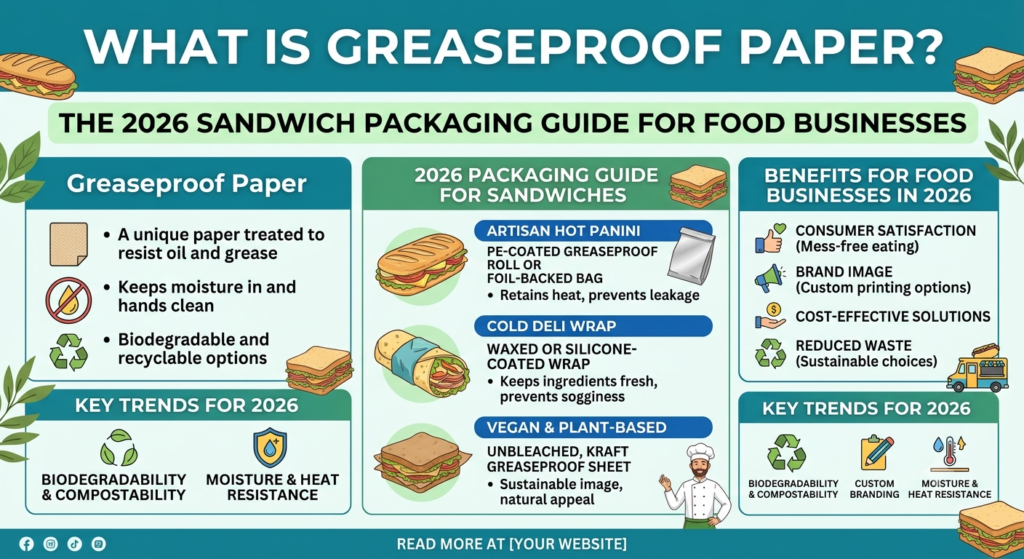
I’ve talked to hundreds of deli owners, sandwich shop managers, and food truck operators over the years. One complaint comes up almost every single time. Their food is good. Their service is fast. But the moment a customer picks up that sandwich and the wrapper starts soaking through, greasy and translucent before they even get to the car something breaks. Not the food. The impression. Here’s the thing nobody tells you when you’re sourcing packaging: that moment is entirely preventable. And fixing it does not require spending a fortune. What Is Greaseproof Paper and Why Does It Matter in 2026? Greaseproof paper is a food-grade, grease-resistant sheet made from 100% virgin wood pulp, produced through supercalendering a process that compresses paper fibres under high pressure, closing the pores naturally without fluorochemical coatings. It ranges from 30 to 60 GSM and meets FDA 21 CFR standards for direct food contact. Why does that manufacturing detail actually matter to you right now? Because the U.S. Environmental Protection Agency’s PFAS restriction roadmap is actively pushing food packaging away from fluorochemical treatments. Businesses still running PE-coated or PFAS-treated papers are going to face compliance headaches sooner than they expect. According to The FDA’s full guidance on PFAS in food contact packaging is publicly available here if you want to read the specifics yourself. It naturally produced barriers like supercalendered greaseproof paper to represent the compliant path forward. So switching is not just a brand decision. For many food businesses, it is going to be a regulatory necessity. Why More Sandwich Shops Are Choosing Custom Sandwich Wrapping Paper Walk into any independent sandwich spot that’s grown a loyal following in the last three years. Almost all of them have one thing in common: their packaging looks intentional. Custom printed sandwich wrapping paper is not something they added after they got big. It’s something that helped them get there. The numbers back this up. A Dotcom Distribution packaging study found that nearly 40% of online shoppers had shared an image or video of a product on social media, with branded packaging playing a direct role in that decision. Run 200 covers a day and you are looking at potentially 80 organic brand impressions daily generated at a per-sheet cost somewhere between $0.20 and $0.50. Most restaurant owners spend more than that on a single Instagram ad that disappears in 24 hours. You can read the full Dotcom Distribution packaging findings here.PRWeb Beyond the social angle, brand consistency matters operationally too. When every member of your team wraps a cold sub, a toasted panini, or a deli club with the same custom printed sandwich paper, your customers start to associate that visual with quality. That association builds repeat business. It is that straightforward. At Print On Papers, our custom greaseproof paper is printed using soy-based food-safe inks with full CMYK and Pantone color matching so your brand color is exactly right, not approximately right. Choosing the Right Grease Resistant Paper for Your Sandwich Type Not all sandwich packaging needs are the same, and picking the wrong paper GSM is one of the most common and easily avoided mistakes in food service. For hot sandwiches and toasted wraps, you need paper that holds up under both heat and moisture pressure simultaneously. Our sheets handle temperatures up to 220°C. For something wet and heavy, a pulled pork sub, a meatball wrap, and a 40 GSM supercalendered sheet performs completely differently than a 28 GSM budget option. In our production testing, the 40 GSM holds a standard oil-heavy filling for over 45 minutes with zero visible grease penetration. The 28 GSM shows through in 12 to 15 minutes. That difference is what your customer feels in their hands. Cold deli applications are a different story. For cold cuts, layered club sandwiches, and cheese-based builds, a lighter 30 GSM works well and keeps your per-unit cost sensible. Our custom deli paper is built specifically for that end of the menu. Then there are pressed and toasted sandwiches, paninis, cubanos, grilled wraps. These go through compression and direct heat at the same time. Standard greaseproof paper can open and lose the wrap under that pressure. Our custom heat seal paper solves that problem. The seal holds through the press. Matching your paper to your actual menu saves money and prevents the kind of packaging failure that lands on Google reviews. FSC-Certified and PFAS-Free: What This Actually Means for Your Business Sustainability language has become so overused in packaging that most buyers tune it out. So let me be specific rather than vague. FSC chain-of-custody certification, as defined by the Forest Stewardship Council, tracks paper from a responsibly managed forest through every step of production to the finished sheet in your kitchen. It is an audited supply chain standard, not a self-declared claim. Every greaseproof paper product from Print On Papers carries that certification. PFAS-free means no per- and polyfluoroalkyl substances were used in manufacturing. This matters because PFAS compounds have been linked to environmental persistence and human health concerns, and U.S. regulators are moving to restrict them in food packaging. Our paper achieves grease resistance through the supercalendering process itself — not through chemical treatment applied after the fact. Combined with soy-based food-safe inks, your custom printed paper sandwich bags carry certifications your customers can actually look up and verify. For eco-conscious buyers in your base, that is not a minor detail. Food Wrapping Paper: More Than Just Sandwich Applications Greaseproof paper handles your sandwich line but the same food-grade paper works across basket liners, tray covers, baked goods wrapping, and charcuterie presentation. Many of our clients start with sandwich wrap and expand their order once they see how the print quality holds up across different kitchen conditions. If you want to explore how custom food wrapping paper can work across your full menu, click here to read more about our food wrapping paper solutions. Conclusion: The Wrapper Tells Them Who You Are Greaseproof paper is not a line item to
Food Wrapping Paper Benefits for Restaurants and Takeaways
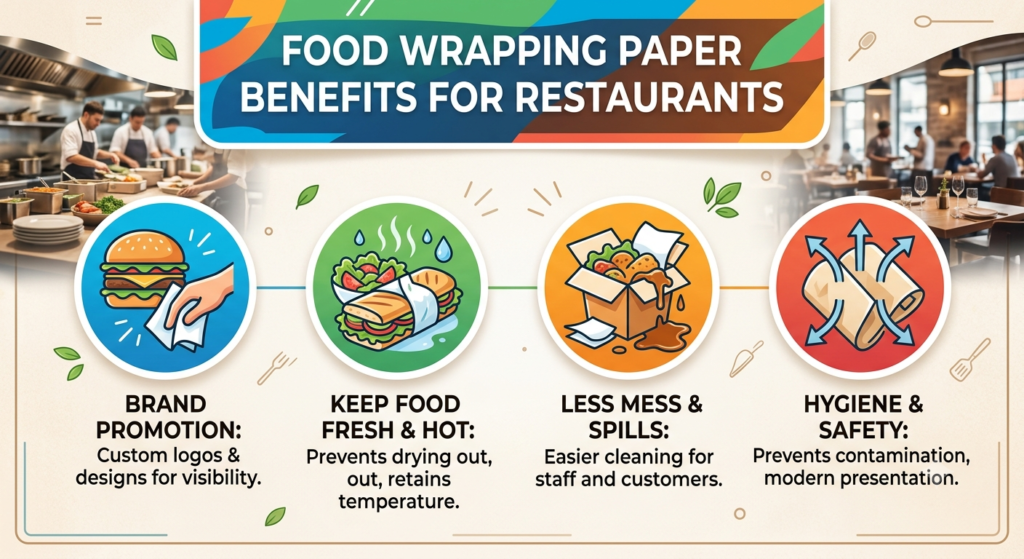
Food wrapping paper is a food-safe, grease-resistant sheet restaurants and takeaways use to wrap and serve food directly to customers. It meets FDA food-contact standards and comes in custom-printed formats that turn every order into a brand moment. Why Your Food Wrapping Paper Tells a Story Before the First Bite Last year, a sandwich shop owner in Brooklyn told us something we have heard dozens of times: “My food is the best on the block. But my packaging looks like every other deli in the city.” That one sentence captures a problem thousands of restaurants are sitting with right now. When a customer picks up their order, they touch the wrapping before they taste the food. That paper is your handshake. It is either saying something about your brand or it is saying nothing at all. Plain white packaging says nothing. Worse, it is generic. The National Restaurant Association’s 2025 Off-Premises Restaurant Trends Report found that 90% of off-premises customers would order a wider variety of items if restaurants used better packaging. Nine out of ten. That is not a marginal improvement opportunity that is a near-universal signal from your existing customer base telling you what they want. Restaurant industry sales in the US are tracking toward $1.5 trillion in 2025. The market is enormous, but so is the competition. The restaurants building loyal repeat customer bases right now are winning on experience, and food wrapping paper is one of the cheapest experience upgrades available. The Business Case Nobody Talks About: Retention Over Reach Most restaurant marketing conversations focus on getting new customers through the door. That is the wrong conversation to start with. Your packaging talks to people who are already buying from you. Every takeaway order is a retention opportunity disguised as a logistical necessity. A customer who unwraps a beautifully printed, branded sandwich wrap goes home with a different memory than someone who unwraps a plain sheet. Shorr Packaging surveyed 2,016 American consumers in late 2024. They found 90% of shoppers are more likely to buy again from brands with eco-friendly packaging. More than half reported actively seeking out sustainable packaging options in the previous six months. Among younger buyers Millennials and Gen Z specifically those numbers were even higher, at 59% and 56%. Your takeaway customers are in those demographics. They notice what you wrap your food in. And frankly, they are judging it. Here is the practical translation: a restaurant owner who upgrades from plain paper to custom-branded, food-safe takeaway wraps is not spending more on marketing. They are making their existing orders do marketing work for them. That is a different kind of leverage. Choosing the Right Type of Food Wrapping Paper for Your Menu Not every paper works for every kitchen. Getting this wrong costs you food quality before the customer even opens the bag. It is the standard for burgers, hot sandwiches, and anything fried. Its dense fiber structure blocks grease without a wax coating, so hot food stays clean and dry without sticking. It handles heat well and keeps presentation sharp on delivery orders. It is the right call for bakeries, artisan delis, and brands with a handcrafted identity. The natural texture photographs well. It has that premium, heritage feel that premium-priced food needs to justify itself visually. It suits cold deli items and cheese-heavy subs where moisture control matters more than heat resistance. For kitchens that pre-portion proteins and work with cold storage, Custom Freezer Paper solves a problem most operators do not think about until it costs them. It is moisture-resistant, food-safe, and fully printable meaning your brand stays consistent even in the walk-in cooler. Bakeries working with pastries, croissants, and high-butter items should look at Custom Butter Paper. It handles direct food contact with fatty items without compromise, and it carries print just as well as any other format. The right choice comes down to what you serve, at what temperature, and what your brand needs to communicate. There is no single answer. But there is always the wrong one and plain, unbranded paper is almost always it. Food-Safe Paper and Compliance: What Every Restaurant Owner Should Actually Know Food safety is not a box to tick. It is the foundation of customer trust. Every paper that touches food in your restaurant needs to meet FDA 21 CFR standards for food-contact materials. That covers the base paper, the inks, and any coatings. What this means practically: the chemistry of your wrapping cannot transfer into your customer’s meal. At PrintOnPapers, soy-based inks are standard across every product. They are non-toxic, food-safe, and cleared for direct food contact. All materials are PFAS-free which is becoming a legal requirement in a growing number of US states as regulators close in on per- and polyfluoroalkyl substances. Paper sourcing is FSC-certified, which means the raw material comes from responsibly managed forests. When a health inspector walks through your kitchen or a customer looks you up online, these certifications are what protects your reputation before you say a word. What Eco-Friendly Packaging Is Actually Worth to Your Business in 2026 Sustainability has moved from a nice-to-have to a customer expectation. The numbers make this hard to argue against. Mintel’s 2025 US Food Packaging Trends Report put it plainly: packaging has become a signal of a brand’s values, not just its logistics. For a takeaway owner, eco-conscious custom food packaging FSC-certified, PFAS-free, compostable-friendly is a genuine point of difference you can lead with. You put it on your menu, your social posts, and your packaging itself. That is a marketing message that costs nothing beyond the paper you were already buying. Custom Sandwich Paper: The High-Frequency Brand Touchpoint Most Restaurants Ignore If you run a deli, a fast-casual spot, a café, or a sandwich chain, pay attention to this section. Custom Sandwich Paper is the most frequently used branded item most food businesses will ever have. Every order, to every customer. Every single day. No other marketing asset touches that frequency at that cost
Custom Sandwich Paper: The Complete Guide for Food Businesses (2026)
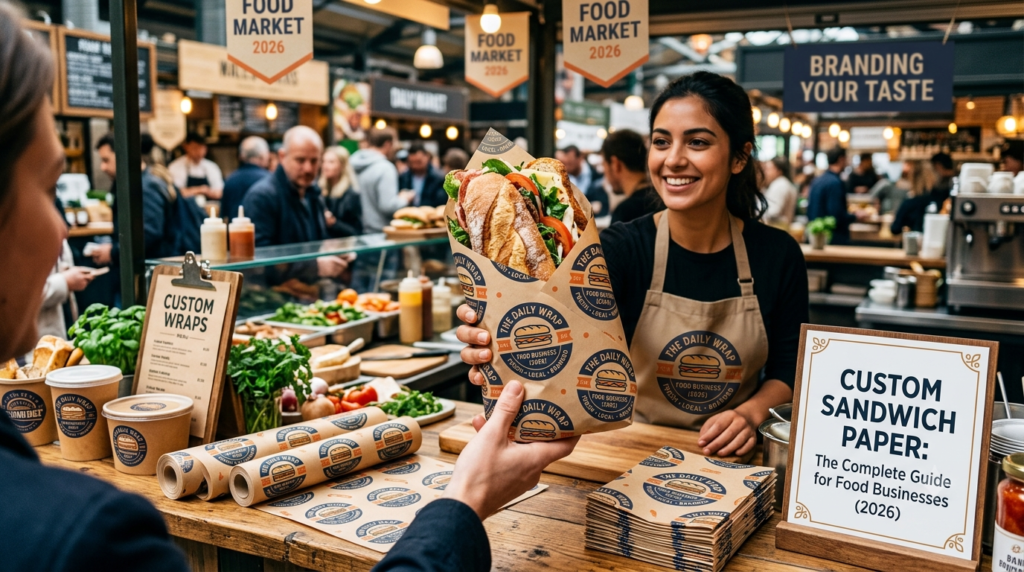
Custom sandwich paper is food-safe wrapping paper printed with your brand’s logo and colors. It keeps sandwiches fresh, grease-free, and protected during handling. Food businesses use it to wrap sandwiches for service, delivery, and takeout. It meets FDA food-contact standards and comes in greaseproof, wax, and kraft options. Think about the last sandwich you ordered from a deli. Before you tasted it, you touched it. You felt the paper. In that split second, before the first bite, you formed an impression about that business. Plain paper said nothing. Branded paper told a story. That one moment is exactly why so many food businesses across the US are switching to custom sandwich paper. It’s not just a wrap. It’s your first physical handshake with every customer, every single day. What Is Custom Sandwich Paper and Why Does It Matter? Custom sandwich paper is food-safe wrapping paper manufactured to FDA food-contact standards and printed with your logo, brand colors, or design. It wraps sandwiches, subs, wraps, and similar items while actively reinforcing your brand identity at the point of delivery. It’s more than food packaging paper. It’s a silent salesperson working every time a customer picks up their order. According to Expert Market Research, the global fast food wrapping paper market was valued at USD 1,159.67 million in 2025 and is projected to reach USD 1,907.05 million by 2035, growing at a CAGR of 5.10%. A significant share of that growth comes from food chains adopting custom-printed sandwich wrapping paper specifically to boost brand visibility. Here’s the thing most small food businesses don’t realize. Every day you use plain paper, you’re giving your competitors a free advantage. Your customer photographs their lunch. They post it. Your blank wrap appears in that photo. Your competitor’s logo doesn’t. Types of Custom Sandwich Wrap Paper: Which One Fits Your Menu? Not every sandwich paper works the same way. Choosing the right type comes down to your menu, your service format, and your brand aesthetic. Here’s what matters: Greaseproof Paper: It is the go-to choice for hot, saucy sandwiches. It resists oil penetration up to 40 GSM and keeps packaging clean even with heavy fillings. Delis, sub shops, and fast-casual restaurants rely on it daily. Wax Paper It handles moisture effectively and works well for cold sandwiches, deli wraps, and refrigerated items. Its smooth finish takes logo printing cleanly. Kraft Paper It gives your brand a natural, artisan look. It’s FSC-certified, biodegradable, and resonates strongly with eco-conscious customers. According to Future Market Insights, the 40–50 GSM segment dominates the paper wrap market, representing the most common spec for sandwich and burger wrapping across QSR formats. Parchment Paper: It suits premium cafe sandwiches and artisan delis. Its heat-resistant coating handles warm items without compromising print clarity. If your menu also includes hot items beyond sandwiches, our Custom Hot Paper is purpose-built for high-temperature applications. For specialty counters, Custom Cheese Paper handles breathable storage while carrying your branding. Bakeries and bagel shops can extend the branded experience with Custom Bagel Paper. Why Custom Printed Sandwich Paper Is a Branding Investment, Not Just a Cost Food businesses often look at sandwich wrapping paper as a supply line item. That framing costs them real money. Consider this: At $0.30–$0.40 per branded sheet, your logo-printed paper delivers more impressions per dollar than almost any digital ad campaign. Every time a customer carries their wrapped sandwich out of your shop, your brand travels with them. According to Innova Market Insights, consumer mentions of branded paper packaging in the food and beverage industry are growing steadily, with Gen Z and Millennials driving the shift toward sustainable, custom-printed options. These are the same customers who photograph their food before eating it and share it with hundreds of followers. Innova Market Insights Custom printed sandwich paper works on three levels simultaneously. It protects the food. It communicates professionalism. And it puts your brand in front of every person who sees, touches, or photographs that order. One deli owner who switched to branded sandwich wraps told our team: “Within a month, customers were tagging us in food photos. We hadn’t changed anything, except the paper.” That’s the social media multiplier effect. And it costs fractions of a cent per sheet. The term “plain paper tax” captures this well. Every time your business uses unbranded food packaging paper, you’re silently paying a cost in lost brand awareness. It accumulates. Quietly. Every single day. What to Look for When Ordering Custom Sandwich Wrapping Paper When you’re sourcing custom printed sandwich wrap paper for your business, five things matter above everything else. Your paper must meet FDA 21 CFR food-contact standards. This covers both the substrate and the inks. At Print On Papers, every sheet uses soy-based, water-based food-safe inks. No exceptions. No shortcuts. For most sandwich wrapping applications, 35–50 GSM delivers the right balance between strength and flexibility. Thinner paper tears. Heavier paper can feel stiff in high-volume service environments. Your logo should look exactly like your logo, not a washed-out approximation of it. Look for CMYK and Pantone color-matching capability so what you see in the proof is what arrives on your counter. Research shows that over 70% of consumers are willing to pay up to 35% more for products from sustainable brands, with 78% actively preferring paper or cardboard packaging over plastic alternatives. FSC-certified paper with PFAS-free coating puts your brand on the right side of that expectation. Pristinemarketinsights A supplier that forces a 50,000-unit minimum order isn’t built for growing food businesses. Print On Papers accepts both small first-run orders and large wholesale quantities. Same quality. Same food-safe materials. Whether you need 500 sheets or 500,000. How to Order Custom Sandwich Paper: A Step-by-Step Guide Ordering is simpler than most business owners expect. Here’s how the process works at Print On Papers: That’s it. Three steps from logo to counter. Ready to Put Your Brand on Every Wrap? Your packaging is talking to your customers right now. The only question is whether it’s saying
Eco-Friendly Custom Tissue Paper for Packaging: Sustainable Branding Ideas
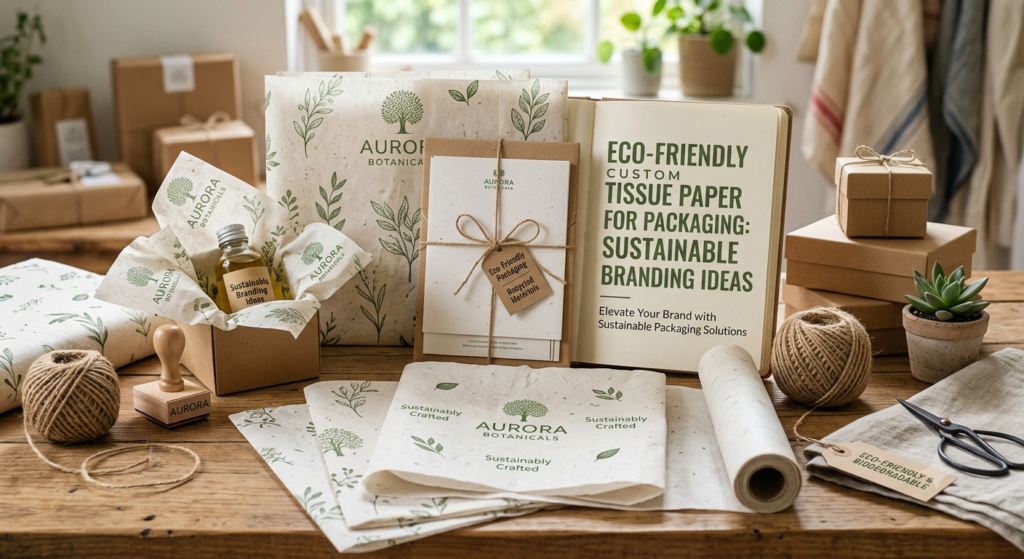
A sustainable skincare brand in Austin ships 350 orders every week. Their product is excellent. Their price point is fair. But their repeat purchase rate was stuck. The culprit was not the product. It was the box. Plain tissue, no logo, no credentials, no signal that the brand cared about anything beyond the product inside. They switched to eco-friendly custom tissue paper with a two-color logo print in their brand green. No other change to the product or marketing. Within one quarter, repeat purchases climbed 22%. Customers began tagging the packaging on Instagram. One unboxing video reached 14,000 views organically. That kind of return from a $100 tissue paper order is not unusual. It is what happens when your packaging finally says what your brand believes. What is eco-friendly custom tissue paper? It is FSC-certified, biodegradable or recyclable tissue paper printed with your brand logo using soy-based, water-based inks. Businesses use it inside packaging boxes and bags to protect products, reduce environmental impact and build brand trust with eco-conscious customers in 2026. Why Eco-Friendly Custom Tissue Paper Has Become a Buying Decision, Not a Branding Bonus Your packaging material is now part of your customer’s evaluation process before they click buy. A UPrinting survey of 1,000 US adults conducted in October 2025 found that 68% of consumers had already changed their shopping habits to reduce plastic waste. At equal price points, 93% said they would choose the product with more sustainably designed packaging. That is not a niche behavior. That is a majority position playing out across US online retail every day. The same survey found that 32% of consumers are willing to pay 6 to 10% more for a product that comes in sustainably designed packaging. And 57% believe brands, not consumers, should lead the effort to reduce packaging waste. The expectation has shifted. Your customers are not waiting for you to catch up. They are already choosing competitors who did. Beyond consumer preference, regulation is tightening. The EU Packaging and Packaging Waste Regulation introduces strict PFAS concentration limits on food-contact packaging starting August 12, 2026. Brands supplying EU markets need PFAS-free tissue paper now, not as a future upgrade, but as a current compliance requirement. 5 Sustainable Branding Ideas Using Eco-Friendly Custom Tissue Paper The right eco tissue paper choice depends on your brand identity, product type and customer base. Here are five specific approaches that work in practice: Branding Idea Best For Eco Credential Repeating logo pattern on white FSC tissue Apparel, cosmetics, boutique retail FSC certified, soy ink printed Compostable kraft tissue in Pantone brand color Zero-waste D2C brands Compostable, biodegradable Biodegradable tissue with QR code linking to your sustainability page Ecommerce and subscription boxes Biodegradable, plastic-free Solid recyclable tissue in brand color Minimalist luxury brands Recyclable at end of life Seasonal FSC tissue for holiday gifting Food brands, florists, gift businesses FSC certified, PFAS-free For seasonal campaigns, Custom Christmas Wrapping Paper from Print On Papers extends your eco branding into gift packaging. It is FSC certified, fully printable with your logo and designed to make every holiday shipment a branded, environmentally responsible moment for your customer. Eco-Friendly Custom Tissue Paper for Small Business: Certified, Affordable and Fast Small business owners carry a persistent misconception about sustainable packaging: that eco-friendly means expensive. The numbers say otherwise. At Print On Papers, eco-friendly custom tissue paper starts at $0.20 per sheet. FSC certification is included on every order as a production standard, not a premium add-on. Zero setup fees. Small runs accepted alongside bulk orders. Here is the cost math: 500 FSC-certified sheets at $0.20 is $100. That creates 500 individually branded, sustainable unboxing moments. Now consider what those moments do. An independent 90-day study conducted by Package InSight at Clemson University, in cooperation with Seaman Paper, found that after 90 days, customers who received tissue-packaged orders had 40% greater brand and product recall than those who received standard void fill. That recall drives reorders. And reorders the compound. Furthermore, a Shorr Packaging survey of 2,016 American consumers found that 39% had already switched to competing brands specifically because those brands offered sustainable packaging. The cost of ignoring eco packaging is no longer theoretical. Customized tissue paper with your logo requires no design experience on your part. Our team at Print On Papers converts your logo file into a print-ready layout at no charge. You review a digital proof. Nothing goes to press until you approve every color and placement in writing. For brands that need a moisture-resistant inner layer alongside eco tissue presentation, Custom Wax Paper provides a food-safe, branded protective layer. It uses water-based inks, meets FDA food-contact compliance and is available in small quantities with the same zero setup fee policy. How to Choose an Eco Tissue Paper Supplier: 7 Questions That Reveal Everything Most brands choose a supplier based on aesthetics or price alone and discover afterward that the sustainability claims were unverified. Before you order, ask these seven questions: FSC certification confirms responsible forest sourcing with full traceability documentation. Ask for it in writing, not just as a badge on a website. Soy-based, water-based inks are the production standard for genuinely sustainable tissue paper. PFAS-free coating is essential for both food-contact compliance and EU PPWR regulatory compliance from August 2026. A supplier that requires 10,000-sheet minimums on eco options is not accessible to small businesses. The right supplier accepts small runs without pricing penalties. Sustainable materials do not require slow production. Print On Papers produces and ships most orders in 5 to 7 working days via DHL, FedEx and UPS. Worldwide. Every order. Your logo file should be enough to start. Your supplier should handle the technical print-ready setup at no additional cost. These are three different material end-of-life pathways. Know which standard your tissue meets and request the certification documentation to verify. For bakeries, delis, food trucks and restaurants, FDA food-contact compliance is non-negotiable. Every tissue paper at Print On Papers meets this standard on every order. Custom Printed Tissue Paper:
How Custom Printed Tissue Paper Improves Your Brand’s Unboxing Experience
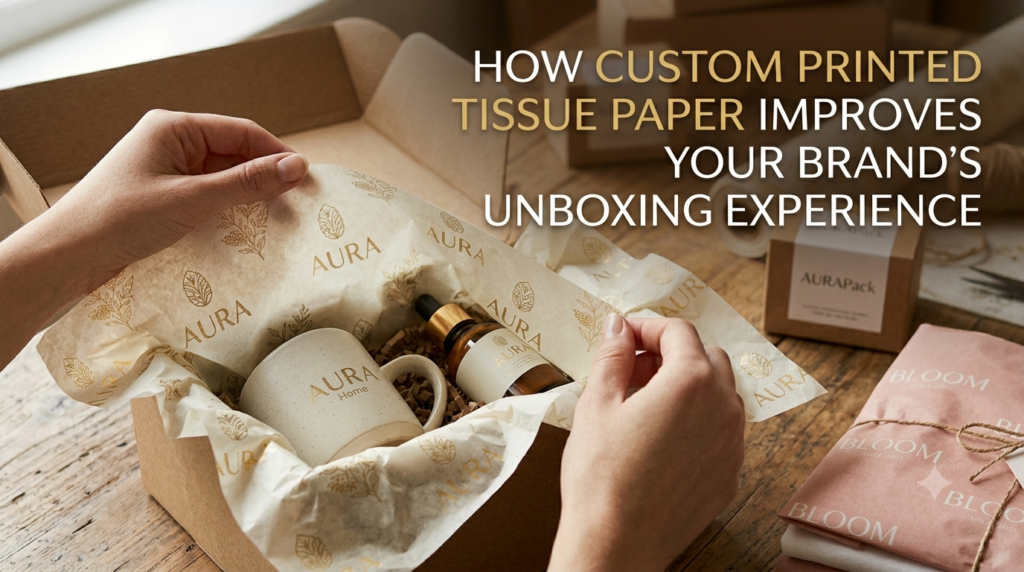
Think about the last time a package genuinely surprised you, before you even reached the product. Not the box. Not a label. But a layer of tissue inside, stamped with a crisp logo in exactly the right brand color, made the whole thing feel like receiving a gift. That moment is not accidental. Brands that create it choose to. And the tool they rely on more consistently than anything else? Custom printed tissue paper. For ecommerce sellers, boutiques, apparel brands, cosmetics companies, and food businesses, branded tissue paper is one of the highest-return, lowest-cost packaging upgrades available today. This guide breaks down exactly why, and how Print On Papers helps you build that experience from your first order. Key Takeaways What is custom printed tissue paper? Custom printed tissue paper is lightweight branded wrapping paper typically 17 to 30 GSM printed with your logo, colors, or pattern using soy-based inks. Businesses use it inside boxes and bags to protect products and create a consistent, memorable unboxing moment every single time. How Custom Printed Tissue Paper Transforms the Unboxing Experience The unboxing moment is now a measurable brand touchpoint, not a packaging afterthought. An independent 90-day study conducted by Package InSight at Clemson University, commissioned by Seaman Paper, found that branded tissue paper elicited 47% more positive emotion than any other packaging material tested. Participants felt joy and surprise for 66% of the interaction time. No other void-fill material came close. Beyond the emotional response, 86% of study participants reported a better brand impression when their order arrived with branded tissue. Additionally, 67% said they were more likely to share the product on social media when tissue paper was included. And 76% said they would more likely recommend a brand that wraps products in tissue paper. These are not vanity figures. Social sharing drives organic reach. Better brand impressions reduce churn. And word-of-mouth referrals cost nothing. Together, those three outcomes represent a business return that is disproportionately large relative to what a sheet of tissue paper actually costs. 5 Industries Using Custom Printed Tissue Paper (And What They Actually Do) Every business type has a different reason for using branded tissue. Here is how the most effective ones apply it: Industry Application Business Outcome Apparel & Fashion Pantone-matched tissue wrapping folded garments Customer links packaging quality to product quality Cosmetics & Beauty Repeating logo pattern lining gift boxes Reinforces premium positioning before the product appears Ecommerce & D2C Branded tissue inside mailer boxes and subscription kits Drives social shares; reduces return rates by 6.6% Jewelry & Luxury Heavyweight 28–30 GSM tissue around individual pieces Protects from friction; signals luxury without extra cost Boutique Retail In-store wrapping at point of sale Turns every purchase into a branded gifting moment For florists, the impact is equally direct. Wrapping stems and blooms in Flower Bouquet Paper printed with your studio’s logo turns every delivery into a branded reveal rather than a simple handoff. It is the kind of detail that customers photograph and share without being asked. Custom Tissue Paper for Small Business: What It Actually Costs Small business owners typically ask one question before anything else: can I realistically afford this? The answer is yes. Custom tissue paper for small business orders at Print On Papers starts at $0.20 per sheet. There are zero setup fees. Small runs sit alongside bulk orders with no penalty for low volume. Here is the ROI math most suppliers never put in writing: 500 sheets × $0.20 = $100 total. That creates 500 individually branded unboxing moments. If just 5% of those customers photograph and share their experience, your brand earns 25 pieces of organic user-generated content at a cost-per-impression lower than any paid social channel running today. Furthermore, the Package InSight study found that participants rated tissue-packaged products as 24% more valuable than the identical item shipped in standard void fill. Higher perceived value means fewer price objections, fewer returns, and stronger repeat purchase behavior. For small businesses competing against much larger brands, that 24% value lift is a real competitive edge. It costs $100. Replicating it through advertising costs thousands. For brands shipping fragile or heat-sensitive products, layering custom printed tissue over Custom Heat Seal Paper creates a dual-layer inner packaging system that looks premium and protects reliably across every shipment. How to Get Custom Design Tissue Paper With Your Logo (No Designer Needed) The most common reason brands delay is design anxiety. They assume creating customized tissue paper with logo artwork requires a graphic designer, specialist software, or packaging industry knowledge. None of those are necessary when you work with Print On Papers. The actual process is four steps: Step 1: Send your artwork. A JPEG, PNG, or PDF is enough. Our design team handles the full conversion to a print-ready file at no extra charge. Step 2: Choose your specs. Select GSM weight (17–20 GSM for retail bags and ecommerce boxes; 28–30 GSM for fragile or high-end products), sheet size, and print method. Not sure? We advise based on your product and industry. Step 3: Approve your digital proof. You see exactly what will print — every color, every placement — before production starts. Nothing goes to press without your written approval. Step 4: Receive your order in 5–7 working days. Every order ships tracked via DHL, FedEx, or UPS. Worldwide, without exception. Pantone color matching is available for brands that require exact color consistency across all packaging materials. CMYK printing covers the full spectrum for detailed artwork, patterns, or gradient designs. When you want to understand every tissue paper option available from paper types and GSM weights to print methods and sustainability certifications read our complete beginner’s guide: Custom Tissue Paper for Packaging: A Complete Guide for Brands. For brands that want a completely different visual identity alongside their tissue, Custom Kraft Paper delivers a natural, earthy aesthetic that is equally printable with your logo ideal for artisan, food, or sustainability-led brands. What Separates Print On Papers From Every Other Supplier
Custom Tissue Paper for Packaging: A Complete Guide for Brands
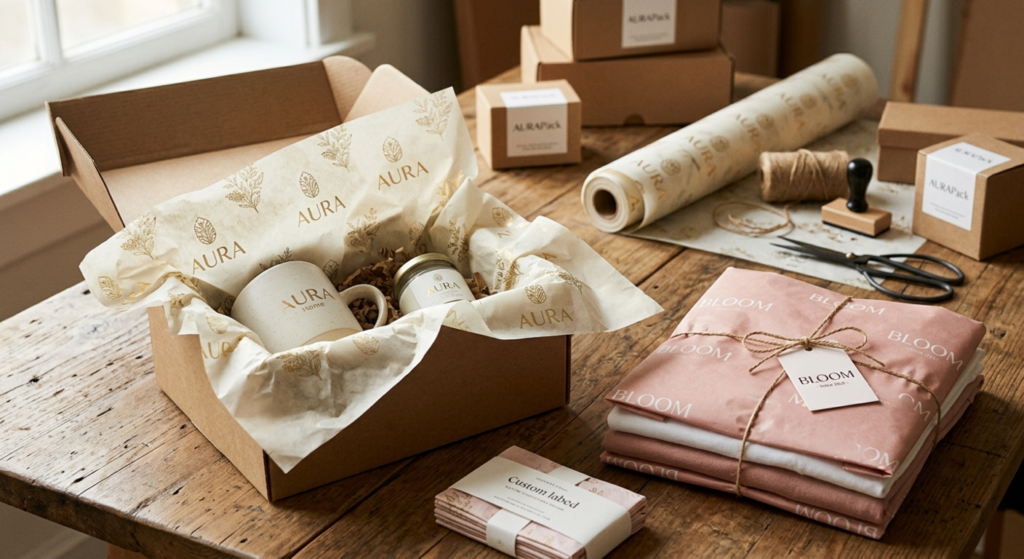
Picture this. A customer receives your boutique skincare order. They open the box. The first thing they touch is plain, white, crinkled tissue. No logo with no color. No story. That two-second moment the unwrap is your brand speaking. And right now, it’s saying nothing. Custom tissue paper for packaging fixes exactly that. It turns a forgettable box into a branded experience that customers photograph, share, and remember. And for food brands, boutiques, ecommerce sellers, and small businesses across the US, it is one of the most affordable branding investments you can make today. This guide covers everything you need to know from types and costs to design tips and ordering. What is custom tissue paper for packaging? Custom tissue paper for packaging is branded, printable wrapping paper businesses use to protect products and reinforce brand identity at the moment of unboxing. It ranges from 17 to 30 GSM and prints with logos, colors, or patterns using food-safe inks. Why Custom Tissue Paper for Packaging Matters More Than You Think The global printed tissue paper market was valued at $558 million in 2024, driven by luxury retail, cosmetics, and ecommerce brands using customized tissue paper to sharpen their unboxing experience and build lasting brand perception. That market is still growing. Brands investing in it now are not just buying paper, they are building customer habits and visual recognition that compound with every single order shipped. Higher perceived value means fewer returns, stronger reviews, and customers who come back without needing to be retargeted. Think about what that looks like for your business specifically. Your customer tears open a box, and before they even touch the product, they are already holding your brand in their hands. That moment is two seconds, maybe three is when the photograph gets taken. It is when the Instagram Story gets recorded. It is when the TikTok unboxing begins. Branded tissue paper gives that moment something worth capturing. Plain white paper wastes it entirely. And sustainability now sits right alongside that visual impact as a non-negotiable. A nationwide survey of 2,016 American consumers conducted in late 2024 by Shorr Packaging found that 90% say they are more likely to purchase from a brand if its packaging is eco-friendly. Branded and sustainable together that is what separates growing brands from forgettable ones in 2026. 5 Types of Custom Tissue Paper: Which One Does Your Business Actually Need? Not every business needs the same paper. Here is a practical breakdown: Paper Type Best For GSM Range Key Feature Printed logo tissue Boutiques, apparel, cosmetics 17–20 GSM Full CMYK or Pantone color matching Solid color tissue Minimalist or luxury brands 17–25 GSM Clean, consistent brand color presentation Eco-friendly tissue Sustainability-led brands 17–20 GSM FSC-certified, PFAS-free, compostable Food-safe tissue Bakeries, delis, food trucks 17–20 GSM FDA-compliant, soy-based inks Premium tissue Jewelry, luxury goods 28–30 GSM Opaque, heavyweight, metallic ink options Choosing the wrong weight is a common mistake. Lightweight 17 GSM tissue looks elegant in retail bags and boutique boxes. However, if you’re shipping fragile products across the country, 28–30 GSM gives you structural protection alongside the branding. At Print On Papers, we help you select the right paper weight, coating, and print method for your specific product, before a single sheet goes to press. Custom Tissue Paper for Small Business: Is It Actually Affordable? This is the question most small business owners Google before they click away. Yes. Custom tissue paper for small businesses is genuinely affordable. At Print On Papers, pricing starts at $0.20 per sheet. There are zero setup fees. Small runs and bulk orders are both welcome. Compare that to what plain packaging costs you invisibly: a negative review, a product return, or a customer who doesn’t come back because the experience felt cheap. The ROI on branded tissue paper becomes obvious fast. Here’s the real cost breakdown that nobody else tells you: For boutiques and food brands wrapping 50–200 orders per week, this is a marketing budget item that costs less than a single Facebook ad and works every single time. For food businesses specifically, Custom Deli Paper and custom tissue paper work as a pairing: one wraps the product at the counter, the other lines the takeout box. Together, they create a fully branded food presentation from prep to table. How to Design Custom Tissue Paper (Even If You Have Zero Design Experience) Most brands delay ordering custom tissue paper for one reason: they think design is complicated. It is not. Here is exactly what happens when you order from Print On Papers: Step 1: Share your requirements. Tell us your paper type, size, quantity, and send us your logo file. Not sure about sizing? Our team walks you through it. Step 2: We handle the artwork. Our design team converts your logo into a print-ready file at no extra charge. You don’t need a graphic designer. You don’t need print experience. Step 3: Approve your digital proof. You see exactly what will print before anything goes to press. No surprises. No guesswork. Step 4: Production and delivery. Most orders are ready in 5–7 working days. We ship tracked via DHL, FedEx, and UPS to anywhere in the world. For bakeries and pastry shops, Custom Wax Paper pairs naturally under branded tissue wax paper handles the moisture barrier underneath while tissue creates the branded presentation on top. That layered approach is how premium bakeries package croissants, pastries, and gift boxes. For kitchens needing oil-resistance rather than branding presentation, Custom Greaseproof Paperis engineered for exactly that purpose, a different product with a different job, but equally important to your full packaging system. What Makes Print On Papers Different From Every Other Tissue Paper Supplier Most suppliers force you to choose between affordable and quality. Or between fast and custom. Print On Papers was built to remove that choice entirely. Here is what our 300+ served brands consistently tell us made the difference: These are not marketing promises. They are operational standards we apply to
Custom Tissue Paper for Packaging: A Complete Guide for Brands
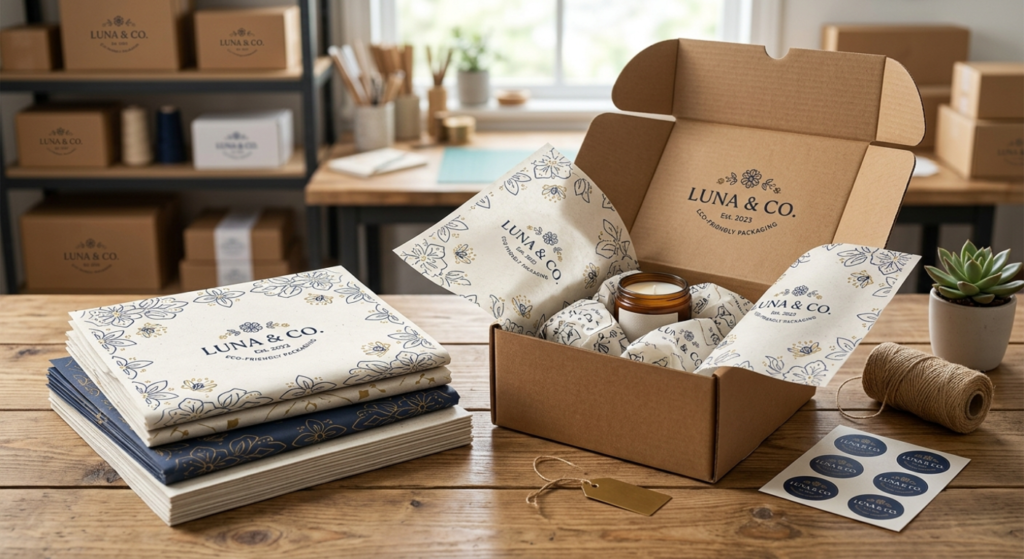
Picture this. A customer receives your boutique skincare order. They open the box. The first thing they touch is plain, white, crinkled tissue. No logo with no color. No story. That two-second moment the unwrap is your brand speaking. And right now, it’s saying nothing. Custom tissue paper for packaging fixes exactly that. It turns a forgettable box into a branded experience that customers photograph, share, and remember. And for food brands, boutiques, ecommerce sellers, and small businesses across the US, it is one of the most affordable branding investments you can make today. This guide covers everything you need to know from types and costs to design tips and ordering. What is custom tissue paper for packaging? Custom tissue paper for packaging is branded, printable wrapping paper businesses use to protect products and reinforce brand identity at the moment of unboxing. It ranges from 17 to 30 GSM and prints with logos, colors, or patterns using food-safe inks. Why Custom Tissue Paper for Packaging Matters More Than You Think The global printed tissue paper marketwas valued at $558 million in 2024, driven by luxury retail, cosmetics, and ecommerce brands using customized tissue paper to sharpen their unboxing experience and build lasting brand perception. That market is still growing. Brands investing in it now are not just buying paper, they are building customer habits and visual recognition that compound with every single order shipped. Higher perceived value means fewer returns, stronger reviews, and customers who come back without needing to be retargeted. Think about what that looks like for your business specifically. Your customer tears open a box, and before they even touch the product, they are already holding your brand in their hands. That moment is two seconds, maybe three is when the photograph gets taken. It is when the Instagram Story gets recorded. It is when the TikTok unboxing begins. Branded tissue paper gives that moment something worth capturing. Plain white paper wastes it entirely. And sustainability now sits right alongside that visual impact as a non-negotiable. A nationwide survey of 2,016 American consumers conducted in late 2024 by Shorr Packaging found that 90% say they are more likely to purchase from a brand if its packaging is eco-friendly. Branded and sustainable together that is what separates growing brands from forgettable ones in 2026. 5 Types of Custom Tissue Paper: Which One Does Your Business Actually Need? Not every business needs the same paper. Here is a practical breakdown: Paper Type Best For GSM Range Key Feature Printed logo tissue Boutiques, apparel, cosmetics 17–20 GSM Full CMYK or Pantone color matching Solid color tissue Minimalist or luxury brands 17–25 GSM Clean, consistent brand color presentation Eco-friendly tissue Sustainability-led brands 17–20 GSM FSC-certified, PFAS-free, compostable Food-safe tissue Bakeries, delis, food trucks 17–20 GSM FDA-compliant, soy-based inks Premium tissue Jewelry, luxury goods 28–30 GSM Opaque, heavyweight, metallic ink options Choosing the wrong weight is a common mistake. Lightweight 17 GSM tissue looks elegant in retail bags and boutique boxes. However, if you’re shipping fragile products across the country, 28–30 GSM gives you structural protection alongside the branding. At Print On Papers, we help you select the right paper weight, coating, and print method for your specific product, before a single sheet goes to press. Custom Tissue Paper for Small Business: Is It Actually Affordable? This is the question most small business owners Google before they click away. Yes. Custom tissue paper for small businesses is genuinely affordable. At Print On Papers, pricing starts at $0.20 per sheet. There are zero setup fees. Small runs and bulk orders are both welcome. Compare that to what plain packaging costs you invisibly: a negative review, a product return, or a customer who doesn’t come back because the experience felt cheap. The ROI on branded tissue paper becomes obvious fast. Here’s the real cost breakdown that nobody else tells you: For boutiques and food brands wrapping 50–200 orders per week, this is a marketing budget item that costs less than a single Facebook ad and works every single time. For food businesses specifically, Custom Deli Paper and custom tissue paper work as a pairing: one wraps the product at the counter, the other lines the takeout box. Together, they create a fully branded food presentation from prep to table. How to Design Custom Tissue Paper (Even If You Have Zero Design Experience) Most brands delay ordering custom tissue paper for one reason: they think design is complicated. It is not. Here is exactly what happens when you order from Print On Papers: Step 1: Share your requirements. Tell us your paper type, size, quantity, and send us your logo file. Not sure about sizing? Our team walks you through it. Step 2: We handle the artwork. Our design team converts your logo into a print-ready file at no extra charge. You don’t need a graphic designer. You don’t need print experience. Step 3: Approve your digital proof. You see exactly what will print before anything goes to press. No surprises. No guesswork. Step 4: Production and delivery. Most orders are ready in 5–7 working days. We ship tracked via DHL, FedEx, and UPS to anywhere in the world. For bakeries and pastry shops, Custom Wax Paper pairs naturally under branded tissue wax paper handles the moisture barrier underneath while tissue creates the branded presentation on top. That layered approach is how premium bakeries package croissants, pastries, and gift boxes. For kitchens needing oil-resistance rather than branding presentation, Custom Greaseproof Paperis engineered for exactly that purpose, a different product with a different job, but equally important to your full packaging system. What Makes Print On Papers Different From Every Other Tissue Paper Supplier Most suppliers force you to choose between affordable and quality. Or between fast and custom. Print On Papers was built to remove that choice entirely. Here is what our 300+ served brands consistently tell us made the difference: These are not marketing promises. They are operational standards we apply to every
Why Restaurants Are Switching to Custom Printed Food Paper in the USA
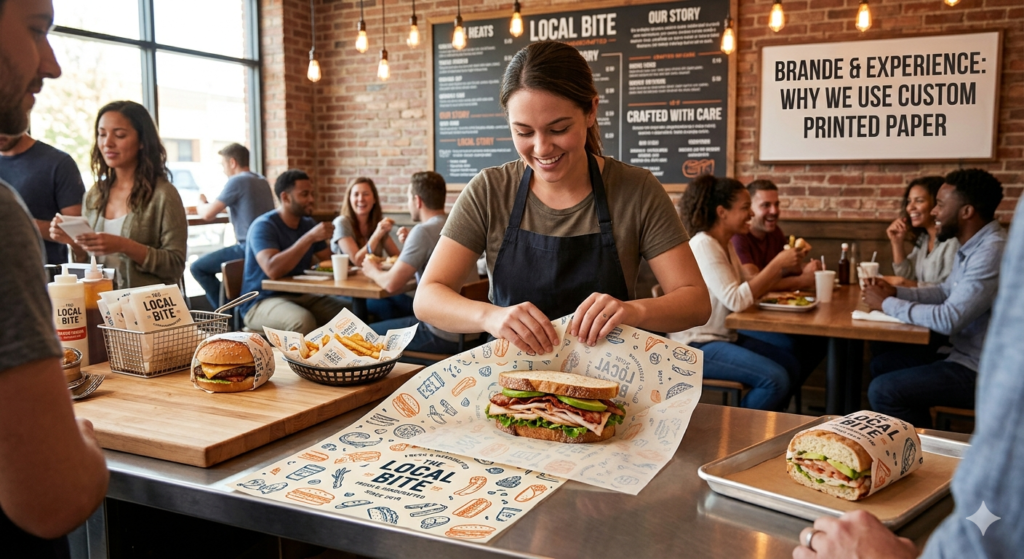
Last Tuesday, a customer at a Brooklyn deli photographed their lunch before eating it, just like 69% of millennials do. They posted it. Their 800 followers saw it. The sandwich looked incredible. The paper wrapped around it? Plain white. No logo. No brand. Just a missed impression that cost the deli owner nothing in paper and everything in visibility. That’s the real cost of generic packaging. And that’s exactly why independent food businesses across the USA are making the switch to custom-printed food paper not as a luxury upgrade, but as a smart, affordable marketing decision hiding in plain sight. What Is Custom-Printed Food Paper and Why Does It Matter? Custom printed food paper is food-contact-safe paper, deli paper, parchment, butcher paper, greaseproof wraps, and basket liners printed with your restaurant’s logo, colors, and design. Every sheet that leaves your kitchen carries your brand. The difference between plain food wrapping paper and custom food wrapping paper isn’t just in looks. It’s the difference between packaging that does a job and packaging that does two jobs: protects the food and markets the business. According to a 2018 national survey by the Paper and Packaging Board and Ipsos, 72% of American consumers say packaging design directly influences their purchase decisions. The wrap around your sandwich is quietly shaping how customers feel about your brand before they take a single bite. 6 Reasons US Food Businesses Are Making the Switch 1. It Turns Every Order Into Free Advertising If you serve 60 customers a day with branded food wrapping paper, that’s 60 brand impressions per day without spending an extra dollar on ads. Multiply that over a year and you’re looking at over 20,000 brand touchpoints. A billboard costs thousands. Your packaging is already going out the door. 2. Your Packaging Gets Photographed: With or Without Your Logo In It The Cropink Studies show 86% of consumers post about their meal when it looks good. If your branded wrap is in that photo, your logo reaches their entire following for free. If it’s plain white paper, the opportunity disappears. According to Influee, user-generated content (customer photos) drives 4x higher click-through rates than branded ads, which means your customers’ posts are more persuasive than your own ads. Make sure your packaging earns a spot in the frame. 3. It Changes How Food Tastes (Seriously) Research published in the International Journal of Food Science and Technology confirms that consumers develop expectations about food based on packaging attributes such as colour, material, shape, and design before the first bite, and these expectations significantly influence their overall sensory experience. A separate study in the same journal examined the “halo effect” in food packaging, finding that the perception of a positive attribute on a product’s packaging overshadows overall judgment, leading consumers to rate the product itself as higher quality than it actually is. 4. It Drives Brand Recall and Repeat Business Consistent brand color use across packaging increases brand recognition by up to 80%. Research attributed to the University of Loyola, Maryland, found that color increases brand recognition by up to 80%, specifically comparing color versus monochrome. When a customer can picture your wrapping your colors, your logo, the feel of your paper, they remember your name. And the next time they’re deciding where to order from, that memory works for you. Packaging is one of the cheapest and most underused tools in a restaurant’s retention strategy. 5. It’s FDA-Compliant and Fully Food-Safe This is the first question most restaurant owners ask, and it should be. The FDA regulates all food-contact materials under its Food Ingredients & Packaging guidelines, ensuring that everything touching your food meets strict federal safety standards. Reputable custom food paper suppliers use food-grade, soy-based, or water-based inks, PFAS-free greaseproof coatings, and FSC-certified paper stock, all compliant with FDA food-contact requirements. Safety and branding are not in conflict. The right supplier delivers both. 6. Small Runs Are Now Accessible: No Bulk Commitment Needed The old barrier to entry, massive minimum order quantities, is gone. Today, independent food businesses, solo food truck operators, and single-location delis can order custom-printed food paper in quantities that make sense for their volume. You don’t need to be a chain to wrap like one. Most orders are production-ready in 5–7 working days and ship via DHL, FedEx, or UPS tracked and fast. Who Is Switching? Every Corner of the Food Industry The shift to custom food paper isn’t just for fine dining. It’s happening across every segment of the food business: Restaurants & Diners use custom deli paper and basket liners to keep every order looking consistent and on-brand from the kitchen to the table. Bakeries & Patisseries use branded parchment paper that handles heat, grease, and delicate pastries while making every box feel as premium as what’s inside. Food Trucks use custom burger paper and taco wraps built for speed and heat. Bold, eye-catching design built for the street and the social feed. Delis & Sandwich Shops use greaseproof wraps that prevent leaks, keep fillings fresh, and turn every regular into a walking brand ambassador. According to the National Restaurant Association, the US restaurant industry supports over 15.7 million employees and contributes $1.1 trillion to the economy. In a market that is competitive, every touchpoint, including your packaging, is a brand decision. What Real Customers Say After Switching “Customers started commenting on our wrapping within the first week. It changed how people perceive our brand completely.” — Owner, Sandwich Shop, New York “I needed low minimums and fast turnaround. Print On Papers delivered both without making me feel like a small account.” — Food Truck Operator, Texas “Our branded parchment arrived on time, it was food-safe, and our customers love it.” — Founder, Artisan Bakery, California Ready to Make Every Wrap Count for Your Brand? You’ve built your menu, refined your service, and created something worth remembering. Don’t let generic packaging be the reason customers forget you. At Print On Papers, we print custom food paper for restaurants,
Custom Deli Paper: Complete Guide for Restaurants & Food Businesses (2026)
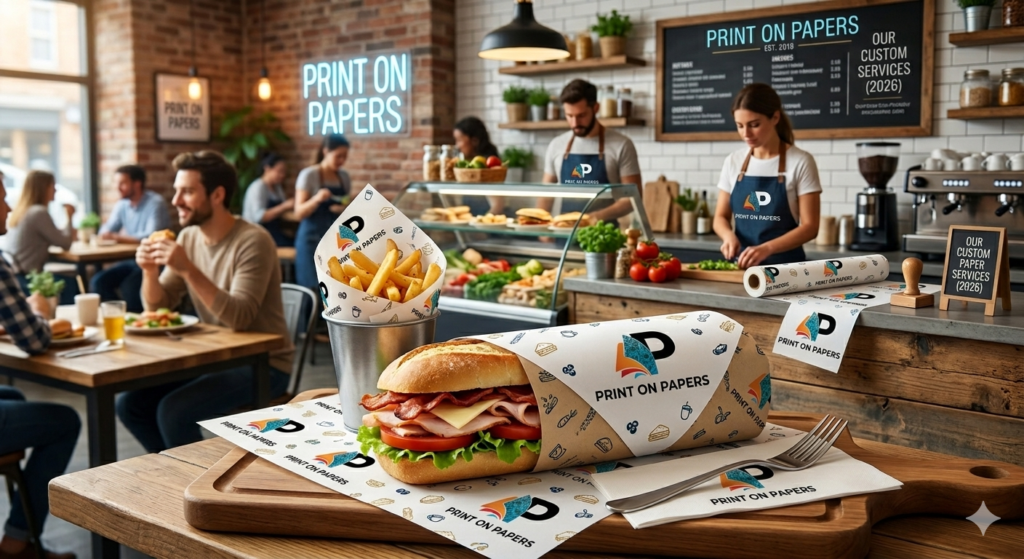
Every day across the US, a restaurant owner perfects their signature dish for the tenth time this week. A deli operator trains a new hire on how to build the perfect sandwich. A food truck founder obsesses over sourcing better ingredients. Then they wrap everything in the same plain white paper that their competitor two blocks away is using. No logo. No color. No memory. That’s the gap custom deli paper closes. It’s food-safe, grease-resistant, and printed with your brand on every single sheet, whether you need 500 to test it or 50,000 to scale. This guide covers everything: materials, FDA food safety standards, sizes, eco-friendly options, and how to place your first order. Because the food you’re serving deserves packaging that’s actually trying as hard as you are. What Is Custom Deli Paper? Custom deli paper is food-safe, fully printed wrapping paper designed specifically for the food service industry. Restaurants, delis, food trucks, bakeries, and catering businesses use it to wrap, present, and brand their food. Unlike plain deli sheets, custom deli paper carries your logo, brand colors, and identity on every single sheet that leaves your kitchen. It comes in several forms: greaseproof, wax-coated, kraft, and parchment-style, each serving a different purpose. But they all share one goal: protecting your food while making your brand impossible to ignore. Why Plain Paper Is Quietly Hurting Your Business Here’s something most food business owners don’t consider until it’s pointed out. Every unbranded wrap that leaves your kitchen is a missed marketing opportunity. Not occasionally, every single time. “According to a study conducted by Ipsos on behalf of the Paper and Packaging Board, 72% of American consumers say packaging design directly influences their purchase decisions.” And they do photograph it. Constantly. When someone shares their meal on Instagram, your packaging is in that frame too. Plain white paper tells no story. Custom printed deli paper with your logo tells the world exactly who made that food and where to get more of it. Is Custom Deli Paper Food Safe? This is the most important question any restaurant owner should ask before placing an order, and the answer depends entirely on the supplier. All legitimate custom deli paper must comply with FDA CFR Title 21, the federal regulation governing materials that come into direct contact with food in the United States. That means food-grade inks, PFAS-free greaseproof coatings, and paper from compliant, tested sources. At Print On Papers, every sheet uses soy-based and water-based food-grade inks, PFAS-free coating options, and FSC-certified paper sourcing. Hot food, cold food, oily food, or delicate pastries, the paper around it meets the standard that protects your customers and keeps your business compliant. Types of Custom Deli Paper for Food Businesses Not all custom deli paper is the same. The right choice depends on what you’re wrapping and how your kitchen operates. Who Uses Custom Deli Paper? Real Business Scenarios Any food business that wraps, serves, or hands food to a customer is leaving branding potential on the table without it. Eco-Friendly Custom Deli Paper: What Sustainable Actually Means Sustainability in food packaging is no longer a marketing angle — it’s a real buying criterion for a growing share of your customers. According to the Forest Stewardship Council, FSC-certified paper comes from responsibly managed forests that balance environmental, social, and economic needs. When sourcing eco-friendly custom deli paper, look for three non-negotiables: FSC-certified paper stock, PFAS-free greaseproof coatings, and water-based or soy-based inks rather than petroleum alternatives. Sustainable packaging doesn’t cost more when you order smart. How to Order Custom Deli Paper in 3 Steps The process at Print On Papers is built for food business owners who don’t have hours to spend on back-and-forth: Step 1: Share your requirements. Paper type, size, quantity, and branding files. No designer? Free design support is included with every order. Step 2: Approve your digital proof. You see exactly what you’re getting before a single sheet is printed. Zero surprises. Step 3: Production and delivery. Most orders are ready in 5–7 working days, shipped tracked via DHL, FedEx, or UPS straight to your door. No complicated ordering process. No massive minimum orders. Just food-safe, fully branded paper delivered fast. Stop Sending Your Food Out in Paper That Doesn’t Know Your Name Every day you wrap your food in plain, unbranded paper is a day your brand goes unnoticed. Custom deli paper from Print On Papers costs less than most food businesses expect and arrives faster than most timelines demand. Free design support, food-safe materials, and flexible ordering from small runs to bulk. Get a Free Quote Today