
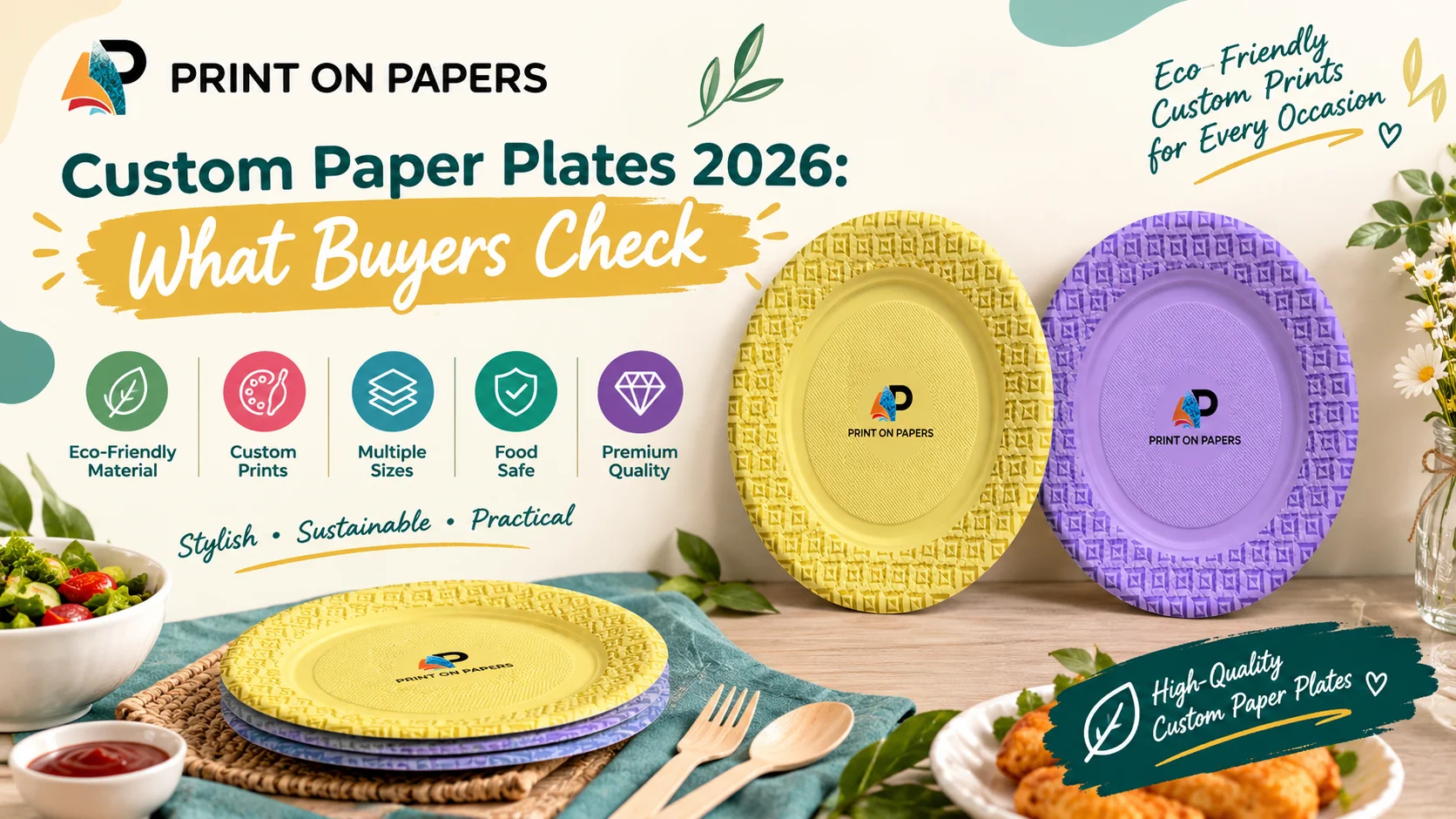
TLDR: Custom paper plates are branded, food safe plates sized by GSM, the weight that decides whether a plate holds a dry pastry or a bowl of curry without buckling. Before ordering, most food brands ask three things. Is it FDA compliant? What GSM fits the menu? And what do the real numbers look like for minimum order, price, and shipping? This guide walks through all three, plus where restaurants, caterers, and food trucks actually put these plates to use.
Take a regular paper plate. Add a logo, a brand color, maybe a tagline running along the rim. That’s pretty much the whole idea behind a custom paper plate, a disposable plate made from food contact approved paper and printed to match a restaurant or caterer’s branding. The exact GSM depends on what food it’s going to carry. Most businesses order these for one reason, and it’s not complicated. A blank plate gets thrown out without anyone noticing it existed. A branded one sticks, sometimes it even ends up photographed. Yes, it costs more upfront. Plenty of food brands still think that’s a fair trade.
A plain white plate doesn’t say who made the food sitting on it. A printed one does, no explanation needed.
Restaurants mostly use these right at the counter, during pickup, which happens to be the last moment a customer actually interacts with the brand before heading out the door. Caterers lean on them for weddings and corporate events. Food trucks have picked up on something else entirely, a plate sitting in someone’s Instagram story works as advertising they never had to pay for twice.
There are real numbers behind this shift. GMI Insights puts the overall disposable tableware market at 34.8 billion dollars in 2025, with plates and dishes alone accounting for 5.5 billion of that. That demand isn’t coming from households grabbing a pack at the grocery store. It’s businesses placing orders. This is a B2B story through and through.
Once a business starts branding one thing, deli wrap or sandwich paper usually, it rarely stops there. Plates tend to come next, which is part of why custom papers keeps growing as a category overall.
GSM means grams per square meter. One number, but it decides a lot, mostly whether a plate survives actual contact with food or falls apart halfway through a meal. Light plates handle dry, cold items just fine. Wet, hot, or sauced food needs more weight behind it, otherwise you’re looking at a soggy mess nobody wants to hand a customer.
Size the plate for the heaviest, wettest item on the menu. Not the average item, the worst case one. A sandwich might sit fine on a lighter plate, but a curry bowl won’t, so order for the curry. Get this wrong and you’re placing a reorder, which nobody enjoys explaining to a manager.
| GSM Range | Best Food Type | Microwave Safe | FDA Status |
| 180 to 220 GSM | Dry snacks, pastries, finger food | Uncoated versions only | Compliant under 21 CFR 176 |
| 220 to 260 GSM | Standard hot entrées, sandwiches | Yes, if uncoated or PLA coated | Compliant under 21 CFR 176 |
| 260 to 320 GSM | Wet, sauced, or multi-course catering meals | Yes, if uncoated or PLA coated | Compliant under 21 CFR 176 |
Here’s something people miss. A PE or wax coated plate handles grease and moisture better than an uncoated one. Don’t microwave it though, the coating warps. Reheating matters for your business? Stick with uncoated or PLA coated plates.
Yes, assuming the plate was actually made to meet federal standards. That standard has a name, Title 21 CFR Part 176, the FDA rule covering which paper and paperboard materials can legally touch food. You can look it up yourself on the federal eCFR database if you want to see exactly what’s approved.
Microwave safety comes down to the coating, not the paper underneath it. Uncoated and PLA coated plates generally reheat fine. Wax or PE coated ones don’t hold up the same way, since heat makes that coating melt or bubble up.
There’s a sustainability piece worth mentioning too. EPA figures put the paper and paperboard recycling rate at 68.2 percent in the most recent reporting year. That’s higher than any other major material tracked in municipal solid waste, and it’s part of why more brands are picking paper over plastic for anything meant to be used once and thrown away.
Independent restaurants tend to order smaller batches for everyday counter service, usually pairing plates with matching wrap or bags so the whole order looks like it belongs together. Catering companies go the other direction. They stock up before the wedding season, often 2,000 units or more in a single run, because one event alone can burn through hundreds of plates in an afternoon.
Food trucks keep things compact. Storage space is tight in a truck, so dimensions stay simple. Bakeries usually go lighter on GSM too, since what they’re serving is mostly dry. No reason to pay for heavy duty paper a catering kitchen actually needs.
| Question | Answer |
| Are custom paper plates food safe? | Yes, provided they’re made to meet FDA 21 CFR 176. That covers the base paper itself along with any coating approved for direct food contact. |
| What GSM is a paper plate? | Most fall somewhere between 180 and 320 GSM. Lighter ones handle dry food without trouble, but wet or saucy dishes need 260 GSM or higher. |
| Can paper plates be microwave safe? | Usually, if they’re uncoated or PLA coated. Wax and PE coated plates are a different story, since the coating tends to warp under heat. |
| What is the minimum order for custom paper plates? | Most suppliers set the floor around 500 units. Price per plate drops as the order grows, so it’s worth confirming the exact number before committing. |
| How long does custom paper plate production take? | Typically 7 to 10 working days after you approve the proof. Rush options exist if an event is coming up fast. |
Three numbers matter here. How many units you need at minimum, what each one costs, and how long production actually takes. Most suppliers set that floor around 500 units, and the price per plate drops the bigger the order gets.
From proof approval to finished product usually runs 7 to 10 working days. Rush turnaround exists if an event is coming up fast. Shipping typically goes through DHL, FedEx, or UPS, tracked the whole way, so nobody’s left guessing when it’ll actually arrive.
Before placing anything, pull up the full custom paper plates spec page. GSM, coating, and print method all move the final price, so knowing exactly what you need first saves a round of back and forth later.
Menu’s set, GSM figured out? Good. The next move is getting an actual quote instead of estimating. Get a Free Quote Now →
Two things happening at once make custom paper plates worth the extra cost. They keep food safe under FDA rules, and they put a brand in front of a customer right when it matters, the moment the food actually lands on the table. The businesses that get this right aren’t guessing their way through it. They match GSM to what’s genuinely on the menu. They confirm FDA compliance before signing off on anything. They lock in real numbers on minimum order and turnaround before committing. Do all three, and the plate earns its keep twice, once as packaging, once as a quiet bit of marketing nobody even realizes is doing its job.
Print On Papers is a custom printed paper and wrapping paper company serving restaurants, bakeries, delis, food trucks, butchers, florists, apparel brands and food brands across the US and worldwide. We deliver food-safe, eco-friendly, fully branded custom paper, from your first 500 sheets to your next 500,000