
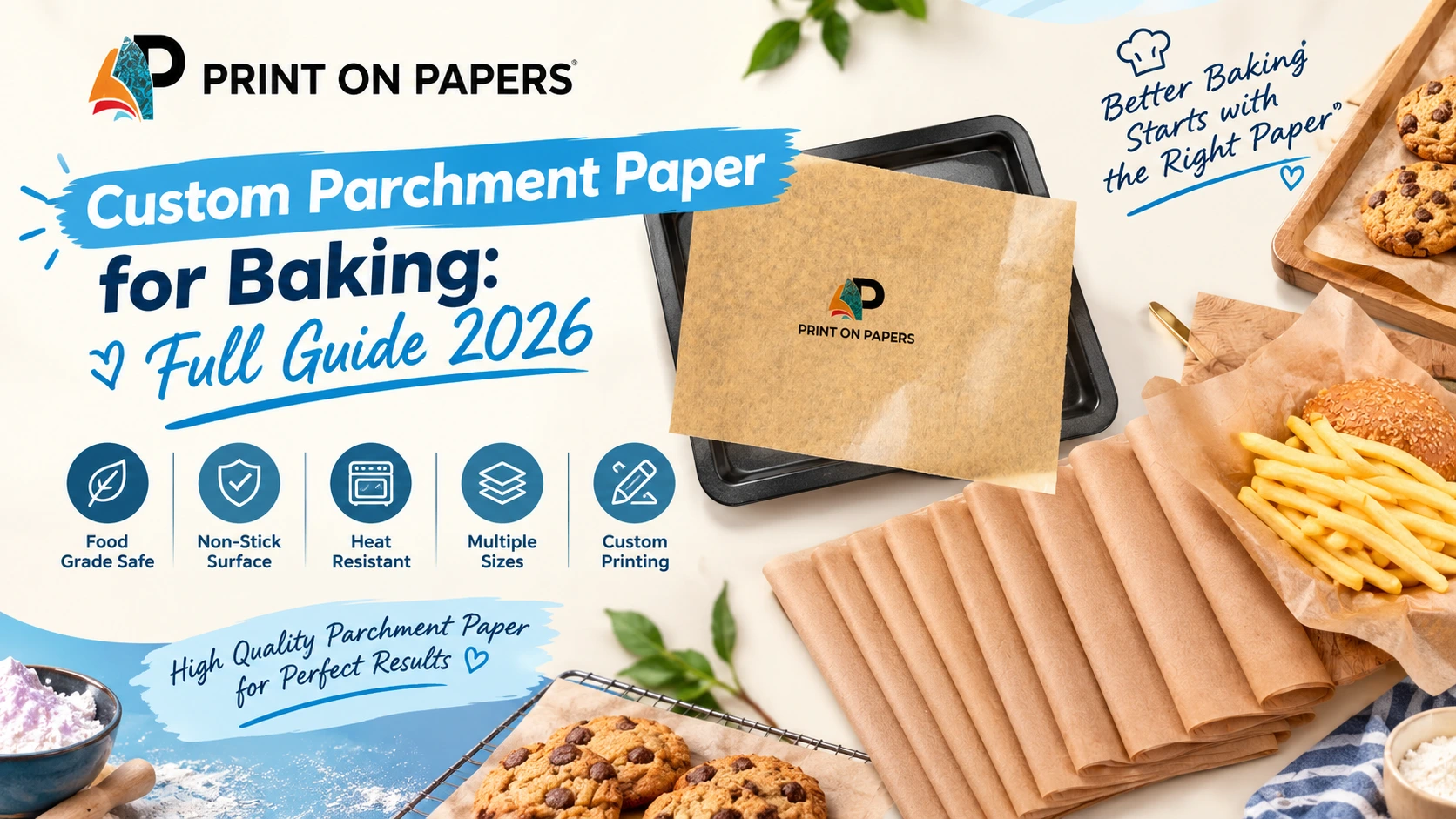
TL;DR: This is silicone coated baking paper with a logo printed on it, and it handles real oven heat the same way plain parchment does. Unbleached sheets are usually good to about 425°F, bleached a bit higher around 450°F, and both clear FDA rules under 21 CFR 176.170 with no PFAS anywhere in the coating. Most bakeries end up choosing bleached or unbleached based on how it looks next to their logo, not because one performs better than the other.
Table of Contents
A bakery owner usually finds out what parchment paper is actually made the hard way, after a tray comes out of the oven looking wrong. Once a business decides to put its logo on that sheet, the stakes go up a little. Will the print survive the heat? Does bleached or unbleached make a real difference? Print On Papers gets asked these questions daily, so here’s what the specs and the testing actually show.
Parchment starts out as plain cellulose paper, nothing special about it yet. During manufacturing, it runs through a silicone bath that coats both sides, and that coating does almost all the real work. Dough won’t weld itself to the sheet because of it, and the paper can sit in a hot oven without curling apart. A logo gets added after that, printed on top once the silicone has cured, so a branded sheet bakes exactly the same as a blank one.
Most kitchens order the branded version for a practical reason. They need sheet pan liners anyway, every day, so spending a little more to get a name printed on them turns something a customer would normally throw out into a small piece of marketing. This paper sits inside a wider custom papers range, built for kitchens juggling more than one food contact sheet at once.
Suppliers usually put unbleached parchment at around 425°F and bump bleached up to roughly 450°F. America’s Test Kitchen decided to push both well past those numbers, running both types at 500°F for a full 20 minutes just to see what would happen. Nothing caught fire. Nothing smoked. The sheets darkened a bit around the edges, and that was really the extent of it.
| Coating Type | Max Temperature | Best Food Use |
| Unbleached silicone | 425°F | Cookies, bread, roasted vegetables |
| Bleached silicone | 450°F | Pastries, high heat bakes, broiling |
| Tested limit (both types) | 500°F for 20 minutes | Short, occasional high heat bakes only |
One habit is worth keeping regardless of the rating. Keep the paper away from an open flame or a heating coil, since that’s a different kind of heat than an oven, where it moves around evenly instead of hitting one spot directly. Stay clear of that, and custom parchment paper gets through a normal bake just fine.
Bleaching is honestly just one more step tacked onto processing, a whitening pass that gives the sheet its familiar pale color. Skip that step and the paper keeps its natural light brown tone instead. Either way, the silicone goes on exactly the same, so a kitchen isn’t giving up heat resistance or non-stick performance by choosing one over the other.
Some bakeries lean unbleached because it photographs nicely next to pastries, that rustic look a lot of shops go for online. Others pick bleached since a white background makes a printed logo stand out more. Either way, food safety doesn’t change. If a kitchen actually needs something for wrapping cold items rather than baking, custom wax paper is built for that instead.
It is, and there’s an actual regulation behind that, not just a label claim. The silicone coating falls under FDA 21 CFR 176.170, the part of federal code governing paper and paperboard materials cleared to touch food. Anyone can look that regulation up themselves, it isn’t a line borrowed from a brochure.
PFAS doesn’t come into the picture here. Those are the chemicals behind a lot of older nonstick cookware concerns, and this coating skips them entirely. The ink used to print a logo stays food grade too, so branding the sheet doesn’t add any new risk to the surface that touches food.
Independent bakeries are probably the biggest group, lining sheet pans every morning before the ovens warm up. Restaurants use it to wrap desserts and baked sides before they leave the kitchen, giving a logo a quick moment in front of a customer. Food trucks and catering crews like it too, a parchment liner works almost like a small ad at every event.
What all three groups want confirmed before ordering usually comes down to the same two things, how much heat the paper can take, and whether it meets food safety rules. Both have real, checkable answers above rather than a general promise.
| Question | Answer |
| What is parchment paper coated with? | Silicone, on both sides of the base sheet. That’s what gives the paper its non-stick quality and lets it handle direct oven heat. |
| Can parchment paper go in the oven at 450°F? | Yes, bleached parchment is usually rated right around 450°F, and testing has shown both bleached and unbleached sheets can even take 500°F for shorter stretches without a problem. |
| Is unbleached parchment paper better? | Not really, performance wise. The heat rating and the non-stick coating stay the same whether it’s bleached or not, so the difference really just comes down to color. |
| What is the minimum order for this paper? | 500 sheets to start, with pricing from $0.20 a sheet depending on size and how detailed the artwork is. |
| Does it contain PFAS? | No, the silicone coating is PFAS free and stays within FDA food contact rules under 21 CFR 176.170. |
Most of what matters here, heat rating, FDA compliance, the coating itself, has already been covered above. What’s left is working out a price for the exact sheet size and print run a kitchen needs, and that part usually takes only a few minutes.
Print On Papers is a custom printed paper and wrapping paper company serving restaurants, bakeries, delis, food trucks, butchers, florists, apparel brands and food brands across the US and worldwide. We deliver food-safe, eco-friendly, fully branded custom paper, from your first 500 sheets to your next 500,000