
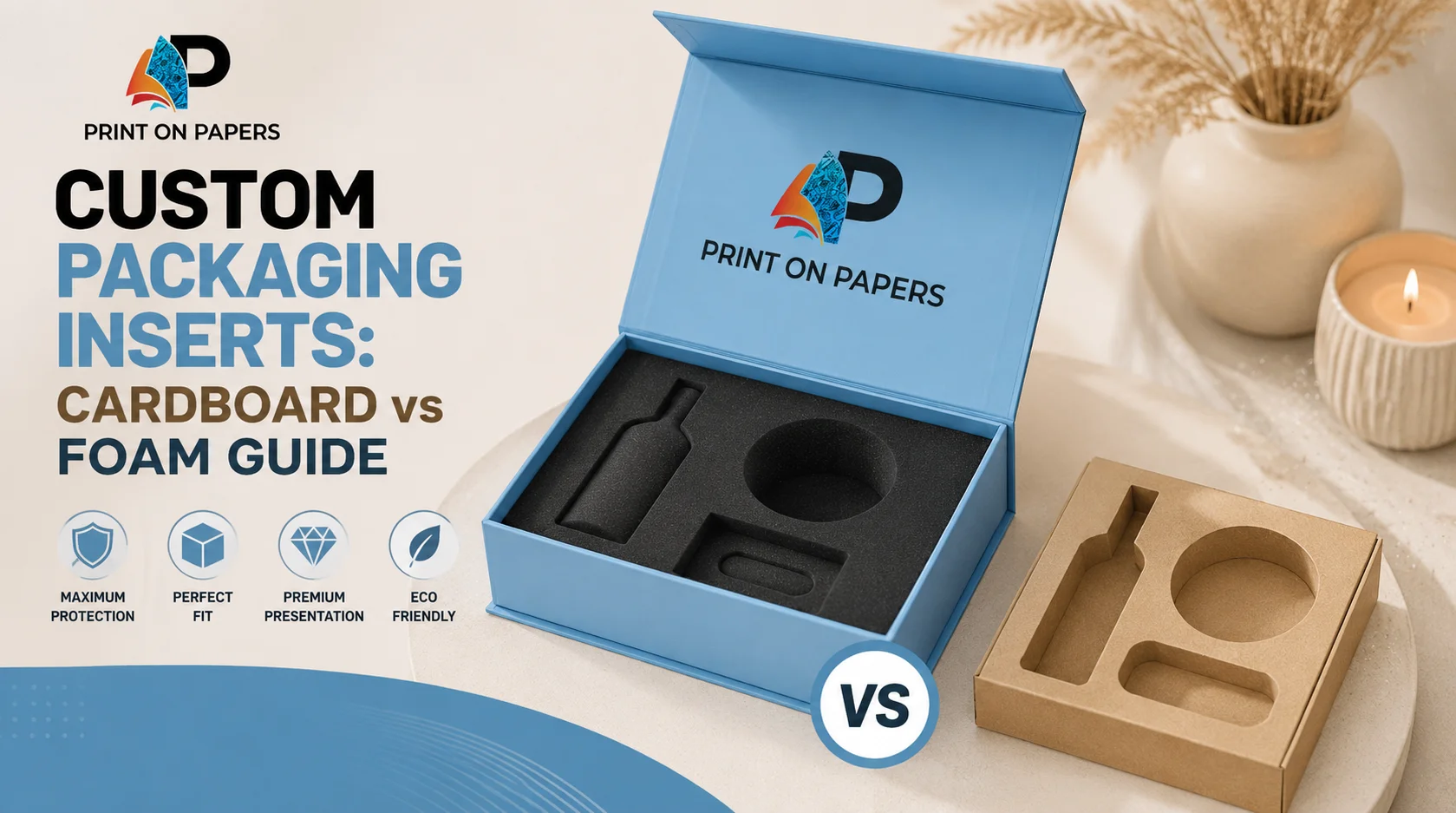
TL;DR: Cardboard inserts cost less and work fine for products under about 2 pounds with basic separation needs. Foam inserts cost more but protect fragile, heavy, or high value items far better. The right choice depends on your product weight, fragility, and how often it gets damaged in transit right now.
Custom packaging inserts hold your product in place inside a box during shipping. Cardboard works well for light, sturdy items and costs less. Foam works better for fragile, heavy, or expensive items because it absorbs shock instead of just dividing space. Pick based on your return rate, not on price alone.
A packaging insert sits inside your box and holds the product steady. It stops movement during shipping. Without one, your product slides around, bangs against the box walls, and often arrives damaged.
Custom packaging inserts come in a few main materials. Cardboard, also called corrugated board, is the most common. Foam, usually EVA, polyethylene, or polyurethane, is the second most common. Both do the same basic job. They hold your product in place and add a layer of protection between the item and the outer box.
This category sits inside the broader world of custom packaging supplies, which also covers tissue paper, roll labels, sleeves, and crinkle filler. Inserts are the structural piece. Everything else in that category handles branding, identification, or lighter cushioning.
One real number should guide this decision more than anything else. According to a review of ecommerce return data by ReadyCloud, about 20 percent of all product returns happen because the item arrived damaged. That is not a small slice of your return costs. It is one in five returns, and packaging choice is usually the direct cause.
This is the real question buyers ask, and the honest answer is that it depends on force, not preference.
Cardboard inserts create fixed sections inside a box. They separate items and stop them from touching each other. But cardboard does not absorb impact the way foam does. If the box gets dropped or squeezed, cardboard can bend, and the product inside can still move enough to crack, chip, or scratch.
Foam inserts work differently. They press around the product and absorb the force of a drop or a hard bump. This makes foam the stronger option for anything fragile, anything heavy relative to its size, or anything with a high replacement cost, like electronics, glass, or precision tools.
The mechanism matters here. A drop test is not a single event during shipping. Packages get handled many times between your warehouse and a customer’s door, and each handoff is a chance for the box to get dropped, tilted, or compressed under other packages.
The mechanism matters here. Damage is not a rare event during shipping. According to 2025 data compiled by Opensend, an ecommerce marketing analytics firm, roughly 3 to 4 percent of all packages shipped in the United States arrive with some form of damage, and 51 percent of shoppers who receive a damaged product say they are unlikely to buy from that seller again. That single number turns insert selection from a packaging detail into a retention issue. A die cut insert that fits your product shape perfectly will still fail if the material underneath cannot absorb the actual forces your box will face.
That is exactly why the material choice for your insert cannot be based on looks alone. A die cut insert that fits your product shape perfectly will still fail if the material underneath cannot absorb the actual forces your box will face.
Buyers usually want real numbers before they commit, not just a general comparison. Here is what a typical spec sheet looks like across both materials.
| Insert Type | Material | Common Size Range | Thickness or Board Weight | From Price |
| Flat Cardboard Insert | Corrugated, B or E flute | 4×4 in to 24×24 in | 40 to 60 GSM board | $0.40/insert |
| Die Cut Cardboard Insert | Chipboard or corrugated | Custom to product shape | 40 to 90 GSM board | $0.45/insert |
| EVA Foam Insert | Closed cell EVA foam | 4×4 in to 20×20 in | 1/8 in to 1 in thick | $0.65/insert |
| Polyethylene Foam Insert | PE foam | Custom cut to product | 1/4 in to 2 in thick | $0.60/insert |
| Polyurethane Foam Insert | PU foam | Custom molded | 1/4 in to 2 in thick | $0.75/insert |
Sizing always follows the product, not a standard chart. A supplier should ask for your product’s exact dimensions and weight before quoting, since even a small mismatch between insert size and product size leads to shifting inside the box.
Cardboard almost always wins on sticker price. It uses the same corrugated material as your outer box, so tooling and material costs stay low. Foam requires cutting or molding a separate material, which adds cost to every unit.
But sticker price is not the full picture. If your damage rate sits above 2 to 3 percent, foam usually pays for itself. Every damaged product costs you the item, the replacement shipping, and often a lost repeat customer. A cheaper insert that raises your return rate is not actually the cheaper option.
Custom packaging inserts wholesale USA no minimum options exist for both materials, so testing this tradeoff does not require a huge upfront commitment. You can order a small batch of each, run it through a real shipping cycle, and compare actual results instead of guessing.
Product ID matters here too. If your product needs labeling alongside protection, pairing your insert with custom roll labels keeps both the protection and the identification consistent across every unit you ship.
Start with three questions. How much does the product weigh? How fragile is it? What is your current damage rate on this item?
Light, sturdy products under about 2 pounds usually do fine with a well fitted cardboard insert. Fragile, heavy, or high value items generally need foam. If your product only needs light cushioning rather than a fitted cavity, custom crinkle paper can be a simpler and cheaper alternative to a full insert.
Do not guess on this. Order samples in both materials, ship a small test batch, and track what actually arrives intact. The data from your own shipments will tell you more than any comparison chart.
Inserts protect what is inside the box. Sleeves handle what customers see first. A custom packaging sleeve wraps around a plain box to add your logo and branding without needing a fully custom box mold. Many brands pair a protective cardboard or foam insert on the inside with a branded sleeve on the outside, getting both protection and presentation without paying for a custom printed box. If you want the full breakdown on how sleeves and inserts work together, click here.
Ordering custom packaging inserts does not need to start with a large commitment. Many US suppliers, including Print On Papers, offer wholesale pricing with no minimum order, so you can test cardboard and foam side by side before scaling up.
Standard production typically runs 7 to 10 working days from proof approval, with rush options available when timelines are tight. Free design support usually comes standard, meaning you send your product dimensions and get back a print ready proof before anything goes into production.
Stop guessing which material will hold up in transit. Get a real quote based on your product’s exact weight and fragility.
| Question | Answer |
| Is cardboard or foam better for shipping fragile items? | Foam is better for fragile items. It cushions the product from impact instead of just holding it in place, which matters most when the item can crack, chip, or scratch on contact. |
| How much do custom packaging inserts cost? | Cardboard inserts typically run lower per unit since they use the same base material as corrugated boxes. Foam costs more upfront but often saves money over time by cutting damage related returns. |
| What packaging insert works best for heavy products? | Heavier products need either thicker corrugated board rated for the weight or a denser foam like polyurethane. Standard thin cardboard will bend and lose its shape under sustained weight. |
| Can I test a packaging insert before ordering a full run? | Yes. Most suppliers can provide a sample or small batch first so you can check fit and protection before committing to a wholesale order. |
| Is cardboard insert packaging recyclable? | Yes. Cardboard inserts are recyclable through standard paper recycling streams. Foam inserts are generally not curbside recyclable, which matters for brands prioritizing sustainability. |
Cardboard and foam both protect products, but they solve different problems. Cardboard is cheaper and works well for light, sturdy items. Foam costs more but earns that cost back once your damage rate climbs. The right custom packaging inserts for your business come down to your product’s weight, fragility, and your actual return data, not a generic recommendation. Test both, track the results, and let your own numbers make the final call.
Print On Papers is a custom printed paper and wrapping paper company serving restaurants, bakeries, delis, food trucks, butchers, florists, apparel brands and food brands across the US and worldwide. We deliver food-safe, eco-friendly, fully branded custom paper, from your first 500 sheets to your next 500,000