
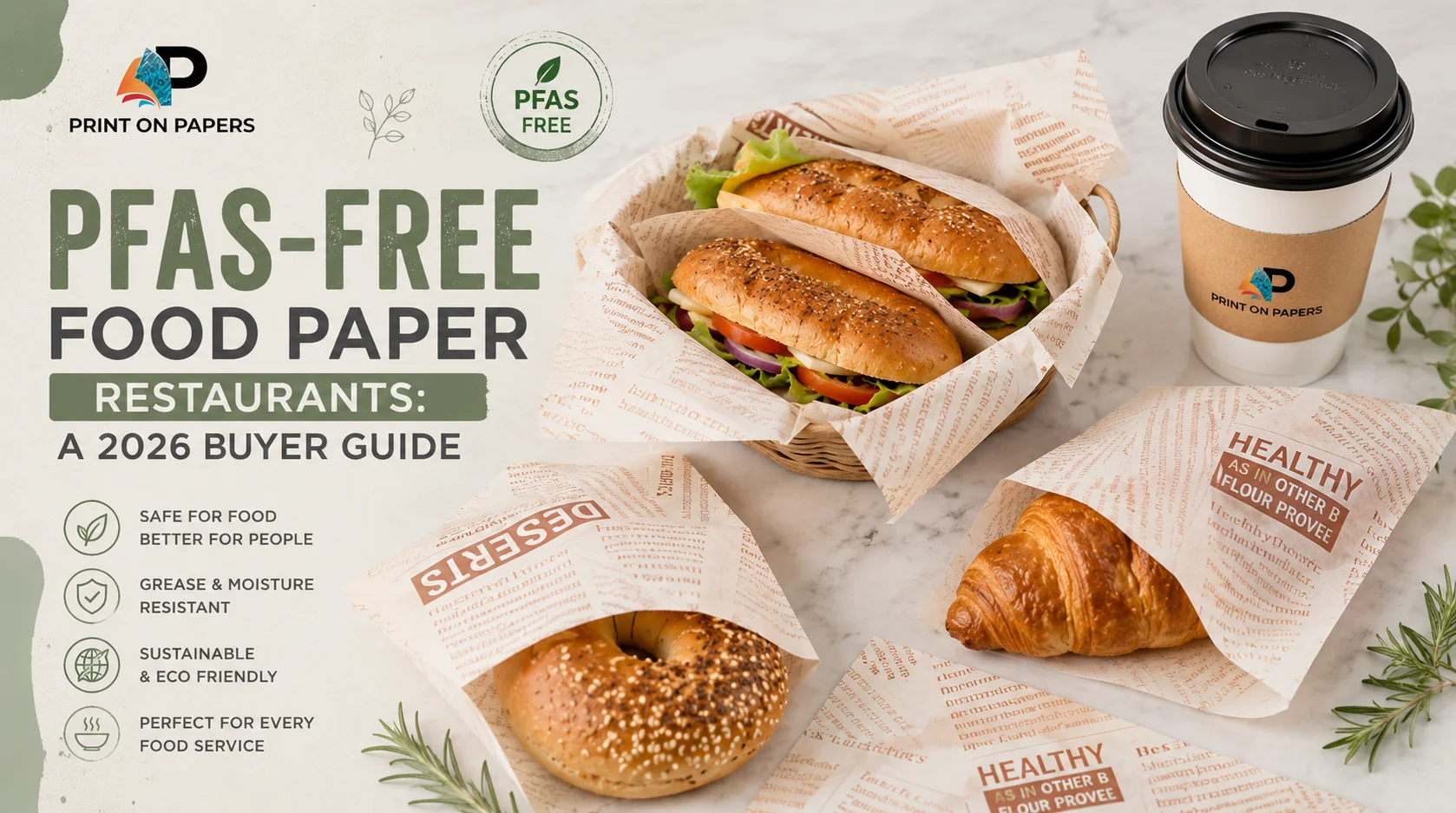
What Is PFAS-Free Food Paper and Why Are US Restaurants Switching in 2026?
TL;DR: PFAS-free food paper is wrapping paper made without added forever chemicals. The FDA confirmed the last of these coatings left the US market in February 2024, and twelve or more states now restrict PFAS in food packaging by law. If you can’t name your paper’s coating or point to a compliance date, there’s a good chance you don’t actually know if it’s compliant. This guide walks through how to check, what to ask your supplier, and what a real switch looks like.
PFAS-free food paper is wrapping and lining paper made without added per- and polyfluoroalkyl chemicals, the coatings that used to keep grease and oil from soaking through a sheet. As of July 2026, this isn’t a fringe concern anymore. It’s a compliance question tied to state law, supplier contracts, and what your customers now expect to see when they open a wrapper.
PFAS stands for per- and polyfluoroalkyl substances. Most people just call them forever chemicals, since they barely break down in soil, water, or the human body once they get there. For decades, paper mills leaned on a PFAS compound called 6:2 FTOH as a grease-proofing agent. It went onto deli wrap, popcorn bags, and pizza boxes to stop oil and moisture from bleeding through the paper.
PFAS-free means none of that sits in the coating. No added fluorinated chemical, no forever chemical in the barrier layer. That doesn’t mean the paper gives up on grease resistance either. Modern coatings still hold up against oil and moisture, just through different chemistry, usually plant-based or PE-based instead of fluorinated.
This isn’t only a packaging footnote. A 2024 review in Environmental Science & Technology pulled together migration data from dozens of studies and found something worth sitting with: PFAS moves from packaging into food under normal use, not just under extreme heat or long-term storage. Forever chemicals food packaging was never a hypothetical risk sitting on a shelf somewhere. It was already in daily use, in ordinary kitchens, before anyone started asking questions about it.
Two things happened, in the right order to actually move a market. The supply chain shifted first. State law is now closing whatever gap federal law left open.
On February 28, 2024, the FDA announced that grease-proofing substances containing PFAS were no longer being sold by manufacturers for food contact use in the US market. This wasn’t a sudden rule. It closed out a voluntary phase-out the agency had been pushing since 2020, after a post-market safety review flagged how long 6:2 FTOH sticks around in animal studies. The FDA followed up in January 2025, formally pulling authorization on 35 food contact notifications tied to PFAS grease-proofing agents, with a compliance deadline of June 30, 2025 for suppliers to clear out any remaining stock.
That single supply-side shift did more to move the market than any state law that followed it. Most food paper made after early 2024, including everyday grill and counter items like custom burger paper and custom hot paper, was already PFAS-free before a single state ban forced anyone’s hand.
Federal action set the floor. States are where the PFAS ban food paper USA story gets specific, and it’s still moving. As of mid-2026, twelve or more states restrict intentionally added PFAS in food packaging, including California, Colorado, Connecticut, Maine, Maryland, Minnesota, New York, Oregon, Rhode Island, Vermont, and Washington.
| State | What Changed |
| Maine | PFAS banned in nine categories of plant-fiber food packaging, effective May 25, 2026 |
| Minnesota | Manufacturers must file detailed PFAS product reports by July 1, 2026 |
| Colorado | PFAS banned in paper and plant-fiber food packaging since January 1, 2024 |
| California | Restricts food packaging to under 100 parts per million total organic fluorine |
| New Jersey | Passed its Protecting Against Forever Chemicals Act in early 2026, manufacturer reporting starts 2027 |
A taco counter running custom taco wrapping paper in California faces a different compliance bar than the same counter in a state with no law yet, at least on paper. In practice, most national and regional chains are asking every location, and every vendor supplying them, to meet the strictest state’s rule regardless of where the restaurant actually sits. Once you supply into that chain, their standard becomes yours.
Most restaurant owners can’t answer this off the top of their head, and that’s not a knock on anyone. Nobody trains a kitchen manager to read a coating spec sheet between lunch and dinner service.
Here’s a fast way to check. Pull a box of your current paper and look at the packing slip or supplier invoice. If it names a specific coating, PE, soy-wax, plant-based, that’s a good sign. If it just says “food safe” with nothing else, that’s worth a second look. A real compliance claim names three things every time: the coating, the regulation it meets, and the date it became compliant. A vague one skips all three and hopes you don’t notice.
This same check matters just as much for meat and cold storage. Butcher counters running custom butcher paper for raw cuts, and kitchens using custom freezer paper for longer-term storage, are handling paper that sits against food for far longer than a quick sandwich wrap does. If a coating’s going to migrate, extended contact time is where it shows up most.
If you’re running a deli counter alongside your regular menu, this question applies just as much to your bagel and deli wrap. We went deeper on that specific angle in our custom bagel paper deli piece, since bagel shops and delis usually face this same coating question from two directions at once, bread on one side of the counter, cold cuts on the other, both falling under the same FDA rule either way.
Ask these four questions before your next order goes in:
If a supplier hesitates on any one of these, that hesitation is usually the real answer. Print On Papers builds every order around FDA 21 CFR 176 compliance and PFAS-free coatings as the default, not something you pay extra to unlock, and can name the coating and compliance date the moment you ask.
Any paper touching food directly falls under this, which covers more of a kitchen than most owners think about day to day. Sandwich counters wrapping cold cuts in custom sandwich paper need the same PFAS-free deli paper coating as a full deli setup. General prep areas leaning on custom food wrapping paper and custom food basket liners for everyday service are covered by the same standard, even though nobody thinks of a basket liner as “packaging” the way a branded wrapper feels like one.
Breakfast and pastry service tends to get overlooked entirely. Custom butter paper sits against food during prep just as long as anything else on this list, and it’s rarely the first thing an operator thinks to ask a supplier about. The full custom food papers range at Print On Papers runs on PFAS-free greaseproof paper as the baseline coating across all of it, not a special order tier you have to request separately.
| Question | Answer |
| What does PFAS-free food paper mean? | It means the paper’s coating has no added per- and polyfluoroalkyl substances in it. Grease resistance comes from a plant-based or PE coating instead of a fluorinated one, and the paper still meets FDA 21 CFR 176 for direct food contact. |
| Is PFAS still legal in restaurant food paper? | No federal ban exists yet, but the FDA confirmed manufacturers stopped selling PFAS grease-proofing agents for food paper back in February 2024. Twelve or more states have their own bans on top of that, with more deadlines landing through 2026 and 2027. |
| How do I know if my current paper has PFAS? | Check your supplier’s packing slip for a named coating type and a compliance date. If neither shows up, ask directly, in writing, and request a certificate rather than a verbal yes. |
| Does PFAS-free paper cost more than regular paper? | Not really. Since most manufacturers stopped selling PFAS coatings back in 2024, most paper made since then is already PFAS-free at standard pricing, not a premium tier you pay extra for. |
| Which states currently restrict PFAS in food packaging? | As of mid-2026, California, Colorado, Connecticut, Maine, Maryland, Minnesota, New York, Oregon, Rhode Island, Vermont, and Washington all restrict it, with New Jersey’s law passed but not yet in effect. |
This is usually the first worry, and it turns out to be mostly unfounded. Since the PFAS phase-out happened at the manufacturer level back in 2024, most paper produced since then is PFAS-free by default rather than as an upgrade. Standard custom food paper pricing starts around $0.20 per sheet with a 500-sheet minimum, the same range compliant and non-compliant paper both land in.
If you’re comparing PFAS-free food paper wholesale USA restaurant certified suppliers side by side, the real cost difference usually isn’t the paper itself. It’s the risk of sitting with a supplier who can’t prove compliance if a state inspector, or a corporate buyer running their own audit, ever asks for paperwork you don’t have.
If you’ve read this far and you’re still not sure what’s on your current paper, that uncertainty is the actual risk, more than the paper itself ever was. Print On Papers builds every custom food paper order around FDA 21 CFR 176 and PFAS-free coatings as standard, ships free worldwide, and sends a compliance certificate with your first order.
PFAS-free food paper restaurants need in 2026 isn’t a hard standard to hit anymore. Most of the market already cleared it by default once manufacturers stopped selling the old coatings back in 2024. What’s actually hard is knowing where your own supplier stands, since most restaurants have simply never asked the question out loud. Pull your last invoice, check for a named coating and a compliance date, and if either one’s missing, ask. If you want the full state-by-state breakdown beyond what’s covered here, click here to read our complete guide.
Print On Papers is a custom printed paper and wrapping paper company serving restaurants, bakeries, delis, food trucks, butchers, florists, apparel brands and food brands across the US and worldwide. We deliver food-safe, eco-friendly, fully branded custom paper, from your first 500 sheets to your next 500,000