
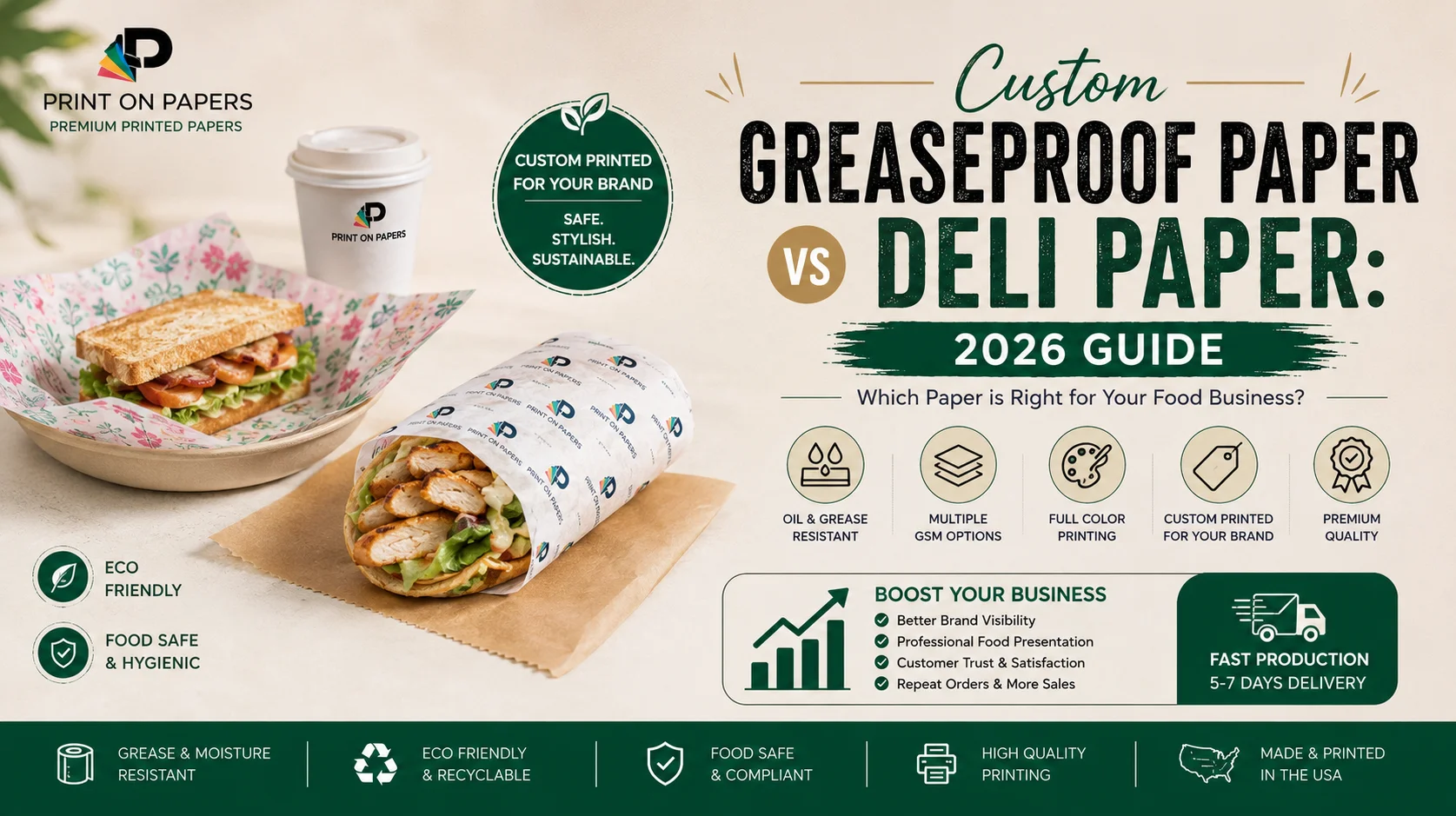
TL;DR: Deli paper is thin and light. It works for cold sandwiches and dry bakery items. It is not built for grease. Greaseproof paper has a denser structure that blocks oil and holds up under heat. If your menu includes fried food, burgers or anything hot and oily, greaseproof paper is the safer call. Both are food safe under FDA rules, and both are now PFAS free after a 2024 federal phase out. Order details, pricing and a free quote sit near the bottom of this guide.
Custom greaseproof paper vs deli paper comes down to one question. Does the paper touch grease, or does it just touch food? Deli paper protects against light moisture and looks great with a printed logo. Greaseproof paper resists oil, holds up to heat and stops grease from soaking through a bag. If hot, fried or oily food is on your menu, greaseproof paper is the paper built for that job.
Picture a Friday lunch rush. Burgers are stacking up on the pass. Someone grabs a sheet of custom deli paper, wraps the order fast, and drops it in the bag. Within a minute, a dark patch spreads across the paper. By the time the bag reaches the counter, grease has soaked through onto the customer’s hand.
That is not a one off mistake. It is the most common reorder call restaurants make after their first few weeks of using deli paper on fried or hot items. The paper was never built to stop oil. It was built to stop light moisture on a cold sandwich or a pastry.
A few problems tend to stack on top of that first failure. The kitchen scrambles to find a fix mid shift. Whoever placed the original order worries about getting stuck with another large batch that does not work. There is a quiet fear that switching paper types might mean losing the clean logo print they already had. And there is a real question about whether the paper they are using even meets current food safety rules, since PFAS coatings on paper packaging changed nationwide in the last two years.
Every one of those worries has a straight answer, and none of them require guessing. Let’s walk through what actually separates these two papers, starting with what greaseproof paper is made from.
Custom deli paper gets its grease resistance from a coating, usually wax or a thin layer of polyethylene laminated onto the surface. That coating is doing all the work. Once it wears thin or the food is hot enough to soften it, oil finds a way through.
Custom greaseproof paper works on a different principle. The cellulose fibers inside the paper are refined and pressed into a dense, tightly packed structure during manufacturing. Instead of relying on a surface coating to block oil, the paper itself is the barrier. You can read more about what greaseproof paper is made from if you want the full manufacturing breakdown.
That structural difference is why greaseproof paper holds up under sustained heat and grease exposure in a way that a coated deli sheet cannot. It is also why greaseproof paper stays effective even after the coating on a comparable deli sheet would have already failed.
Custom deli paper runs light, usually between 30 and 35 GSM, with a wax or thin PE coating. Custom greaseproof paper runs heavier, between 35 and 40 GSM, with a dense cellulose structure and no wax coating needed. That extra density is what holds an oily burger or a basket of fries without breaking down.
Here is a closer look at deli paper vs greaseproof paper if you want the full use case comparison beyond hot food. For the hot food decision specifically, the table below covers what matters most.
| Feature | Deli Paper | Greaseproof Paper |
| GSM range | 30 to 35 GSM | 35 to 40 GSM |
| Barrier type | Wax or PE coating | Dense cellulose structure |
| Grease resistance | Light to moderate | High |
| Heat tolerance | Low | Higher, holds up to hot food |
| Best for | Cold sandwiches, pastries, cheese | Burgers, fried chicken, pizza slices |
| Recyclable | Depends on coating | Recyclable where coated paper is accepted |
| Starting price | $0.20 per sheet | $0.22 per sheet |
The price gap between them is two cents a sheet. That is not the kind of difference that should push a burger stand toward the wrong paper.
Yes, and this part is worth getting exactly right, because the rules changed recently. In February 2024, the FDA announced that manufacturers had completed a voluntary phase out of PFAS chemicals used as grease proofing agents on food packaging paper. That phase out started with commitments made back in 2020. In January 2025, the FDA followed up in the Federal Register, confirming that 35 food contact notifications tied to those older PFAS substances were no longer effective, with a compliance date of June 30, 2025 for any remaining stock.
In plain terms, PFAS free greaseproof paper is not a marketing claim anymore. It is where the entire US market for this product has landed. Beyond the federal action, several states have passed their own laws restricting PFAS in food packaging, so this is not only a federal story either.
Food safety for both papers still runs through 21 CFR 176.170, the federal rule covering paper and paperboard that touches food. Every custom greaseproof paper and every custom deli paper sold by Print On Papers meets that standard, uses soy based food safe inks instead of petroleum ink, and ships on FSC certified base stock. Recyclable greaseproof paper is also the norm now, not the exception, as long as your local recycling program accepts coated food paper.
Cold sandwich counters and bakeries do not need the extra grease protection. Custom deli paper is still the right call there, and custom deli paper for sandwich shops specifically covers that use case, at a lower price per sheet.
Anything fried, hot or heavy on sauce should move to greaseproof. That includes burgers, fried chicken, tacos, pizza slices and anything coming out of a fryer basket. Custom greaseproof paper for restaurants covers exactly this use case, with the same branding options you already expect on deli paper. If your menu sits in between, serving both cold items and hot ones, most kitchens end up stocking both papers rather than trying to force one to do both jobs.
Custom greaseproof paper wholesale USA no minimum PFAS free pricing starts at 500 sheets, with no order penalty for staying at that floor. Digital printing covers runs between 500 and 5,000 sheets, and larger orders move to offset printing, which brings the per sheet cost down further. There is also no setup fee on wholesale greaseproof paper orders, so the quote you get is the price you pay.
Standard production takes 7 to 10 working days from proof approval, with a rush option in 5 to 7 days when timing is tight. Shipping is free worldwide through DHL, FedEx or UPS, tracked from dispatch out of Valley Stream, New York. Print On Papers includes free design support on every order, so sending over a logo is usually the only step before production starts.
Deli paper and greaseproof paper are just two products inside a much larger lineup. If your kitchen needs more than one type of food wrap, from bakery sheets to fry paper to takeout liners, it is worth browsing the full range of custom printed papers available as flat sheets or rolls, all starting from that same 500 sheet minimum.
| Question | Answer |
| Can I use deli paper for hot food? | Not for anything fried or greasy. Deli paper resists light moisture, not oil, and it will let grease soak through within a few minutes of contact with hot, fatty food. |
| Does greaseproof paper contain PFAS? | No. As of the FDA’s February 2024 market phase out, PFAS grease proofing chemicals are no longer sold for food packaging use in the US, and Print On Papers’ greaseproof paper is PFAS free. |
| Is greaseproof paper the same as parchment paper? | No. Parchment paper is built for oven baking at high heat. Greaseproof paper is built for wrapping hot, oily food at the counter, not for going into an oven. |
| What GSM is best for wrapping burgers? | Look for greaseproof paper in the 35 to 40 GSM range. That density holds up to grease and heat without the paper going soft or translucent. |
| Is custom greaseproof paper recyclable? | Yes, wherever your local recycling program accepts coated food paper. It has no wax coating to strip out first, which makes recycling simpler than with some coated deli papers. |
If your kitchen is handing out grease stained bags right now, the fix does not need to wait until next month’s order. Send over your logo, pick your paper, and get a free quote today. Production starts within days, not weeks.
The custom greaseproof paper vs deli paper decision is not complicated once you separate what each paper is actually built to do. Deli paper is for cold, dry, light service. Greaseproof paper is for anything hot, fried or heavy with oil. Both are food safe, both are PFAS free as of 2024, and both ship with the same branding quality you already expect. Match the paper to what is actually on the plate, and the grease stained bag problem goes away for good.
Print On Papers is a custom printed paper and wrapping paper company serving restaurants, bakeries, delis, food trucks, butchers, florists, apparel brands and food brands across the US and worldwide. We deliver food-safe, eco-friendly, fully branded custom paper, from your first 500 sheets to your next 500,000