
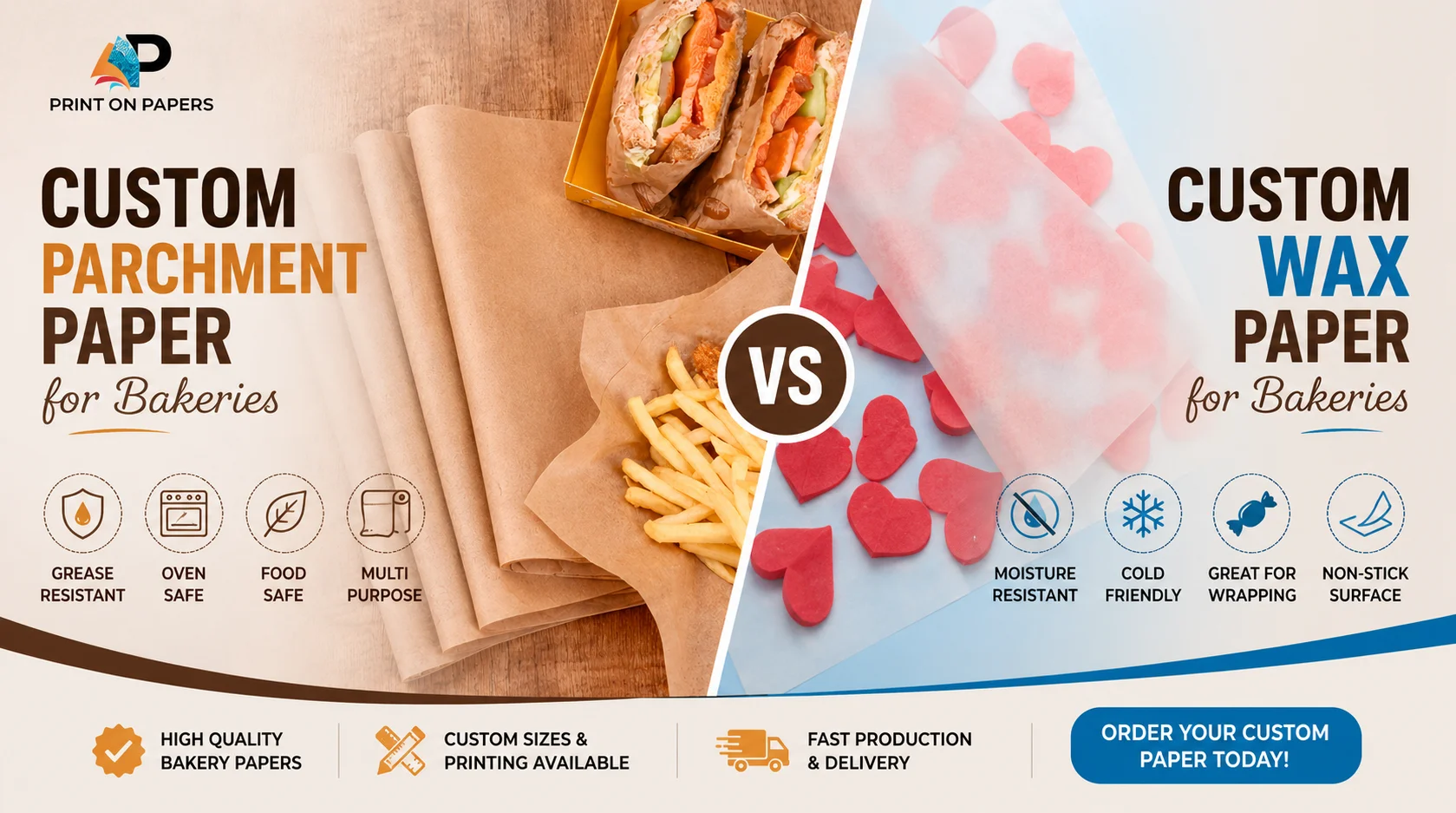
Custom Parchment Paper vs Wax Paper for Bakeries: Which Is Right for Your Baked Goods?
TLDR
Parchment paper is silicone-coated, oven-safe to 450°F, and right for baking cookies, cakes, and artisan bread. Wax paper is paraffin-coated, moisture-resistant, and best for cold wrapping and confectionery. Both are available custom-printed with your bakery logo from 500 sheets.
Table of Contents
- The Morning a Wrong Paper Destroyed an Entire Bakery Batch
- What Is Custom Parchment Paper vs Wax Paper? (2026)
- The One Difference That Changes Everything for Bakeries
- Which Bakery Type Needs Which Paper?
- Will Logo Ink Transfer to Your Baked Goods?
- Parchment vs Wax Paper Comparison Table
- FAQs About Custom Parchment Paper vs Wax Paper Bakery
- How to Order Custom Bakery Paper in the USA
- Conclusion
1. The Morning a Wrong Paper Destroyed an Entire Bakery Batch
Sarah runs a small patisserie in Brooklyn. Last March, a generic paper supplier sent her a shipment labeled “baking paper.” It looked right. It felt right. It was exactly the right size for her half-sheet pans.
By 7 AM, 80 macarons were destroyed. Every single one had fused to the paper lining in the oven. The shells cracked when she tried to lift them. The entire tray went in the bin.
That was $240 in product, four hours of prep labor, and a missed wholesale order to a local café chain.
The paper was wax paper. Not parchment. The paraffin wax coating melted in her 325°F oven, bonded to the delicate macaron shells, and made them impossible to salvage.
At Print On Papers, our production team hears stories like this regularly. More than 30% of first-time custom bakery paper inquiries from US bakeries start the same way. A baker used the wrong paper and it cost them money, product, or both.
This guide sorts that out for good. So you know exactly which paper your bakery needs, and you never make that expensive swap again.
2. What Is Custom Parchment Paper vs Wax Paper? (2026)
What is parchment paper for bakeries?
Parchment paper is cellulose-based paper coated on both sides with food-grade silicone. That silicone layer does three things extremely well. It resists heat up to 450°F. It prevents baked goods from sticking. And it keeps grease from soaking through the sheet.
In the US foodservice industry, you will also see it called baking paper or bakery liner paper. They refer to the same product. Paper and paperboard components used in direct food contact in the US are governed under Title 21 CFR Part 176, as confirmed by the FDA’s food contact substance regulations. Every sheet of parchment paper that touches your baked goods must comply with those standards.
What is wax paper for bakeries?
Wax paper is paper coated with paraffin wax, soy-based wax, or beeswax. That wax layer makes it moisture-resistant and non-stick at cold or room temperatures. But the wax melts somewhere around 120°F. That single fact ends its usefulness the moment your oven turns on.
Wax paper is genuinely useful for cold wrapping, candy storage, cookie layering in boxes, food prep countertop protection, and dough rolling. For those tasks, it does the job well and at a lower price per sheet than parchment.
Both papers look almost identical on a supply shelf. Both feel similar in your hand. That similarity causes the exact problem Sarah ran into at 7 AM.
Both are available with your logo on every sheet through custom wax paper and custom parchment paper options, starting from 500 sheets with no setup fees.
3. The One Difference That Changes Everything for Bakeries
Heat tolerance is the only thing that really matters when you are comparing these two baking paper types in a commercial bakery kitchen.
Parchment paper goes in the oven. Wax paper does not.
That is the full parchment paper vs wax paper comparison for any baker who works with heat. Everything else, the coating science, the GSM weight, the moisture resistance ratings, builds on top of that single rule.
Here is what happens technically. Silicone, the coating on parchment, is a heat-stable compound that holds its structure even at sustained convection temperatures. It does not migrate into food. It does not break down at baking temperatures under 450°F. The America’s Test Kitchen 2026 parchment paper review confirmed that in testing, none of the silicone-coated parchment papers they evaluated ignited or compromised food quality even in a 500°F oven environment.
Paraffin wax, the coating on standard wax paper, starts melting around 120°F. That melted wax does not stay on the paper surface. It transfers. It bonds with the food sitting on top of it. In a bakery oven at 325°F, that process happens in the first few minutes of baking, well before your cookies or croissants are anywhere near done.
There is one narrow exception worth knowing. Dry wax paper, which has the wax embedded into the paper fiber rather than layered on the surface, can technically tolerate oven heat up to 400°F when it is completely covered by batter or dough. No direct heat exposure, no uncovered surface. In a commercial bakery operation, this scenario rarely applies. And the risk of using it incorrectly is the same result Sarah got, destroyed product and a wasted morning.
Can I use wax paper instead of parchment for baking?
No. Wax paper is not oven-safe for direct use in a commercial bakery setting. The wax coating melts at oven temperatures and can bond directly to your baked goods. For any heat application, parchment paper is the correct and only safe choice.
The specialty bakery sector is growing fast. According to Technavio’s Specialty Bakery Market Growth Analysis report, the global specialty bakery market is forecast to grow by $16.21 billion between 2024 and 2029 at a 4.6% CAGR. As more regional and artisan bakeries scale their operations, paper selection shifts from a daily kitchen preference into a food safety and compliance decision
4. Which Bakery Type Needs Which Paper?
Different bakeries have different needs. The custom parchment paper vs wax paper bakery decision changes depending on what you actually bake and how you sell it.
- Artisan bread and sourdough bakeries need parchment paper for every bake. Sourdough and artisan loaves go into ovens at 375°F to 500°F. A silicone-coated sheet protects the base from the baking stone or steel without burning or fusing to the crust. Our custom parchment paper is produced in 40 to 60 GSM and rated to 450°F, which covers the full temperature range that artisan baking requires.
- Patisseries and cookie bakeries use parchment for oven work and custom wax paper for their takeaway packaging. Macarons, financiers, and shortbread bake at 300°F to 375°F. Parchment prevents sticking and gives you even browning on the bottom. After baking, custom wax paper handles the wrapping, box lining, and customer-facing packaging layer.
- Confectionery and candy bakeries genuinely benefit from wax paper. Caramels, fudge, and hard candies set at room temperature or in cold storage. Wax paper’s moisture barrier prevents the humidity transfer that makes candy textures turn sticky and degrade during shelf life. For any hot candy process, however, parchment is still the correct paper.
- Wholesale bakeries and specialty food brands typically run both papers in the same operation. Parchment handles the oven lining stage. Branded custom wax paper handles the retail wrapping and customer-facing packaging stage. A regional patisserie brand selling through grocery retail channels, for example, might use printed parchment for production and printed wax paper for branded consumer-facing packaging.
- Food trucks and market stall bakeries benefit from starting small. At Print On Papers, food truck operators often test custom branded parchment paper at our 500-sheet minimum order before committing to a larger quarterly run.
5. Will Logo Ink Transfer to Your Baked Goods?
This is the question bakery owners ask us most before placing their first custom paper order. And it is a fair concern.
The short answer is no, when the paper is printed correctly with food-grade inks.
Here is why. All printing on custom food paper goes on the non-food-contact face of the sheet. The face that touches your baked goods is left unprinted. Ink and food surface never meet.
But that guarantee holds only when the ink formulation is food-safe. At Print On Papers, every order uses soy-based and water-based food-grade inks that comply with FDA 21 CFR Part 176 standards for paper and paperboard components used in direct food contact. There are no petrochemical solvents in our ink formulations.
There is a specific risk you should know about when sourcing from any supplier. Some cheaper parchment paper products use Quilon coating, which contains chromium stearate. The America’s Test Kitchen 2026 parchment paper review specifically flagged Quilon-coated parchment as a health concern when used at high sustained temperatures. Chromium is a heavy metal that poses toxicity concerns when the coating degrades under heat. We do not use Quilon coatings on any product in our range.
An Ipsos survey conducted on behalf of the Paper and Packaging Board found that 63% of consumers perceive products in paper and cardboard packaging as higher quality than those in other materials. For bakeries, branded paper is a brand investment. But only when the paper is food-safe at the material level.
6. Parchment vs Wax Paper Comparison Table
| Feature | Custom Parchment Paper | Custom Wax Paper |
| Coating Type | Food-grade silicone | Paraffin, soy, or beeswax |
| Heat Resistance | Up to 450°F | Melts above 120°F |
| Oven-Safe | Yes | No |
| Non-Stick | Yes, high performance | Yes, cold use only |
| Moisture Resistance | Moderate | High |
| Best Bakery Use | Baking, pan lining, oven wrapping | Cold wrapping, candy, takeaway packaging |
| GSM Range | 40 to 60 GSM | 30 to 60 GSM |
| FDA 21 CFR 176 | Compliant | Compliant |
| Custom Logo Printing | Yes, food-grade soy inks | Yes, food-grade soy inks |
| Starting Price (Print On Papers) | From $0.40 per sheet | From $0.30 per sheet |
| Minimum Order | 500 sheets | 500 sheets |
| FSC Certified | Yes | Yes |
7. FAQs About Custom Parchment Paper vs Wax Paper Bakery
Can I use wax paper instead of parchment for baking?
No. Wax paper is not oven-safe for direct bakery use. The wax coating melts around 120°F and can contaminate your baked goods. Use parchment paper for all oven work in a commercial bakery.
What temperature is safe for parchment paper in a bakery oven?
Parchment paper handles temperatures up to 450°F safely in a standard commercial oven. Avoid using either paper in a broiler, which reaches above 500°F.
Will logo ink from custom-printed parchment transfer to my baked goods?
No, when the paper uses food-grade soy-based inks. All printing sits on the non-food-contact face. At Print On Papers, every order is FDA 21 CFR 176 compliant and uses soy-based food-grade inks with no petrochemical solvents.
What is the minimum order for custom parchment paper in the USA?
The minimum at Print On Papers is 500 sheets. All orders ship free worldwide via DHL, FedEx, or UPS. Standard production runs 7 to 10 working days from proof approval.
Is custom wax paper food-safe for direct contact with baked goods?
Yes, at room temperature and in cold storage. Custom wax paper is FDA 21 CFR 176 compliant for cold food contact. It is not safe for any oven application.
How does custom parchment vs wax paper for artisan bakery USA sourcing work?
Most US artisan bakeries order custom parchment for oven use and custom wax paper for retail packaging. Both carry your logo, brand colors, and artwork from the same supplier with consistent print standards across both products.
8. How to Order Custom Bakery Food Paper USA
Step 1: Share your paper type, size, and quantity
Tell us whether you need parchment, wax paper, or both. Share your dimensions in inches, your quantity, and your logo file in any format, including JPG, PNG, PDF, AI, or EPS. Not sure which paper works for your specific baked goods? Our team matches you to the right product and GSM for your application.
Step 2: Approve your free digital proof
Our in-house design team builds your complete print-ready artwork within 24 to 48 business hours. You receive a full-color proof at actual scale. Unlimited revisions at no extra cost. Nothing goes to production until you approve it in writing.
Step 3: Production and free worldwide delivery
Standard production runs 7 to 10 working days from proof approval. Rush options in 5 to 7 days are available for most paper types. Every order ships free worldwide via DHL, FedEx, or UPS, fully tracked from our facility in Valley Stream, New York.
Ready to Put Your Brand on Every Sheet?
Print On Papers has served over 400 food businesses across the US since 2020. Every order uses FDA-safe, FSC-certified materials with soy-based food-grade inks. Starting from 500 sheets and from $0.20 per sheet.
No setup fees. No design fees. No commitment before you see your proof.
9. Conclusion
The custom parchment paper vs wax paper bakery decision comes down to one simple operational question: is the paper going into an oven or not?
If yes, parchment paper is your only correct choice. The silicone coating holds up to 450°F, prevents sticking, and meets FDA 21 CFR Part 176 standards for food-contact paper. If no, wax paper is a reliable, lower-cost option for cold wrapping, candy work, and customer-facing retail packaging.
Most commercial bakeries in the US use both papers for different parts of their daily operation. Custom printing makes both work harder for your brand at the same time.
The global bakery paper market was estimated at $5 billion in 2025 and is forecast to reach $7.5 billion by 2033 at a 5% CAGR, according to the Market Report Analytics Bakery Paper Market report. For bakeries sourcing custom-printed bakery food paper USA wide, the paper you choose directly affects food safety, product presentation, and the brand impression customers carry out the door.
Get the paper right. Brand it. Ship it consistently.