
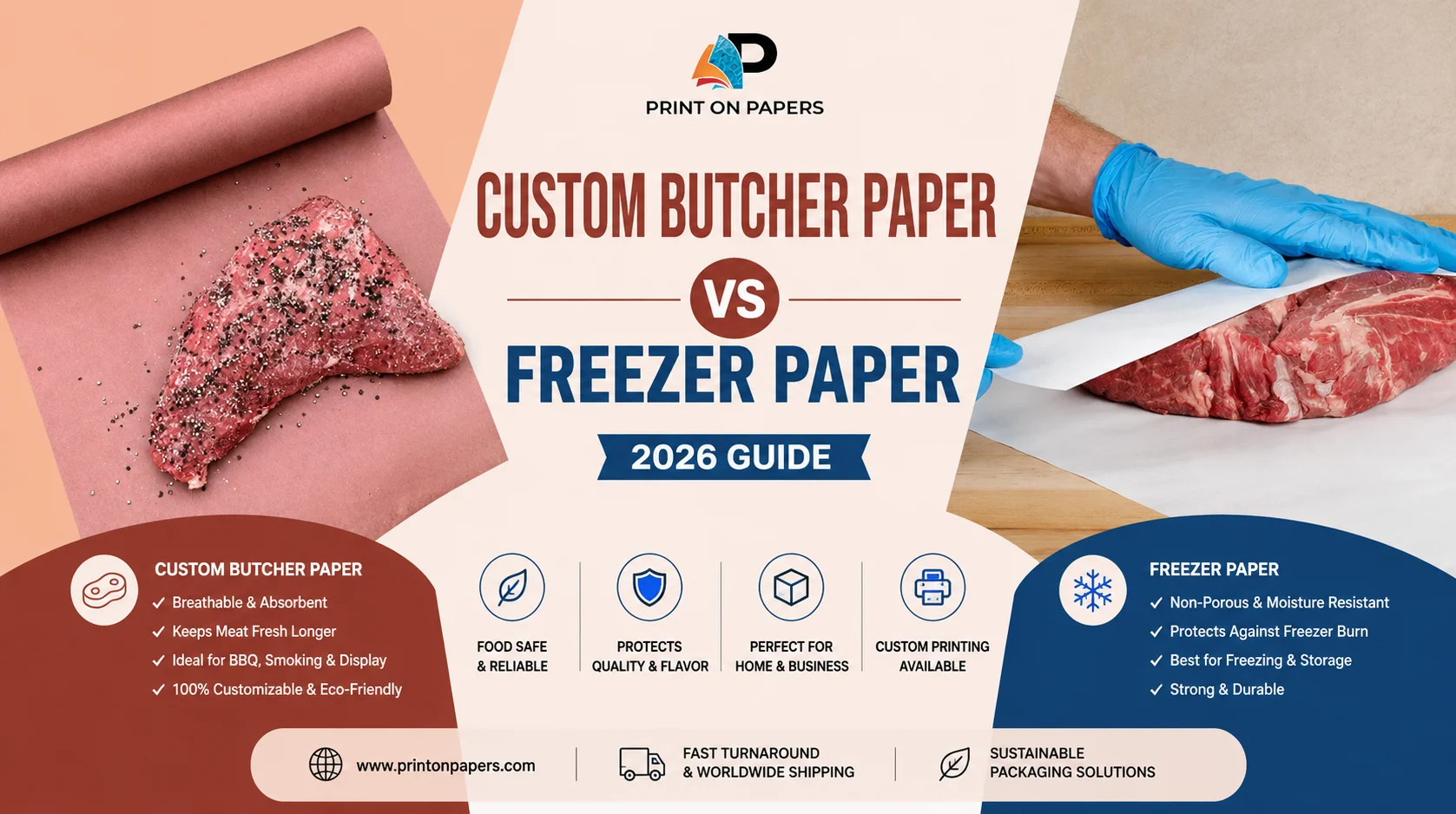
TLDR: Custom butcher paper is uncoated, breathable kraft fiber built for fresh counter service, deli wrapping, and BBQ smoking in the United States. Custom freezer paper carries a BPA-free polyethylene coating on one face that seals moisture in and prevents freezer burn for up to 12 months. Both take full custom printing with your logo. Choosing the wrong one costs you product quality, customer trust, and FDA compliance standing.
Butcher paper is uncoated kraft paper. It breathes, allows controlled moisture transfer, and suits fresh counter service for up to 24 to 48 hours. Freezer paper is the same kraft base with a BPA-free polyethylene coating on one side. That coating seals moisture in, prevents freezer burn, and protects protein in frozen storage for up to 12 months.
Here is a scenario every US meat counter operator has lived through at some point. You open a supply delivery, pull out two rolls of paper, and they look completely identical. Same weight. Same color. Same roll format. One is custom butcher paper. The other is custom freezer paper. And using one in place of the other has real consequences for your product quality, your customers, and your FDA compliance posture.
At our production facility in Valley Stream, New York, we hear this story regularly. An operator orders one paper, a supplier ships the other, and the difference only shows up when a week of wrapped steaks comes out of the walk-in freezer with gray edges and surface dehydration. That is freezer burn. That is product loss. And it is entirely preventable when you know which paper your counter needs and why.
This guide is written for deli operators, butcher shop owners, specialty food brands, and food truck operators across the United States who need a clear, practical answer, not a generic comparison chart.
Custom butcher paper is produced from bleached or unbleached kraft fiber through the kraft pulping process. It carries no plastic coating, no wax layer, and no polyethylene film. This uncoated structure makes it breathable. Meat wrapped in butcher paper can release surface moisture gradually. This keeps fresh cuts looking vibrant at the counter and prevents the slimming that occurs when protein sits trapped against a non-breathable surface.
Commercial butcher paper runs from 40 to 90 GSM depending on the application. Standard deli counter wrapping typically uses 40 to 60 GSM. High-volume butcher shop service, wrapping full briskets or large primal cuts, benefits from 60 to 90 GSM for tear resistance and durability during handling.
Key specifications:
Best uses include fresh counter service, deli wrapping for same-day or next-day consumption, custom sandwich paper for deli and lunch counters, BBQ and smoking applications, counter and basket lining, and retail meat presentation.
One important point. Butcher paper is not suitable for long-term frozen meat storage without an additional moisture barrier. Using it alone in a walk-in freezer results in measurable surface dehydration within 48 to 72 hours at sub-zero temperatures. This is the most common and costly mistake we see from new operators sourcing meat wrapping paper for the first time.
Our custom butcher paper is available from 500 sheets with no setup fee, produced to FDA 21 CFR 176 standards, FSC-certified, and printed with your logo using food-grade soy-based inks.
Custom freezer paper starts from the same kraft base as butcher paper. Then one face receives a BPA-free polyethylene coating. That single addition changes nearly everything about how the paper performs in contact with frozen protein.
The PE coating creates a moisture vapor barrier. When you wrap a steak or deli cut in freezer paper with the coated face against the meat, air cannot reach the protein surface. Moisture cannot escape. Ice crystal formation on the meat surface is prevented. The result is protein that holds its color, texture, and flavor through weeks or months of frozen storage.
One critical safety point. Never use freezer paper in an oven, smoker, or near any heat source. The PE coating melts above 250°F and directly contaminates the food it is touching. This is the most frequent misuse mistake in butcher shops and restaurant kitchens across the US.
Our custom freezer paper starts from $0.20 per sheet, ships free worldwide via DHL, FedEx, or UPS, and arrives in 7 to 10 working days from proof approval.
| Feature | Custom Butcher Paper | Custom Freezer Paper |
| Base material | Kraft fiber, bleached or unbleached | Kraft fiber with BPA-free PE coating |
| Coating | None, uncoated | One-side PE polyethylene |
| GSM range | 40 to 90 GSM | 57 to 65 GSM |
| Breathability | Yes, controlled moisture transfer | No, fully vapor-sealed |
| Moisture barrier | Partial, light grease resistance | Full moisture vapor barrier |
| Best use | Fresh counter, deli service, BBQ smoking | Frozen storage up to 12 months |
| Safe temperature | Up to 250°F | Down to minus 40°F |
| PFAS-free | Yes | Yes |
| BPA-free | Yes | Yes, PE coating |
| FDA 21 CFR 176 | Compliant | Compliant |
| FSC-certified | Yes | Yes |
| Recyclable | Yes, uncoated | Generally no, PE coating |
| Custom logo printing | Yes, food-safe soy inks | Yes, on uncoated face only |
| Roll and sheet options | Both available | Both available |
| Price from Print On Papers | From $0.40 per sheet | From $0.20 per sheet |
This is the section most competitor blogs skip entirely. They compare the papers and then leave you to figure out the decision yourself. Here is a clear, scenario-based guide built around how US meat businesses actually operate.
This is where the decision becomes a food safety and regulatory issue, not just an operational one.
All paper and paperboard in direct contact with food in the United States must comply with Title 21 of the Code of Federal Regulations, Part 176, which governs indirect food additives in paper and paperboard components. For aqueous and fatty food contact, the specific section is 21 CFR 176.170. According to the USDA Food Safety and Inspection Service, packaging materials entering any meat or poultry facility in the US must be accompanied by a supplier guarantee confirming compliance with the Federal Food, Drug and Cosmetic Act. That means your paper supplier must be able to provide written documentation. Not a verbal assurance. Written compliance documentation on request.
Every order from Print On Papers ships with FDA 21 CFR 176 compliance documentation available on request. All inks are soy-based and food-grade. All coatings are PFAS-free and BPA-free. These are verifiable material specifications, not marketing language.
Per- and polyfluoroalkyl substances were historically used in grease-resistant paper coatings across the US food packaging industry. The legislative landscape has shifted decisively. Maine’s LD 1503, passed on July 15, 2021, became the most comprehensive PFAS law in the US and includes a PFAS ban on plant-fiber food contact packaging that took effect May 25, 2026. Minnesota’s Amara’s Law, signed in 2023, requires manufacturers to disclose intentionally added PFAS in products to the Minnesota Pollution Control Agency, with reporting requirements phased in from 2025 onward. As of March 2026, hundreds of PFAS-related bills are active across 23 state legislatures. The direction is clear.
The grease resistance in Print On Papers butcher paper comes from dense cellulose fiber structure, not from any PFAS-based chemical treatment. This matters for your compliance posture today and for your positioning as US state laws continue to tighten through 2026 and beyond.
A 2024 food wrapping paper industry report found that approximately 56% of US foodservice operators had already adopted recyclable paper-based packaging to replace single-use plastics, driven partly by PFAS-related state legislation. The baseline expectation for US operators is now PFAS-free, FSC-certified paper, not a premium tier.
Plain white roll paper is not a neutral choice. It is a daily missed branding opportunity that compounds with every single wrap your counter produces.
An Ipsos survey conducted for the Paper and Packaging Board found that 63% of US consumers believe products wrapped in paper packaging appear higher quality than the same product in plain covering. For a deli counter or butcher shop where perception of freshness and craft drives repeat purchase, that number is directly tied to revenue.
Every custom printed sheet that leaves your counter is a working impression. A steak wrapped in custom butcher paper wholesale with your logo sits in a customer’s refrigerator with your brand visible every time they open the door. A portion wrapped in your meat wrapping paper with a logo goes into their freezer for weeks. That is repeat-exposure marketing at zero additional cost per impression.
Digital printing adoption in branded food wrapping paper rose 31% globally between 2020 and 2024, according to a 2024 food wrapping paper market analysis published by IndustryResearch.biz. Independent butcher shops and deli operators across the United States are ordering custom branded paper at a scale that used to be accessible only to regional chains. Print On Papers makes this accessible from 500 sheets with no setup fee and free shipping across all 50 US states and worldwide.
Pantone color matching is available for both butcher paper and custom freezer paper. This means your logo and brand colors stay consistent whether a cut is coming off the counter in butcher paper or going into the freezer in freezer paper. Consistent branding at every touchpoint is what separates a commodity meat counter from a craft operator customers return to.
Ordering from Print On Papers takes three steps and requires no design experience, no large upfront commitment, and no setup fee.
Choose butcher paper, freezer paper, or both. Not sure which GSM or coating fits your counter’s specific use? The team will recommend the correct paper, coating weight, and format for your application. No commitment required at this stage. Responses within one business hour Monday to Friday, 9am to 6pm Eastern Time.
Send your logo in any format, including JPG, PNG, PDF, AI, or EPS. The in-house design team builds your complete print-ready artwork at no additional cost, including CMYK color conversion, bleed settings, and registration marks. Pantone color matching is available for exact brand color reproduction. Unlimited revisions at no charge until the proof is exactly right. Nothing goes to print without your written approval.
Rush production in 5 to 7 working days is available for most paper types. Every order ships free worldwide via DHL, FedEx, or UPS with full tracking. You receive your tracking number by email on dispatch day from our facility in Valley Stream, New York.
Custom butcher paper wholesale orders scale from 500 sheets up to 500,000 sheets with the same food-safe materials and print quality at every volume. The per-sheet price decreases at 1,000, 5,000, and 25,000 sheet tiers. Whether you need branded meat wrapping paper with a logo for a single food truck or a consistent supply for a regional butcher chain, the process and standards are identical.
According to the USDA FSIS official guidance on meat and poultry packaging materials, packaging suppliers for commercial meat operations in the United States must provide a written guarantee confirming FDA compliance. Print On Papers provides this documentation on request for every single order.
For US operators responding to customer expectations in 2026, this question matters more than it did five years ago.
Uncoated custom butcher paper is the more sustainable option. It is fully recyclable and biodegradable, as long as grease contamination levels meet local curbside recycling thresholds. Grease resistance in Print On Papers butcher paper comes from cellulose fiber density, not from wax or PFAS coating, which means it enters the paper recycling stream without contamination issues in most US municipalities.
Custom freezer paper with PE coating is generally not curbside recyclable because the polyethylene layer cannot be separated from the fiber base in standard recycling systems. However, BPA-free PE coating is significantly safer than legacy PFAS-based coatings and meets all US state compliance requirements where PFAS restrictions are currently in effect.
Both papers use FSC-certified base stock and soy-based food-safe inks at Print On Papers. An Emarsys customer loyalty report found that 39% of Gen Z and 42% of millennial consumers in the US will pay a premium for sustainable food packaging. For meat counter operators building a brand with younger customers, that stat has a direct impact on purchasing decisions your packaging can influence.
Butcher paper is uncoated kraft fiber that breathes. It is designed for fresh counter service and short-term refrigerator storage of up to 24 to 48 hours. Freezer paper is the same kraft base with a BPA-free PE coating on one face. That coating creates a sealed moisture vapor barrier for frozen protein storage of up to 12 months. The coating is the only structural difference, but it determines everything about which paper belongs where.
No. Uncoated butcher paper allows moisture vapor to pass through. For any protein going into a sub-zero freezer beyond 48 hours, you need the PE coating of custom freezer paper to prevent freezer burn and surface dehydration. Short-term refrigerator storage of one to two days is acceptable with butcher paper. Anything going into a walk-in freezer needs freezer paper.
Yes, when produced to FDA 21 CFR Part 176 standards. Not all butcher paper sold in the US meets this requirement. Always request written compliance documentation from your supplier before using any paper in direct contact with raw protein. Print On Papers provides this documentation on every order on request.
Never. The polyethylene coating on custom freezer paper melts above 250°F and directly contaminates the food. Use uncoated butcher paper for all smoking and cooking applications. This applies to both conventional ovens and commercial smokers.
Custom freezer paper with BPA-free PE coating protects raw protein in sub-zero storage for up to 12 months. Butcher paper without an additional moisture barrier degrades in frozen storage within 48 to 72 hours. For deli meat paper USA operators, the rule is simple: butcher paper for the counter, freezer paper for the back.
Yes. At Print On Papers, logos and full-color brand artwork are printed on the uncoated kraft face of freezer paper using food-safe soy-based inks. The PE-coated face, which contacts the meat directly, remains unprinted. This preserves full FDA 21 CFR 176 compliance for direct protein contact.
Both butcher paper and freezer paper can be FDA 21 CFR 176 compliant when manufactured to that standard. The compliance must cover the base paper, any coating, and all printing inks. Demand written documentation. If your supplier cannot produce it, that paper has no business touching raw protein at your counter.
Custom butcher paper vs freezer paper is a clear decision once you know what each paper actually does. Butcher paper breathes. It is right for fresh counter service, deli wrapping, custom sandwich service, and BBQ smoking across US food operations. Freezer paper seals. It is the only compliant choice for frozen protein storage beyond 48 hours in any US commercial kitchen or walk-in freezer.
Most meat counter operations in the United States need both. The paper at your service counter and the paper in your back freezer do different jobs. Both can carry your brand. Both can carry your logo in Pantone-matched color with soy-based food-safe inks on FSC-certified stock. Every wrapped cut becomes a touchpoint. Every branded sheet in a customer’s freezer is a reminder of where they bought their meat.
Print On Papers serves independent butcher shops, specialty deli operators, BBQ restaurants, food trucks, and multi-location chains across all 50 US states and internationally from a 500-sheet minimum, with free design support, FDA 21 CFR 176 compliance documentation, and free worldwide shipping via DHL, FedEx, or UPS.
Get a free quote in under two minutes. Tell the Print On Papers team your paper type, dimensions, and quantity. The design team handles everything else, including your artwork, color matching, and compliance documentation.
No setup fees. No design experience needed. FDA 21 CFR 176 compliant. FSC-certified. Ships to all 50 US states and worldwide. Minimum 500 sheets.
Print On Papers is a custom printed paper and wrapping paper company serving restaurants, bakeries, delis, food trucks, butchers, florists, apparel brands and food brands across the US and worldwide. We deliver food-safe, eco-friendly, fully branded custom paper, from your first 500 sheets to your next 500,000