
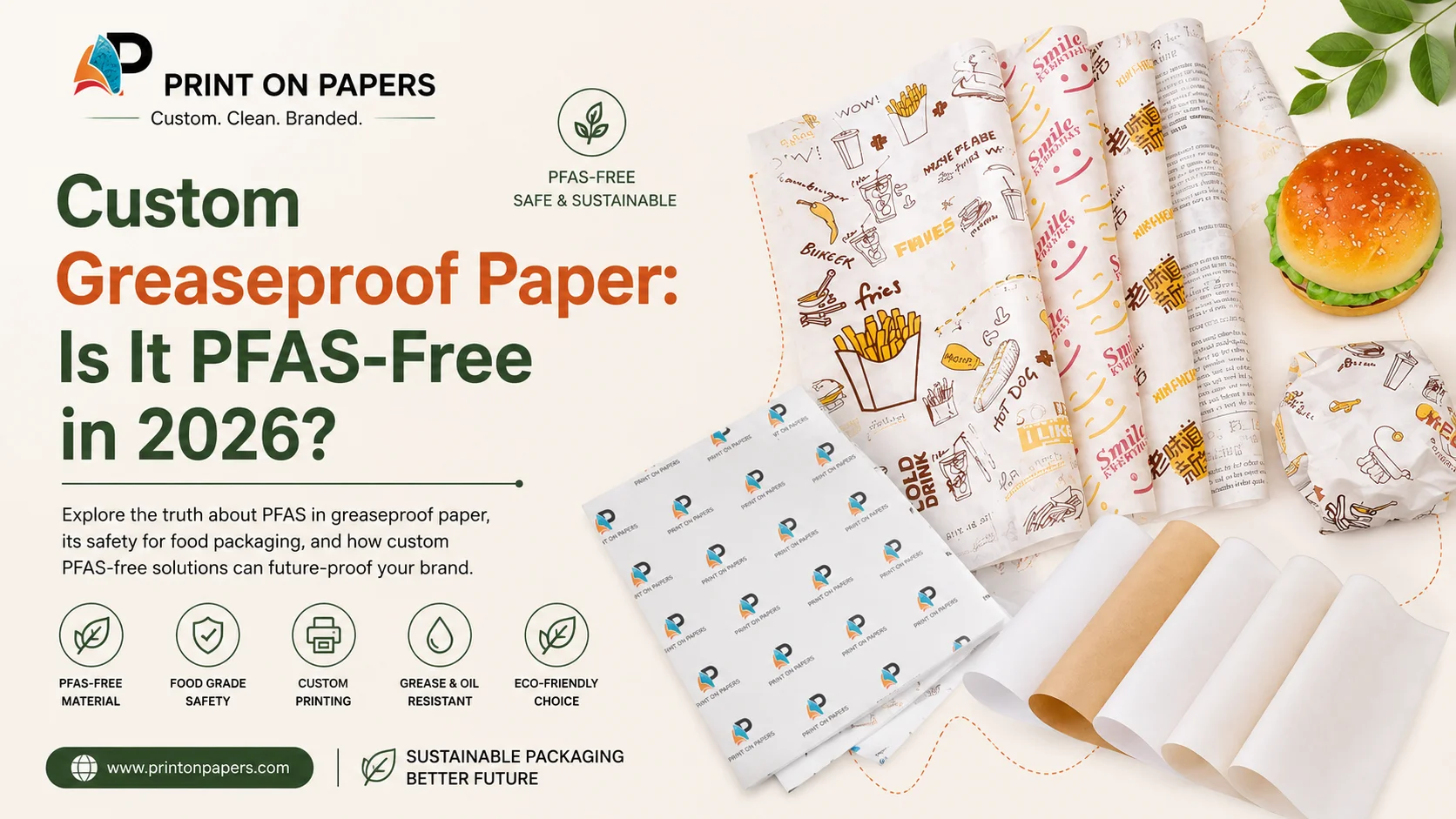
TLDR: Custom greaseproof paper that’s PFAS-free gets its grease resistance from a dense cellulose fiber structure, not a fluorochemical coating. The FDA confirmed in February 2024 that PFAS grease-proofing agents aren’t sold for food contact use in the US anymore, and by January 2025 it had ruled that 35 related food contact notifications no longer apply. So for your restaurant, PFAS-free greaseproof paper should be the default now, not something you pay extra for, and honestly, you should just ask any supplier to confirm it in writing before you place an order.
Table of Contents
A health inspector walks into a sandwich shop one afternoon, and she’s not there for the fridge temps. She wants the paperwork on the greaseproof paper sitting next to the register. The owner just blinks at her. Paper needs paperwork now? Nobody ever told him that.
It’s a small scene, but it’s happening more often across US kitchens in 2026, and that’s really the whole reason for this guide.
PFAS is short for per and polyfluoroalkyl substances, and people call them forever chemicals for a reason, they barely break down, not in the ground, not in a body. For years, manufacturers leaned on certain PFAS compounds to coat paper food wrap so grease wouldn’t bleed through it.
Here’s the catch though. Those coatings don’t just sit there doing their job quietly. They can move into whatever food is sitting on top, and that risk goes up fast when the food is hot or greasy, which, let’s be honest, is most of what ends up wrapped in this kind of paper anyway.
When paper is genuinely PFAS-free, the grease resistance is coming from the fiber itself, not a chemical layer brushed on top. Manufacturers press the fibers tighter during production. That closes off the little gaps oil would otherwise slip through. No fluorochemical anything added afterward.
Worth pointing out, because the phrase gets thrown around loosely in marketing copy. A supplier calling something eco-friendly or biodegradable hasn’t actually told you it’s PFAS-free, those are different claims entirely. What actually confirms it is a written compliance statement, and ideally a material safety data sheet to back it up.
Here’s the timeline, stripped down.
Back in July 2020, manufacturers agreed to voluntarily phase out PFAS grease-proofing agents over a three year window. By February 2024, the FDA said that phase-out was done. PFAS-containing substances were no longer being sold into the US market for grease-proofing on paper packaging.
Then January 2025 happened, and the FDA went a step further than just confirming a phase-out. Thirty-five food contact notifications tied to PFAS grease-proofing substances got declared no longer effective, officially as of January 6, 2025. Suppliers had until June 30, 2025 to clear out whatever stock predated that date.
So this isn’t a soft suggestion or an industry trend the FDA is nudging along. The approvals that allowed PFAS in this use case are gone. A supplier still pushing PFAS-coated greaseproof paper isn’t just behind the times, they’re outside what’s currently allowed.
Short version: the regulatory door is shut, but old inventory doesn’t just vanish overnight, so it’s on you to actually check what you’re buying.
Before that 2024 phase-out wrapped up, independent research had already raised concerns. A peer-reviewed review published in Environmental Science & Technology identified dozens of PFAS compounds across food contact materials including paper packaging, with the majority falling into chemical families linked to known health risks. That research is exactly why the 2024 and 2025 FDA actions carry real weight now, the substances researchers had been flagging are the same ones the FDA has since moved to eliminate from the supply chain.
If your current supplier can’t hand you written confirmation that their greaseproof paper is PFAS-free, that gap right there is the actual risk. Not a technicality.
This is usually where restaurant owners get surprised. Going PFAS-free doesn’t mean the paper performs worse.
What’s happening instead is a tightly packed cellulose fiber structure doing the job a chemical coating used to do. During production, the fibers get pressed more densely, which physically blocks the paths oil would normally travel through. Paper built this way usually sits somewhere in the 25 to 50 GSM range, GSM just meaning grams per square meter, basically how dense and heavy a sheet is.
It holds up fine against burgers, fried chicken, pizza, the exact stuff greaseproof paper exists for in the first place. So this isn’t really a tradeoff at all. It’s a different way of solving the same problem, and it works.
Run through this with any supplier, even the one you’ve already been using for years.
At Print On Papers, every sheet of custom greaseproof paper ships PFAS-free, period, with FDA 21 CFR 176 compliance and FSC-certified stock confirmed in writing before you ever commit to an order. Inks are soy based, and you get a digital proof first, so nothing goes to print until you’ve actually seen and approved your design.
Orders start at 500 sheets. That works whether you’re a single shop testing a new logo or running multiple locations placing recurring orders. And if your kitchen deals with high heat applications, sealed wraps, hot sandwiches, that kind of thing, custom heat seal paper is built for exactly that, same PFAS-free standard applied across the board. Still figuring out which paper actually fits your menu? Our guide on what greaseproof paper actually is goes deeper into the material side of things.
| Question | Direct Answer |
| Is greaseproof paper with PFAS still safe for food? | The FDA has ruled that PFAS grease-proofing agents are no longer authorized for sale in the US food contact market as of 2024 and 2025, so a current PFAS-free option is the compliant choice now. |
| What’s the difference between PFAS-free and chemical-free food wrap? | PFAS-free means that a specific class of forever chemicals is absent. Chemical-free is vague and doesn’t guarantee any particular compound is excluded, so PFAS-free is the claim worth trusting more. |
| Can custom printed greaseproof paper actually be PFAS-free? | Yes, custom printing and PFAS-free manufacturing aren’t in conflict. Suppliers print logos on PFAS-free stock using food safe inks, no tradeoff in grease resistance needed. |
| How do I find out if my current supplier still uses PFAS? | Just ask, directly, for written confirmation and a material safety data sheet. If they can’t get you either within a few days, that’s basically your answer. |
| Does PFAS-free greaseproof paper cost more? | Not really, pricing is largely the same now since PFAS-free has become the standard manufacturing approach rather than some specialty upgrade, especially after the FDA’s 2024 phase-out. |
At this point you know what changed at the federal level, what to actually ask a supplier, and what PFAS-free means on the ground. The next step’s simple. Request your free quote here and you’ll get a straight answer on pricing, minimum order size, and compliance paperwork within one business day, no setup fees on that first order either.
PFAS-free isn’t some niche eco claim anymore, it’s just where federal regulation landed, after years of voluntary phase-outs and then a formal FDA ruling that shut the door on the remaining approvals back in January 2025. If you run a restaurant, the safest move is honestly pretty simple. Get written PFAS-free confirmation from your supplier, check that the paper actually meets FDA 21 CFR 176, and treat your greaseproof paper as something worth getting right, not just something to order fast and forget about.
Print On Papers is a custom printed paper and wrapping paper company serving restaurants, bakeries, delis, food trucks, butchers, florists, apparel brands and food brands across the US and worldwide. We deliver food-safe, eco-friendly, fully branded custom paper, from your first 500 sheets to your next 500,000