
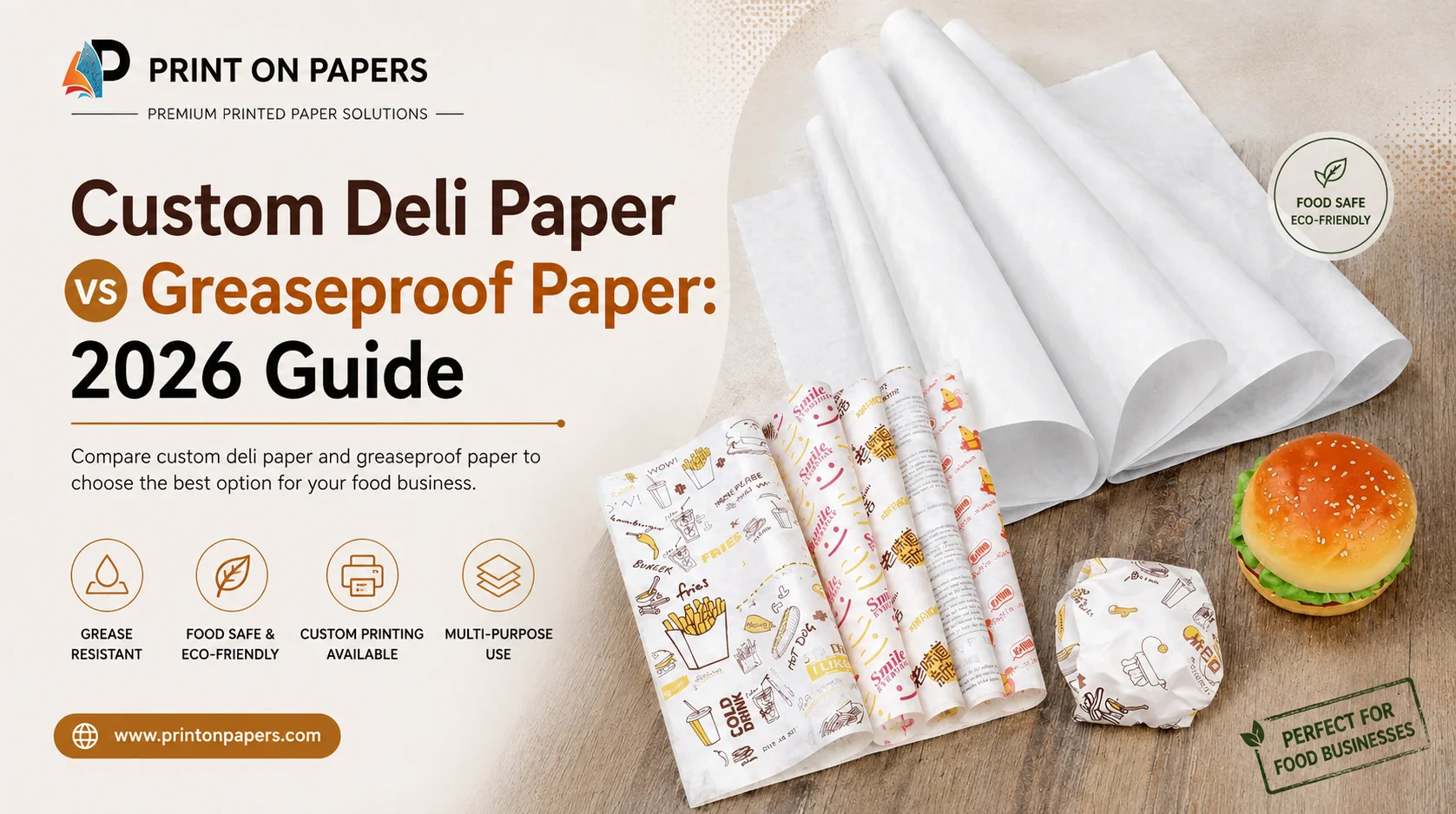
Custom Deli Paper vs Greaseproof Paper: What’s the Real Difference for Your Restaurant?
TLDR: Pick deli paper for cold wraps, pastries, and sandwiches. Pick greaseproof for burgers, fried chicken, and anything served hot with visible oil. Order the wrong one and you will know it the hard way, usually during your busiest hour.
Table of Contents
- The Paper Problem Nobody Warns You About
- What Is Custom Deli Paper? (2026)
- What Is Greaseproof Paper? (2026)
- Custom Deli Paper vs Greaseproof Paper: Side-by-Side Breakdown
- Which Paper Fits Your Restaurant Type?
- Before You Place Your Next Paper Order, Read This
- FAQs
- Conclusion
1. The Paper Problem Nobody Warns You About
Here is something most food business owners only figure out after it goes wrong.
A restaurant owner in a busy New York deli told me this story. She switched paper suppliers to save three cents per sheet. Two weeks later, a customer posted a photo online. The greasy handprint on the wrap was front and center. Twenty-two people shared it. She called us the next morning.
That three-cent saving cost her something no spreadsheet could calculate.
Food packaging decisions feel small until they are not. The global food contact paper and board market hit USD 64.2 billion in 2024, per IMARC Group’s Food Contact Paper Market Report, growing at 4.8% annually. Restaurants are buying more printed food paper than ever. But a surprising number are still buying the wrong type because nobody sat them down and explained the actual difference between deli paper and greaseproof paper.
That is what this guide does.
2. What Is Custom Deli Paper? (2026)
Deli paper is a food-grade wrap made from kraft fiber, either bleached white or left in its natural unbleached brown. This gets either a wax coating or a light poly coating to push back moisture and surface grease.
It is thin, and it folds cleanly. It tears easily. Busy counter staff love it.
Cold turkey subs, cheese slices, croissants, bagels, and pastries all wrap well in it. The surface is smooth enough to take sharp logo printing. CMYK and Pantone colors come out clean. For any food business that wants to stop using plain white paper and start building a brand at the counter, custom deli paper is where most of them start.
Here is the honest truth about its limits though. Press a hot, greasy burger into deli paper and wait ninety seconds. The oil migrates through. That is physics, not a manufacturing defect.
3. What Is Greaseproof Paper? (2026)
Greaseproof paper does not rely on a coating at all. It is built differently from the ground up.
During manufacturing, the cellulose fibers get beaten down and super-calendered, which means they are pressed together under heavy rollers until the sheet becomes so dense that oil molecules cannot pass through the gaps. No wax. No plastic film laminate. Just compressed fiber.
That structure holds up against direct oil contact at temperatures well above 80°C. Fried chicken, beef patties, pulled pork with sauce, hot fries sitting in a basket liner, all of it stays contained. The food stays fresh and your customer’s hands stay clean.
The FDA regulates food contact materials under 21 CFR Part 176. Custom greaseproof paper from a certified supplier meets those standards. One thing to check before you order anywhere: in February 2024 the FDA moved to phase out PFAS, the chemical compounds previously used to boost grease resistance. Responsible suppliers now use PFAS-free formulations. If your current supplier cannot confirm this, that is worth a conversation.
4. Custom Deli Paper vs Greaseproof Paper: Side-by-Side Breakdown
Here is the food paper comparison USA restaurant operators keep asking for.
| Feature | Custom Deli Paper | Greaseproof Paper |
| Grease Resistance | Surface moisture, light grease only | Heavy oils, fats, hot sauces |
| Heat Tolerance | Up to 60°C (wax variant) | Stable above 200°C |
| Best Menu Fit | Cold subs, pastries, bagels, deli meats | Burgers, fried items, hot wraps |
| Print Sharpness | Excellent, smooth surface | Good, slight texture |
| Starting Cost | From $0.25 per sheet | From $0.40 per sheet |
| FDA Compliance | Yes | Yes, confirm PFAS-free |
| Eco Credentials | FSC-certified options | Biodegradable, PFAS-free options |
| Logo Printing | Yes | Yes |
One comparison that confuses people is deli paper vs wax paper. They are related but not identical. Wax paper is one type within the deli paper category. It uses paraffin for moisture resistance and cannot go near heat. Deli paper also comes in poly-coated variants that handle slightly more grease. Greaseproof paper is a separate product entirely, built through fiber compression rather than any surface coating.
5. Which Paper Fits Your Restaurant Type?
Best Paper for Burger Restaurants and Hot Food Counters
If your kitchen produces burgers, fried chicken sandwiches, hot burritos, or anything with visible grease on the surface when it leaves the line, greaseproof is the call. No question. For custom deli paper vs greaseproof paper for burger restaurant USA operators, the answer is greaseproof every time. The price difference per sheet is real. A soaked-through wrap in a customer’s hand is more expensive.
Best Paper for Sandwich Shops and Delis
Cold subs, room-temperature wraps, deli meat platters, cheese boards, and bagels all live comfortably in deli paper. The difference between deli paper and greaseproof paper for sandwich shop owners is simple: if the food is cold or dry when wrapped, deli paper handles it at a lower cost with sharper printed branding.
Bakeries, Pastry Shops, and Cafés
Baked goods need to breathe a little. Trap too much moisture and that croissant crust turns soft. A light-coated deli paper lets just enough air through to keep texture intact while still protecting against butter and oil from laminated pastries.
Food Trucks and Pop-Ups
Most food trucks run both types, and that is the right move. Hot, greasy items get greaseproof. Cold wraps, sides, and bread-based items get deli paper. Print On Papers prints both with matching brand colors so everything looks like it came from the same kitchen, because it did.
6. Before You Place Your Next Paper Order, Read This
Most ordering mistakes happen because the buyer never matched the paper to the actual food temperature and grease level. Run through these five checks before confirming any order.
First, name your greasiest menu item and what temperature it hits the wrap at. Second, ask your supplier to confirm FDA 21 CFR Part 176 compliance and specifically whether the greaseproof coating is PFAS-free. Third, request a digital proof before production starts. Fourth, ask whether small runs are available so you can test before committing to a large volume. Fifth, get your delivery timeline in writing against your current stock level.
At Print On Papers, most orders are ready in 5 to 7 working days. Small first-time orders and large custom deli paper wholesale volumes both get the same attention. The design team handles the artwork at no charge.
Get an Estimate and our team gets back to you within 24 hours.
FAQs
Is deli paper the same as greaseproof paper?
No. Deli paper covers wax-coated and poly-coated food wraps that resist light moisture. Greaseproof paper is manufactured through super-calendering, which creates a dense fiber structure that blocks oil and fat without any added coating. They work for different foods and different temperatures.
Can I print my logo on both paper types?
Yes, both accept full-color printing. Deli paper gives you cleaner fine-line detail because the surface is smoother. Greaseproof paper has a slightly textured feel but still carries logos, brand colors, and custom patterns well.
What is the minimum order for custom deli paper wholesale in the USA?
Minimums vary by supplier. At Print On Papers, both small test runs and large wholesale orders are welcome. Contact the team with your sheet size and quantity for an accurate quote.
Does greaseproof paper actually work for hot food?
Yes. The super-calendered fiber structure maintains its oil-blocking performance well above 80°C, making it reliable for everything from fried items to sauced hot sandwiches.
Which paper meets FDA food contact compliance?
Both can. The key is sourcing from a certified supplier. For greaseproof paper specifically, confirm PFAS-free certification following the FDA’s 2024 phase-out, as outlined in the FDA Food Chemical Safety guidelines.
Conclusion
The custom deli paper vs greaseproof paper question really comes down to two things: how hot is the food, and how much grease does it release?
Cold food and dry wraps belong in deli paper. Hot and oily food belongs in greaseproof. Both carry your logo. Both meet food safety standards when sourced correctly. The only wrong answer is ordering one when your menu clearly needs the other.
Restaurants that get this right protect their food quality, protect their brand, and protect their customers’ experience from the first unwrap to the last bite.
Do not let the wrong paper make that call for you.
Get an Estimate from Print On Papers and have your custom printed food paper ready in 7 working days.